
 Lesson 2.1
Lesson 2.1 · Air, Water & Monsoon
Cross-Ventilation
Why aligned openings, an open centre, and a window facing the breeze are not superstition but the oldest air-conditioning humans ever built.
The house that breathes
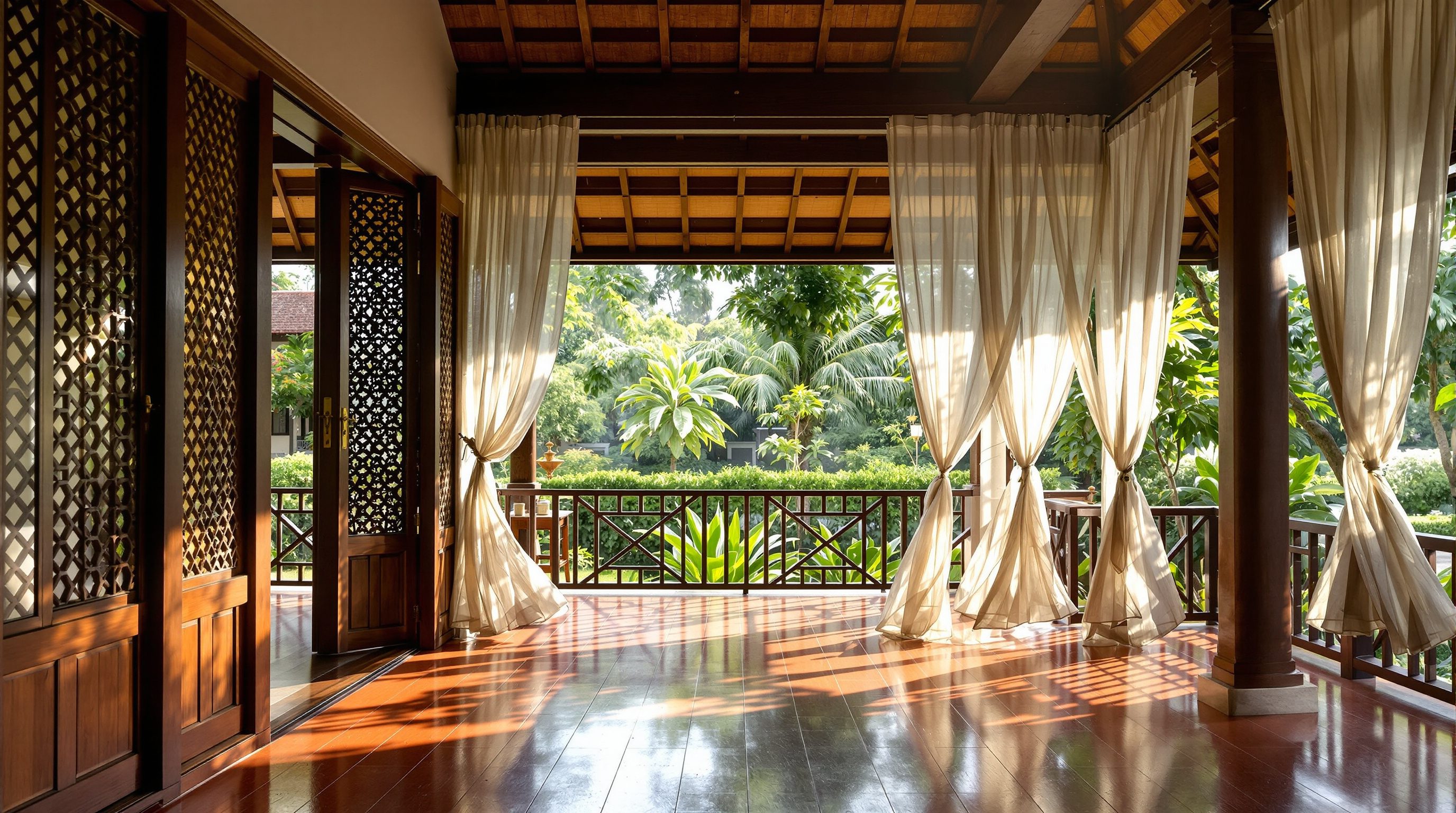
Stand in a Kerala tharavadu at noon in May and you feel it before you understand it: a steady current sliding across your skin, the air never still. No machine made that. A builder centuries ago aligned a door, opened a courtyard to the sky, and turned the whole house into a lung.
Air moves because pressure tells it to
Cross-ventilation is not air "flowing through" a room by good fortune. It is air driven through by a difference in pressure between one opening and another. Knock that difference out and the air sits still, however many windows you cut.
There are two engines, and a good house uses both. The first is wind-driven. When wind strikes a wall, it piles up against it — that windward face sits at positive pressure. The leeward and side walls fall into the wind's shadow at negative pressure. Put an opening on the high-pressure side and another on a low-pressure side, and air is pushed in one and pulled out the other. The path matters: openings on opposite or adjacent walls work; two windows on the same wall share the same pressure and barely move air at all.
The second engine is stack, or buoyancy. Warm air is lighter than cool air, so it rises. Give it a high escape — a clerestory, a vent, a courtyard open to the sky — and it leaves, drawing cooler air in through low openings to replace it. This engine needs no wind at all; it runs on heat, which a tropical afternoon supplies for free.
Same-wall windows are two doors on the same side of a tent — fresh air looks in, shrugs, and leaves the way it came.
Why the coast builds open and the desert builds heavy
Module 1.3 praised thick walls and small openings — for the hot-dry interior, where the enemy is radiant heat and the night is cool enough to dump it into. On the hot-humid coast the calculus flips. Here the air is already saturated; thick mass just traps the mugginess. The body cannot cool itself because sweat will not evaporate in still, wet air.
So coastal and Kerala architecture does the opposite: it opens up. Verandahs, raised floors, jaali screens, deep eaves and a permeable plan all serve one master — keep the air moving. Moving air sweeps sweat off the skin and carries both heat and humidity out of the building. In the humid tropics, airflow is not a nicety; it is the primary comfort strategy.
This is the first place Vastu's air-instincts ring true. The tradition's love of verandahs, courtyards and aligned openings is not arbitrary — it is the memory of a climate where a house had to breathe or be unliveable.
The open centre is a chimney you can stand in
Vastu asks you to keep the Brahmasthan — the centre of the house — open and unbuilt. Dress that in physics and it becomes one of the most elegant passive devices we have: the courtyard as a stack-ventilation engine.
Through the day the courtyard floor and walls warm; the air column above heats, lightens and rises, spilling out of the open top. As it leaves, it pulls cooler, shaded air from the surrounding rooms into the centre — a slow, continuous draught with no wind required. At night the process can reverse, the courtyard shedding heat to the cold sky and pooling cool air for the rooms to drink in the morning. It is daylighting, rain capture and ventilation in one move.
The design levers are worth memorising, because they are the same whichever engine you lean on. Place inlet and outlet on different pressure zones. Make the inlet smaller than the outlet — squeezing the entering stream speeds it up, like a thumb over a hose. Orient the main openings to the prevailing breeze — across much of India that is the south-west summer monsoon wind. And keep the path between inlet and outlet unobstructed; a wardrobe or a wall in the middle of the run kills the flow as surely as shutting the window.
A smaller inlet than outlet feels backwards — surely the big hole lets more in? But it is speed you want across skin, not volume. Thumb the hose.
Where the air-logic stops
Now the discipline of this course: one true rule never vouches for its neighbours. The same tradition that gives us the breathing courtyard also fixes the number of doors and windows — they must be even, say some texts; never tally to certain unlucky counts, say others.
Search that for a mechanism and you find none. Air does not count. A pressure difference does not care whether it is driven across two openings or three, even or odd; it cares about where they sit and how big they are. A house with five well-placed, well-sized, well-aligned openings ventilates better than one with four badly placed ones. The number rule is convention — respect it as belief if your client holds it, but never present it as airflow engineering.
That is the whole method in one lesson: the aligned opening earns a 🟢, the open centre earns a 🟢, the door-count earns a 🔴 — and each verdict is reached on its own evidence, not inherited from the rule beside it.
How each rule sorts
Three air-rules, three verdicts — reached on evidence, not inherited from each other.
This is textbook cross-ventilation: air is driven from a higher-pressure opening to a lower-pressure one, so inlet and outlet must sit in different pressure zones. Two openings on the same wall share one pressure and barely move air.
An open centre works as a stack-ventilation engine: warm air rises and escapes through the open top while cooler air is drawn in from surrounding rooms, driving airflow even with no wind, and it doubles as a daylight well.
Airflow depends on the position, size and pressure of openings, not their tally. There is no physical mechanism by which an even or odd count changes ventilation; this is convention, not building science.
The breathing house, sorted
- Air moves only when a pressure difference pushes it — from wind on a windward wall, or from warm air rising up a stack like a courtyard.
- On the humid coast, moving air is the main comfort strategy; this is why Vastu's verandahs, jaalis and open centres are real climate logic, not decoration.
- Levers that actually work: openings on different walls, a smaller inlet than outlet, orientation to the prevailing breeze, and an unobstructed path.
- Rules fixing the number of openings carry no airflow mechanism — honour them as belief, never as engineering.
We have moved the air through the house; next we follow the water. Lesson 2.2 asks why Vastu sends water and the well to the north-east — and whether the slope, the sun and the monsoon actually agree.
The author
Amogh N P
Architect, interior designer, and creative polymath. Studio Matrx began in his notebooks — his vision of design made honest, useful, and open to everyone. Its Academy is written and taught in his memory, and free, forever.
More about Amogh →