
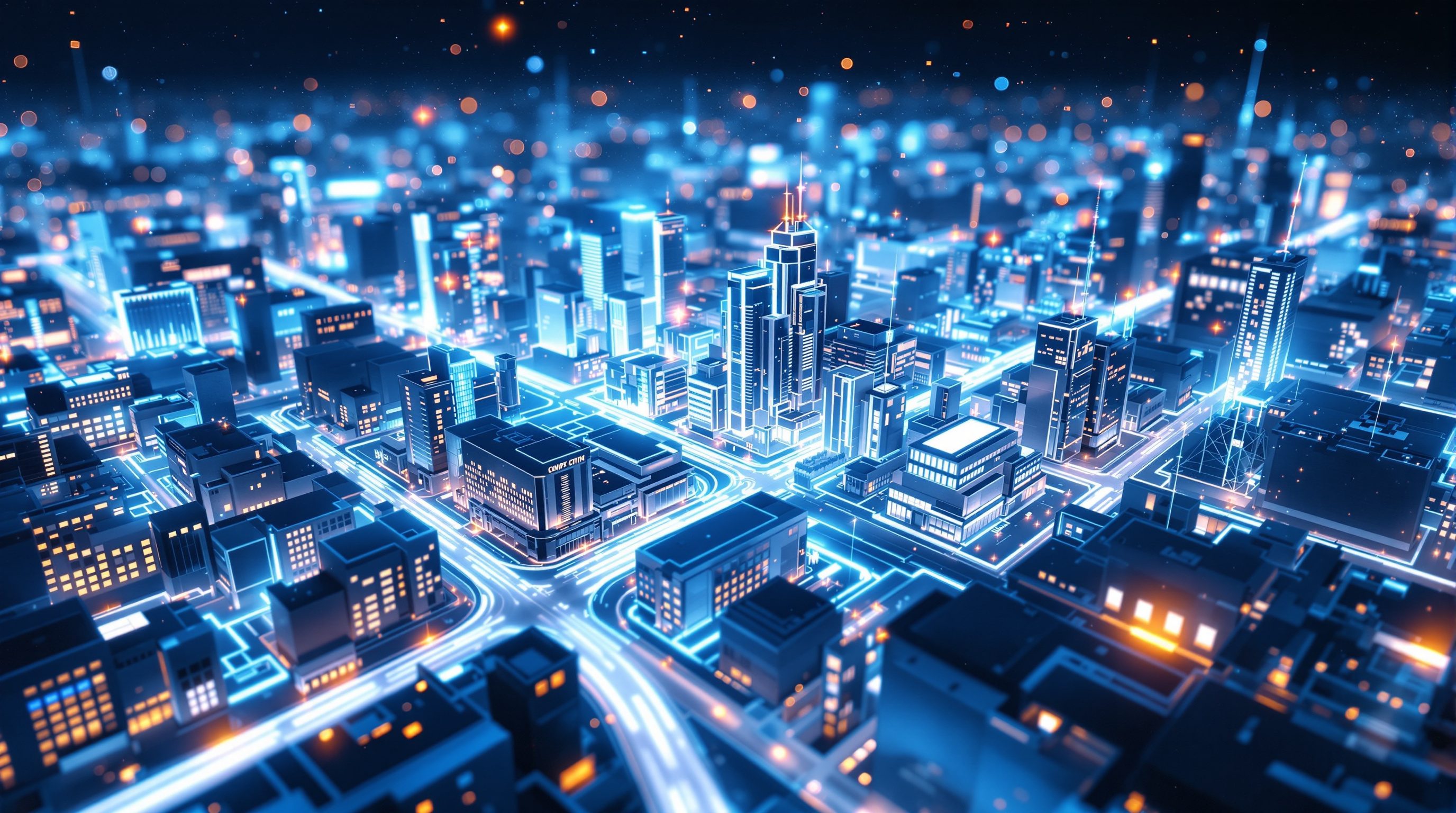
 Lesson 4.1
Lesson 4.1 · Simulation & Analytics
Simulating the City
A twin earns its name not when it shows you the city as it is, but when it lets you run the city forward in a model and ask what it would do if you changed something - and that power is exactly as trustworthy as the model and the data behind it
A beautiful 3D model can show you the city exactly as it is today - but it cannot tell you what happens tomorrow if you close a road, add ten thousand homes, or face a heatwave. Simulation can try. The question is how much to trust it.
So far this course has treated the twin mostly as a mirror: a model kept current by live data so the city can see itself as it actually is. That is already valuable. But a mirror only ever shows the present. The moment a city asks a question about the future - what if we build this, ban that, or a flood arrives - the mirror falls silent, because the future has not happened yet and there is no data to stream.
This module is about the faculty that lets a twin answer those questions: simulation. A simulation is a model that you run forward in time, letting its rules and its data play out to estimate how the real system would behave under conditions you have not yet seen. It is the difference between a dashboard that reports the traffic and a model that predicts the traffic an unbuilt metro line would relieve. Simulation is what turns a live 3D model from an observation tool into a decision-support tool - and it is also where the temptation to over-trust a twin is strongest, because a simulation produces confident-looking numbers about a future nobody can actually check yet. This lesson lays the honest groundwork: what simulation adds, the main families of model, and the iron rule that a simulation is only ever as good as the model and the data beneath it.
A twin runs the city forward. The number looks certain; it never is. Validate against the past, report the range, compare scenarios.
From showing the city to running it forward
Recall the test that defines a twin: model plus live data plus simulation plus a feedback loop into decisions. The first two give you a living mirror. Simulation is the third ingredient, and it is what separates a twin from a very good monitoring screen. Visualisation answers 'what is happening, and where?' Simulation answers a fundamentally different and harder question: 'what would happen if?'
The distinction matters because the two rest on completely different footings. A visualisation is grounded in measurement - it shows data that was actually collected from the real city, so its honesty is a question of whether the sensors are accurate and current. A simulation is grounded in a model - a set of rules, equations or learned patterns that claim to capture how the city behaves - and it is run to produce numbers about situations that have not occurred and cannot be measured. That is an enormous leap. When a dashboard says a junction is congested, you can in principle go and look. When a simulation says a proposed junction will be congested in 2031, there is nothing to look at; you are trusting the model's account of cause and effect.
This is why simulation is both the most powerful and the most dangerous thing a twin does. Powerful, because testing an intervention in a model before pouring concrete is vastly cheaper and safer than testing it on the street - you can try a pedestrianisation, a drainage upgrade or a new tower a hundred times in the model and only build the one that works. Dangerous, because a simulation wraps a set of assumptions in the authority of precise output, and a decision-maker who forgets that the number came from a model rather than from reality can be badly misled. The skill this module builds is holding both truths at once: simulation is the reason twins are worth building, and every simulation result is a conditional estimate - 'if the model and data are right, then roughly this' - never a fact about the future.
Dashboard = what IS (you can go look). Simulation = what WOULD BE (nothing to look at yet - you're trusting the model).
Three families: agent-based, physics-based, statistical and ML
Urban simulations come in several families, and knowing which family a result came from tells you a lot about what it can and cannot claim. Most city models are one of three kinds, or a combination.
Agent-based models simulate a population of individual 'agents' - people, vehicles, households - each following simple behavioural rules, and let the overall pattern emerge from their interactions. A pedestrian-evacuation model, a model of how commuters choose routes, or a model of how a neighbourhood gentrifies are typically agent-based. Their great strength is capturing emergent, bottom-up behaviour that no equation dictates from above: congestion, crowding, tipping points. Their great weakness is that the results depend entirely on the behavioural rules you gave the agents, and real people are far more varied and surprising than any rule set - especially in an Indian city, where movement, street use and the informal economy follow logics that tidy agent rules rarely capture.
Physics-based models apply the laws of physics and engineering to the city's fabric: how air flows between towers (computational fluid dynamics), how heat builds in a district, how water spreads in a flood, how a structure responds to load. These rest on well-established science, so within their domain they can be genuinely predictive - but they are computationally heavy, acutely sensitive to boundary conditions and input geometry, and still simplifications of messy reality. Their binding use belongs to qualified engineers, not a designer reading a twin.
Statistical and machine-learning models learn patterns from historical data - predicting tomorrow's energy demand, air quality or ridership from what happened before. They can be remarkably accurate when the future resembles the past, and fast to run. But they are weakest exactly when you need them most: at the novel interventions a twin exists to test, where there is no historical precedent to learn from, and they can silently encode the biases of their training data. In practice, serious urban twins stitch these families together - an ML model feeding an agent-based traffic model feeding a physics-based air-quality model - and each hand-off is a place where error and assumption accumulate.
A simulation is only as good as its model and its data
This is the sentence to carry out of the whole module, so it is worth stating bluntly: a simulation is only as good as the model it runs and the data it is fed. A flawless model fed stale or biased data produces confident nonsense; perfect data run through a model that misrepresents how the city works produces confident nonsense just as surely. Output precision - a number to three decimal places - says nothing about accuracy. The computer will always return an answer; whether that answer bears any relation to reality is a separate question the software cannot answer for you.
Three discipline points follow. First, calibration and validation. A credible model is tuned so that, when fed past conditions, it reproduces what actually happened (calibration), and is then checked against independent data it was not tuned on (validation). A simulation that has never been shown to reproduce the known past has no earned claim on the unknown future. Always ask: has this model been validated, against what, and how well did it do? Second, garbage in, garbage out - the oldest rule in computing and the most ignored in city twins. If the informal settlements are not in the data, the flood model will not flood them on screen even as it floods them in life; if a road's real capacity is mis-entered, the traffic result is wrong from the first step. Much of a twin's value rides on data you may never see. Third, the model is a simplification with a boundary - it was built to answer particular questions and is silent, or simply wrong, outside that scope. A mobility model knows nothing about air chemistry; asking it a question it was not built for yields an answer-shaped artefact, not knowledge.
None of this is a reason to distrust simulation wholesale - it is the reason to use it well. A validated model, run on good data, within its intended scope, with its assumptions on the table, is one of the most valuable instruments a city has. The failure is not simulating; the failure is forgetting that the map is not the territory and selling the map as the territory.
Garbage in, garbage out. If the informal city isn't in the data, the model won't flood it on screen - even as it floods in life.
Every honest result comes with uncertainty attached
No simulation predicts the future; at best it estimates a range of plausible futures with stated confidence. A simulation result that arrives as a single bare number - '47,000 vehicles per day' - is being presented dishonestly, because it hides the uncertainty that every model carries. The honest form of the same result is a range with its assumptions named: 'between roughly 40,000 and 55,000, assuming the new housing fills at the planned rate and fuel prices hold, with most uncertainty coming from how many residents switch to the metro.'
Uncertainty in an urban simulation comes from several stacked sources, and it compounds. There is input uncertainty - the data is never perfectly accurate or complete. There is parameter uncertainty - the behavioural rules and coefficients are estimates, not facts. There is structural uncertainty - the model's very conception of how the city works may be partly wrong. And there is the deep uncertainty of human and political behaviour, which no model fully tames: people respond to a new road by driving more (induced demand), adapt in ways the model never encoded, or make collective choices that defy any rule. A twin that projects decades ahead is stacking uncertainty on uncertainty, and its far-future numbers should be read as illustrative directions of travel, not forecasts.
The professional response is not to abandon simulation but to treat uncertainty as a first-class output rather than an embarrassing footnote. Run the model many times across plausible inputs (sensitivity analysis) and report the spread. State assumptions openly. Compare scenarios against each other rather than trusting any single absolute number - the relative result ('A floods less than B') is usually far more robust than the absolute one ('A floods to 0.8 metres'). And keep binding engineering conclusions - the flood depth a drain must carry, the wind load a facade must resist - with the qualified engineers and their validated, accountable models, never with a designer's read of a planning twin. Module 4.4 turns this discipline into a decision-support method; the rest of this module applies it to mobility and to the environment.
Calibration & validation
Whether a model has earned any claim on the future
A credible model reproduces the known past (calibration) and is checked on independent data it was not tuned on (validation). An unvalidated model's forecast is an assertion. Always ask against what it was validated and how well it did.
Model family (agent-based / physics-based / statistical-ML)
What kind of claim a given result can legitimately make
Each family has a domain and characteristic failure modes. Physics-based can be predictive within its scope; ML is weakest at the novel interventions a twin exists to test. Know which produced your number. Module 1.4.
Uncertainty & sensitivity analysis
Honest reporting of how much to trust a result
Report ranges, not bare numbers; run the model across plausible inputs and show the spread; trust relative comparisons over absolute values. Uncertainty is a first-class output, not a footnote. Module 4.4.
Binding engineering results
Flood depth, wind load, structural and traffic capacity
Statutory and safety-critical conclusions stay with qualified engineers running accountable, validated models and the governing codes - never a designer's read of a planning twin. Modules 4.2, 4.3, 6.
Workshop - interrogate a simulation result instead of believing it
The core skill of this module is refusing to take a simulation result at face value and instead asking the questions that reveal how much to trust it. In this workshop you practise that on a real or proposed urban simulation.
Just a published simulation result you can read about and a notebook. No modelling software - this workshop is about critical reading of a model's claims, not building one.
Goal: turn a confident simulation claim into an honest, conditional statement
Inputs: a real urban-simulation result you can read about (a traffic, flood, energy or crowd study for a city or project) + this lesson + a notebook
Time: ~40 minutes
- 1Find a result: locate a published urban simulation - a traffic forecast, a flood map, an energy-demand projection, a pedestrian-flow study. Write down its headline claim exactly as stated.
- 2Classify the model: is it agent-based, physics-based, statistical / ML, or a chain of several? What can that family legitimately claim, and what are its characteristic blind spots?
- 3Hunt for validation: does the source say whether the model was calibrated and validated, and against what data? If it is silent, note that the forecast is unvalidated - an assertion, not an earned prediction.
- 4Find the hidden inputs and assumptions: list the key inputs the result depends on (growth rates, behaviour, geometry, capacities). Which are uncertain? Which, if wrong, would change the answer most?
- 5Rewrite the claim honestly: restate the headline as a conditional range with its main assumptions named and its biggest uncertainty flagged - framed as critical reading, not a technical re-analysis, and noting that binding engineering belongs to qualified engineers.
You’ll walk away with
A one-page interrogation of a real urban simulation: the original claim, the model family, whether it was validated, the inputs that matter most, and an honest rewritten version of the claim with its uncertainty visible. Keep it as a template for reading any twin output.
Three altitudes on the same idea
Read the band that fits you — or all three.
Simulation is how you test a design move in the living city before it is built - and how that move will be judged by others running their own models. When you propose a tower, a block or a masterplan, a twin lets you and the authorities simulate its effects on traffic, wind, shadow, heat and drainage in real context rather than by assertion. Learn to read which family a result came from (agent-based, physics-based, statistical or ML), to ask whether the model was calibrated and validated, and to present your own simulation outputs with their assumptions and uncertainty visible rather than as bare numbers. Use simulation to strengthen a design argument and to catch problems early; but defer binding engineering results - structural, wind, flood, traffic capacity - to qualified engineers running accountable models, and never let a confident render stand in for their sign-off. Your edge is judgement about when a simulation is trustworthy enough to act on.
The same simulate-before-you-build logic scales down to the building and the room - and nests inside the city twin. Building-scale simulation (energy, daylight, thermal comfort, occupancy flow, evacuation) increasingly runs on a building twin whose boundary conditions - outdoor temperature, solar exposure, street-level air - come from the surrounding city model. Understand that an interior comfort or energy simulation inherits the uncertainty of every input it draws from the wider twin, and that a validated result for one occupancy pattern can mislead for another. Treat simulation as a way to reason about how a space will perform and feel, not as a guarantee; keep binding mechanical, fire and structural engineering with the qualified engineers. And be mindful that occupancy simulation feeds on data about real people in the space - a privacy duty, not just a modelling input.
Learn to ask three questions of any urban simulation and you will be ahead of most people who quote them. First: what kind of model is this - agent-based, physics-based, or statistical / ML - and what can that kind legitimately claim? Second: has it been calibrated and validated, and on what data - can it reproduce the known past before it is trusted on the unknown future? Third: where is the uncertainty, and is it shown? You are not expected to build a city simulator. You are expected to understand that a simulation runs a model forward, that its confident output is conditional on the model and the data being right, and that a single bare number hiding its uncertainty is a red flag. This critical literacy - knowing that the map is not the territory - is exactly the skill a twin-literate designer brings to a room full of people ready to believe the screen.
“The city twin ran a simulation and it says the new road will carry 47,000 vehicles a day and cut congestion by 18 percent. The computer worked it out from real data, so these are the facts - that is what will happen once we build it.”
Do it yourself
No tools needed - reason it through.
- 1In one sentence, what does simulation add to a twin that visualisation and a live dashboard cannot provide?
- 2Name the three main families of urban simulation and one thing each is good at and one it is weak at.
- 3What do 'calibration' and 'validation' mean, and why is an unvalidated forecast only an assertion?
- 4Why is a single precise simulation number (with no range) a warning sign rather than a reassurance?
- 5List the stacked sources of uncertainty in an urban simulation and explain why comparing scenarios is safer than trusting one absolute value.
The one line to carry out
Peer-reviewed journals & authoritative standards
- 01Computer simulation — Wikipedia - Computer simulation, 2026.
- 02Simulation — Wikipedia - Simulation, 2026.
- 03Agent-based model — Wikipedia - Agent-based model, 2026.
- 04Systems modeling — Wikipedia - Systems modeling, 2026.
With the honest groundwork laid - what simulation adds, the families of model, and the discipline of validation and uncertainty - we can apply it to the question cities ask most often of their twins: how people and vehicles move. Next, mobility and traffic.
The author
Amogh N P
Architect, interior designer, and creative polymath. Studio Matrx began in his notebooks — his vision of design made honest, useful, and open to everyone. Its Academy is written and taught in his memory, and free, forever.
More about Amogh →