
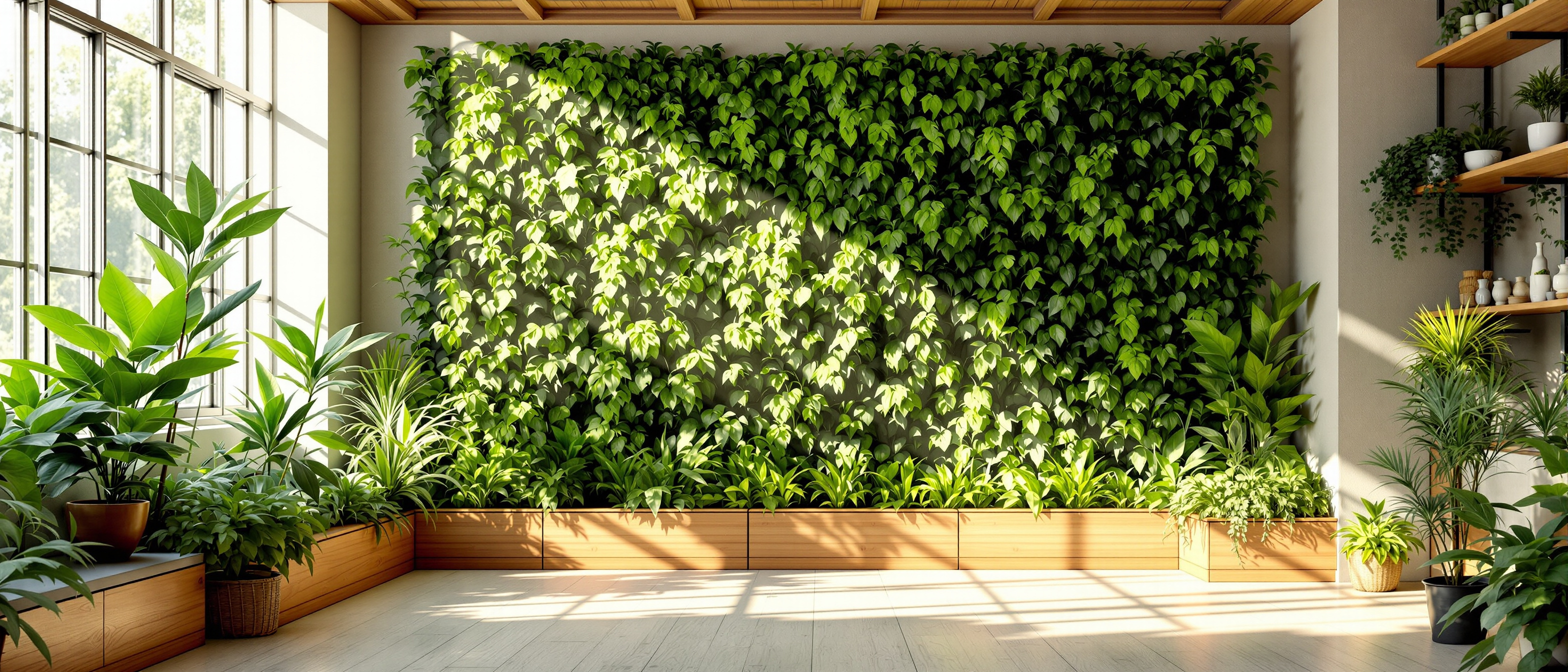
Green Building & Sustainability
Sustainability is performance, not a style — and gadgets come last
No design field attracts more greenwashing, so this course begins by refusing the easy version of it. Sustainability is not a style of plants on walls and earthy colours, and it is not a gadget you bolt on — it is measurable performance: how much energy and water a space uses, the health of its indoor environment, the embodied carbon of its materials, and what happens at end of life. And there is an order that matters: reduce demand first, make what remains efficient, and add renewables last. This unit sets that foundation and reads the green rating systems honestly.
Learning objectives
By the end of this lesson, you will be able to — mapped to the course outcomes for Sustainable Interior Design:
Define green building and sustainability as performance and resource use, not a style or a gadget.
Apply the energy hierarchy — reduce demand first, then efficiency, then renewables.
Explain the GRIHA, IGBC and LEED rating systems as frameworks, and the performance gap and greenwashing.
What 'green' really means
Sustainability is measurable performance, not a look. The order that matters is the energy hierarchy — reduce demand with passive design, then efficiency, then renewables — and ‘green is always expensive’ is a myth: passive moves are cheap and the savings compound.[1, 2]
Performance, not a look
'Green design' is not a style of plants on walls, jute rugs and earthy colours. Sustainability is measurable PERFORMANCE and resource use: how much energy and water a space consumes, the quality of its indoor environment, the embodied carbon of its materials, and what happens to it at end of life. A room can look 'natural' and perform terribly, or look sleek and perform brilliantly. Judge the numbers and the lifecycle, not the aesthetic.[1]
Green rating systems
India’s national GRIHA (TERI + MNRE, 2007), IGBC (CII, 2001) and the US LEED are useful frameworks and market signals — but a certificate is not a guarantee: points can be chased, and a performance gap means a rated building can still use more energy than designed.[3, 4]
GRIHA and IGBC
India has two main green rating systems. GRIHA (Green Rating for Integrated Habitat Assessment) is the NATIONAL system, developed by TERI with the Ministry of New and Renewable Energy and launched in 2007, tuned to Indian climate and resources and required for many government projects. IGBC (Indian Green Building Council), set up by the CII in 2001, is the most widely used, with levels from Certified to Silver, Gold and Platinum across many building types.[3]
At a glance
| Aspect | The fact | The folklore |
|---|---|---|
| Sustainability | Measurable performance and resource use | A style — plants, jute, earthy colours |
| The right order | Reduce demand, then efficiency, then renewables | Bolt on a solar panel / eco-gadget |
| 'Green is expensive' | A myth — passive moves are cheap and save over time | Always a costly sacrifice |
| A green rating | A useful framework and market signal | A guarantee of low energy use |
| Certification | Can be point-chased; verify with measured performance | Proof the building performs |
| GRIHA | India's national system (TERI + MNRE, 2007) | A foreign import |
Key terms
Building designed for measurable low resource use (energy, water, materials), healthy indoor environments and low lifecycle impact — a performance question, not a style.
Reduce demand (passive design) first, then make what remains efficient, then add renewables — the order that separates real green design from greenwashing.
Green Rating for Integrated Habitat Assessment — India's national rating (TERI + Ministry of New and Renewable Energy, 2007), tuned to Indian climate; required for many government projects.
IGBC (Indian Green Building Council, CII, 2001) — India's most-used rating; LEED (USGBC, 2000) — the world's most recognised, run in India via GBCI/IGBC.
The documented difference between a building's designed/rated energy use and its actual measured use in operation — why a certificate is not a guarantee.
Marketing a product or building as sustainable through appearance or a bolt-on gadget while its actual performance and resource use are poor.
Study task
Take one real interior and apply the energy hierarchy in order. List, first, the reduce moves that cost little and cut demand at source (orientation, shading, insulation, daylight, natural ventilation); then the efficiency moves for what remains (efficient AC and LED on good controls); and only then any renewables. Explain, in a sentence, why doing them in the reverse order — a solar panel on a hot, unshaded, glass-walled room — is greenwashing. Finally, pick one green rating system (GRIHA, IGBC or LEED), name one thing it would reward in your interior, and one way its certificate could still fail to reflect real performance.
Self-assessment
1. What is sustainability in design, really?
2. What is the correct order of the energy hierarchy?
3. What is GRIHA?
4. Does a green rating guarantee a low-energy building?
5. Why is 'green is always more expensive' a myth?
Recap
References & further reading
- [1]Green building and sustainability fundamentals — performance not style, indoor environmental quality, lifecycle (Markus & Morris, Buildings: Climate and Energy; green-building literature). https://www.studiomatrx.org/guides/green-building-certifications-india
- [2]The energy hierarchy — reduce demand (passive), then efficiency, then renewables (BEE/ECBC and passive-design references). https://beeindia.gov.in/
- [3]Green rating systems — GRIHA (TERI + MNRE, 2007), IGBC (CII, 2001), LEED (USGBC, 2000; via GBCI/IGBC in India); WELL, EDGE, ECBC. https://www.grihaindia.org/
- [4]The performance gap and rating critique — measured vs designed energy use; point-chasing (CSE India, 'Green Building' analysis; academic performance-gap studies). https://www.cseindia.org/
Further reading
- T.A. Markus & E.N. Morris, Buildings: Climate and Energy (Pitman).
- Arvind Krishan & others, Climate Responsive Architecture (Tata McGraw-Hill).
- GRIHA and IGBC rating manuals; USGBC LEED reference guides.
Sources gathered and fact-checked June 2026. Published values vary by source, sample and method — treat as indicative and confirm against the cited standard before structural use.
The author
Amogh N P
Architect, interior designer, and creative polymath. Studio Matrx began in his notebooks — his vision of design made honest, useful, and open to everyone. Its Academy is written and taught in his memory, and free, forever.
More about Amogh →