
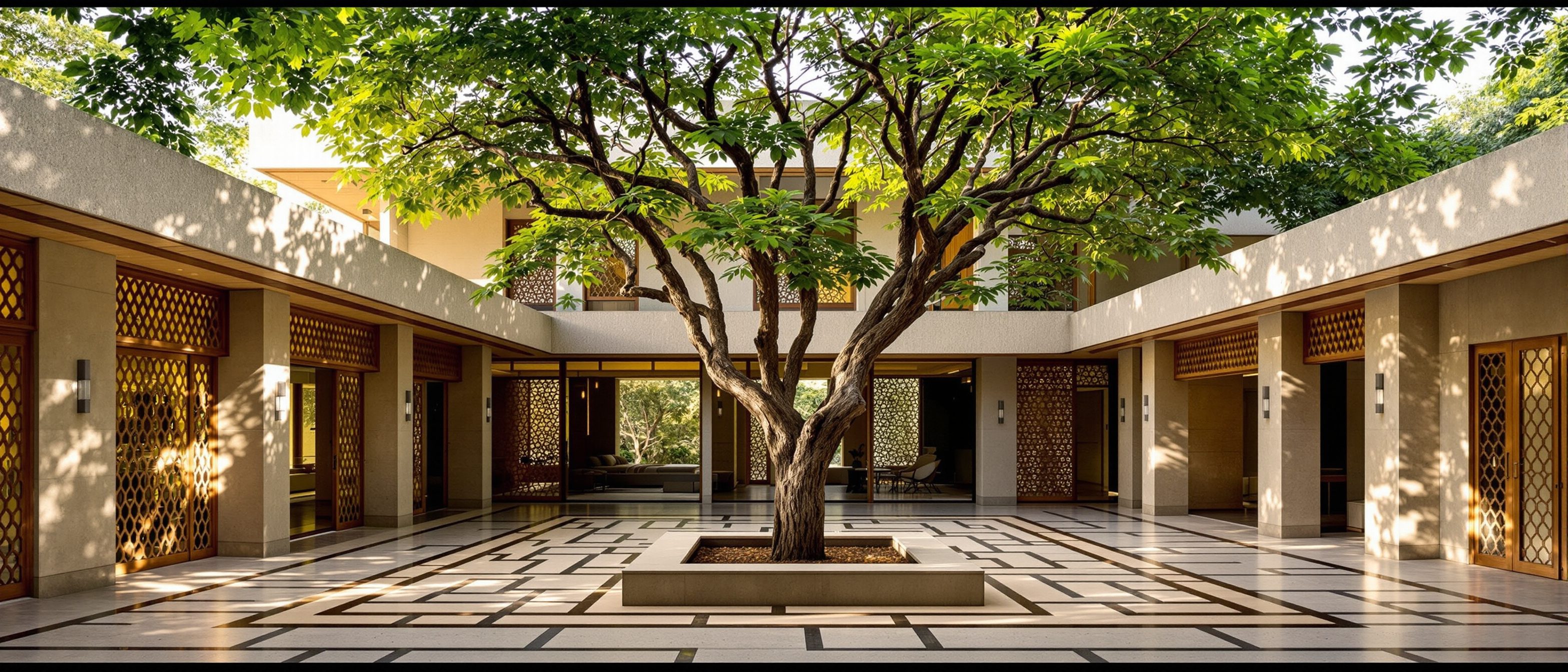
Passive Design Strategies
Comfort from the building itself — orientation, shade, mass, air, light.
A passive building gets most of its comfort from its own form, fabric and orientation — from the sun, the wind and the ground — rather than from machines. This unit is the toolkit: site and microclimate; orientation and solar geometry; passive solar design and thermal mass; passive heating and cooling; window placement, daylighting and shading. In India the problem is mostly keeping cool, and a well-oriented, shaded, ventilated, daylit building can cut its energy enormously before any air-conditioning. Stack the strategies with the explorer. (The physics is in the Climatology course.)
Learning objectives
By the end of this unit, you will be able to — mapped to the course outcomes for Sustainable & Resilient Building Design:
Explain what a passive building is and the thermal-comfort requirements it must meet.
Use site, microclimate, orientation and solar geometry in a passive design.
Apply thermal mass, passive heating/cooling, ventilation, daylighting and shading.
Stack passive strategies and judge their combined effect on energy and comfort.
The passive toolkit
A passive building draws on the sun, wind and ground; start with the site, get orientation right, and use mass and passive cooling.[2, 5]
Comfort without machines
A PASSIVE building achieves comfort from its FORM, FABRIC and SITING — orientation, shading, mass, ventilation, daylight — drawing on the sun, wind and ground, with active systems only as a top-up. It is the foundation of low-energy design: every degree of comfort the building provides for free is a degree the air-conditioner does not have to. In India's hot climates the priority is passive COOLING; in cold/hill regions, passive solar HEATING.[2, 5]
The envelope in action
Daylight without heat, shade the glass before the sun hits it (horizontal for south, vertical for east/west), and cool by ventilation — stacked, they transform a building's energy.[6, 2, 5]
Light without heat
WINDOW PLACEMENT balances daylight, view and ventilation against unwanted heat gain. DAYLIGHTING — sized, shaded, well-placed openings, light shelves and courts — brings natural light deep inside, cutting electric lighting (and its heat) by day, while glare and direct sun are controlled. A daylit building is healthier and lower-energy — but only if the daylight does not become a heat or glare problem.[6]
Stack the strategies
Toggle the passive strategies on and watch the cumulative energy saving over a conventional building grow — together they do far more than any one alone.
Stack passive strategies · watch the saving grow
0%
energy saved vs conventional
Toggle a strategy on — each adds to the saving, with diminishing returns when stacked.
Indicative — passive savings stack with diminishing returns; case studies show 30–60%+ over a conventional design.
At a glance
| Aspect | One | The other |
|---|---|---|
| Comfort source | Passive: form, fabric, siting | Active: machines (AC) |
| Cheapest move | Orientation | (then) shading |
| Hot-dry climate | Thermal mass + night flush | (humid: air movement matters more) |
| Shading geometry | Horizontal for high south sun | Vertical fins for low east/west sun |
| One strategy vs all | Any one: modest help | Stacked: 30–60%+ savings |
Key terms
One that gets most of its comfort from form, fabric and siting, not machines.
The local climate of a site, shaped by its sun, wind, trees, water and ground.
The sun's altitude and azimuth through the year — the basis of orientation and shading.
Heavy fabric that absorbs and releases heat, flattening the indoor temperature swing.
Admitting and storing winter sun for warmth (Trombe wall, direct gain) in cold regions.
Removing heat by ventilation, night-flushing, evaporation or earth coupling — no compressor.
A chajja, fin, overhang or jaali that blocks sun before it reaches the glass.
Flushing the day's stored heat from the thermal mass with cool night air.
Studio task
Take a simple house plan and redesign it passively for your climate: fix the orientation, add the right shading on each face, decide whether to use thermal mass, set up cross- and stack-ventilation, and bring in daylight without glare. Use the explorer to estimate the combined saving, then sketch the section showing every passive move at work.
Self-assessment
1. The cheapest and most fundamental passive design move is —
2. Thermal mass is most useful in a climate with —
3. To shade a south-facing window from high summer sun you would mainly use —
Recap
References & further reading
- [1]Iyengar, K. — Sustainable Architectural Design: An Overview (Routledge, 2015).
- [2]Chiras, Dan — The Solar House: Passive Heating and Cooling (Chelsea Green, 2002).
- [5]Koenigsberger, O.H. et al. — Manual of Tropical Housing and Building, Part I: Climate Design (Orient Longman, 1993).
- [6]Lechner, Norbert — Heating, Cooling, Lighting (Wiley, 2015).
Further reading
- Dan Chiras — The Solar House (2002).
- Koenigsberger et al. — Manual of Tropical Housing and Building (1993).
- Norbert Lechner — Heating, Cooling, Lighting (2015).
Sources gathered and fact-checked June 2026. Published values vary by source, sample and method — treat as indicative and confirm against the cited standard before structural use.
The author
Amogh N P
Architect, interior designer, and creative polymath. Studio Matrx began in his notebooks — his vision of design made honest, useful, and open to everyone. Its Academy is written and taught in his memory, and free, forever.
More about Amogh →