
 Lesson 4.2
Lesson 4.2 · Multiply its use
Convertible Furniture That Actually Works
Layering lives or dies on the furniture. A great convertible piece is a quiet miracle; a bad one is a daily ordeal you stop using within a month. Here's how to tell them apart before you buy.
Every showroom sofa-bed converts beautifully when a trained salesperson does it once. The test that matters is whether a tired person can do it alone, in the dark, every single night, for ten years.
In Lesson 4.1 you learned that the Layer lever depends on a fast, low-friction transition. That transition is almost always a piece of furniture. So this lesson is about the hardware of layering — and, just as importantly, its failure modes.
Because convertible furniture has a dirty secret: most of it is bought for the dream and abandoned in practice. The folding desk that's too flimsy to write on. The sofa-bed that's a lumpy sofa and a worse bed. The wall-bed nobody can lift. Knowing which pieces deliver, and the specific way each kind fails, is what separates layering that works from a flat full of clever furniture nobody uses.
The three tests every convertible must pass
Whatever the piece, hold it to the same three questions. A convertible that fails any one of them will be abandoned, and abandoned furniture is just an expensive single-function object taking double the space.
1 · The one-person, one-minute test
Can one ordinary person convert it alone, in under a minute, without strain? If it takes two people or real effort, the layer breaks — you simply won't do it nightly. This is the single biggest predictor of whether a convertible gets used.
2 · The no-compromise test
Is it genuinely good in both modes — a real bed and a real sofa, a real desk and a real console? If either mode is bad, you've bought a compromise, not a multiplier. Better a good sofa and a guest mattress than a bad sofa-bed used as both.
3 · The displaced-props test
When it converts, where do the cushions, the bedding, the laptop go? If the piece has no home for what it displaces (or a partner cupboard nearby does), the freed floor fills with clutter and the layer is undone. Convertibles and storage are a package.
Find the piece for your layer
Answer three questions about the layer you're trying to create. The tool points to the convertible most likely to actually work for it — and warns you off the ones that won't.
Go deeper — why daily-use convertibles must be near-effortless
There's a sharp rule professionals use: the more often a convertible switches, the lower its friction must be — and the relationship isn't linear. An occasional guest bed can tolerate real effort, because it's deployed a few times a year. A daily sofa-bed must be near-effortless, because friction compounds: a 90-second nightly chore is over nine hours a year of fighting your own furniture, and humans simply stop doing it.
This is why the most expensive convertible is often the cheapest in the end. A quality wall-bed with a counterbalanced mechanism that drops in five seconds gets used for a decade; a bargain sofa-bed that needs wrestling gets used for three weeks and then stays a permanent (bad) bed or a permanent (bad) sofa. For daily layers, spend on the mechanism — it's the part that determines whether the layer survives contact with real life.
Four workhorses, and how each one fails
The four convertibles that genuinely earn their place in an Indian compact home. Tap each to see what it does well — and the specific failure mode to design against. The failure mode is the part the showroom won't tell you.
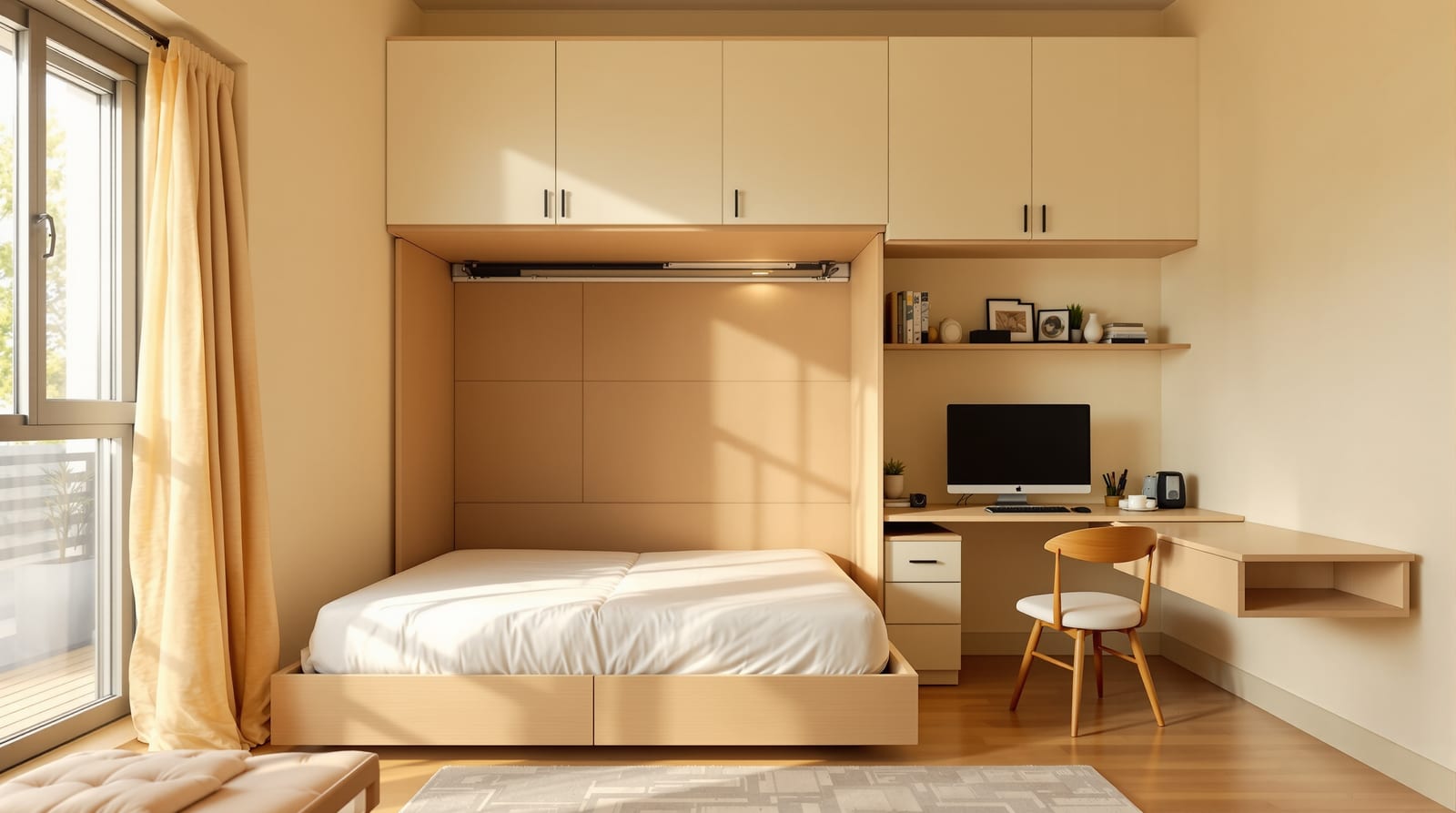
The wall bed (Murphy)
Folds vertically into the wall in seconds, freeing the entire floor by day. A real, full-size mattress — no compromise on sleep. The gold standard for a daily living-to-bedroom layer.
A cheap mechanism is heavy and stiff, so nobody lifts it; and it eats wall depth (~400mm) whether up or down. Needs a free, structurally sound wall.
Pair with a counterbalanced mechanism for the daily switch, and a slim cabinet alongside for bedding — humid storage ruins a mattress folded away damp.
Fig 4.2a — Every convertible has a failure mode. Designing against it is the whole skill.
For a sofa-bed used every single night, a family is choosing between a quality wall-bed mechanism and a much cheaper basic sofa-cum-bed. What's the most important factor?
Run the method yourself
Take the layered room you named in Lesson 4.1. Now spec the piece that will make its transition work.
- 1Name the two modes the piece must serve, and which is the “primary” one it'll spend most hours as.
- 2Count the switches. Daily? Weekly? Occasional? This sets how much you should spend on the mechanism.
- 3Run the three tests. One-person-one-minute, no-compromise, displaced-props. Write down how your candidate piece passes each — or where it fails.
- 4Decide the storage partner. Name exactly where the displaced props live. If there's no answer, that's your next problem (and Module 5).
- Convertible furniture is the hardware of layering — and most of it is bought for the dream, then abandoned in practice.
- Four workhorses: wall bed, sofa-cum-bed, fold-down desk, nesting/stacking — each with a specific failure mode to design against.
- Three buying tests: one-person-one-minute, no-compromise, displaced-props. Fail one and the piece gets abandoned.
- The more often it switches, the lower its friction must be. For daily layers, spend on the mechanism.
A great convertible handles the furniture. But a room that switches roles needs more than one clever piece — the lighting, the storage, the whole transition has to flow. How do you design a room that changes its entire identity in under two minutes?
The author
Amogh N P
Architect, interior designer, and creative polymath. Studio Matrx began in his notebooks — his vision of design made honest, useful, and open to everyone. Its Academy is written and taught in his memory, and free, forever.
More about Amogh →