
Layout Planning & Approvals
FSI, the layout, and the clearances that unlock it.
Between buying land and selling a building lies the work of turning land into a scheme and a scheme into an approval. Learn the layout parameters — plots, roads, infrastructure, open space and the efficiency of a layout; the FSI/FAR that sets the buildable quantum and largely sets the land's value; the master plan and the Detailed Development Plan; and the front-end clearances and approvals — sanction, RERA registration and NOCs — that a project cannot sell without.
Learning objectives
By the end of this lesson, you will be able to — mapped to the course outcomes for Real Estate Management:
Lay out a development with efficient plots, roads, infrastructure and open space.
Explain how FSI/FAR sets the buildable quantum and the land's value.
Read the master plan and the Detailed Development Plan.
Sequence the front-end clearances and approvals, including RERA.
Layout & FSI
A layout's efficiency is the saleable area it wins from a gross site; and the FSI fixes how much you can build — and since you sell floor area, it largely fixes the land's value.[1, 3]
Plots, roads, open space
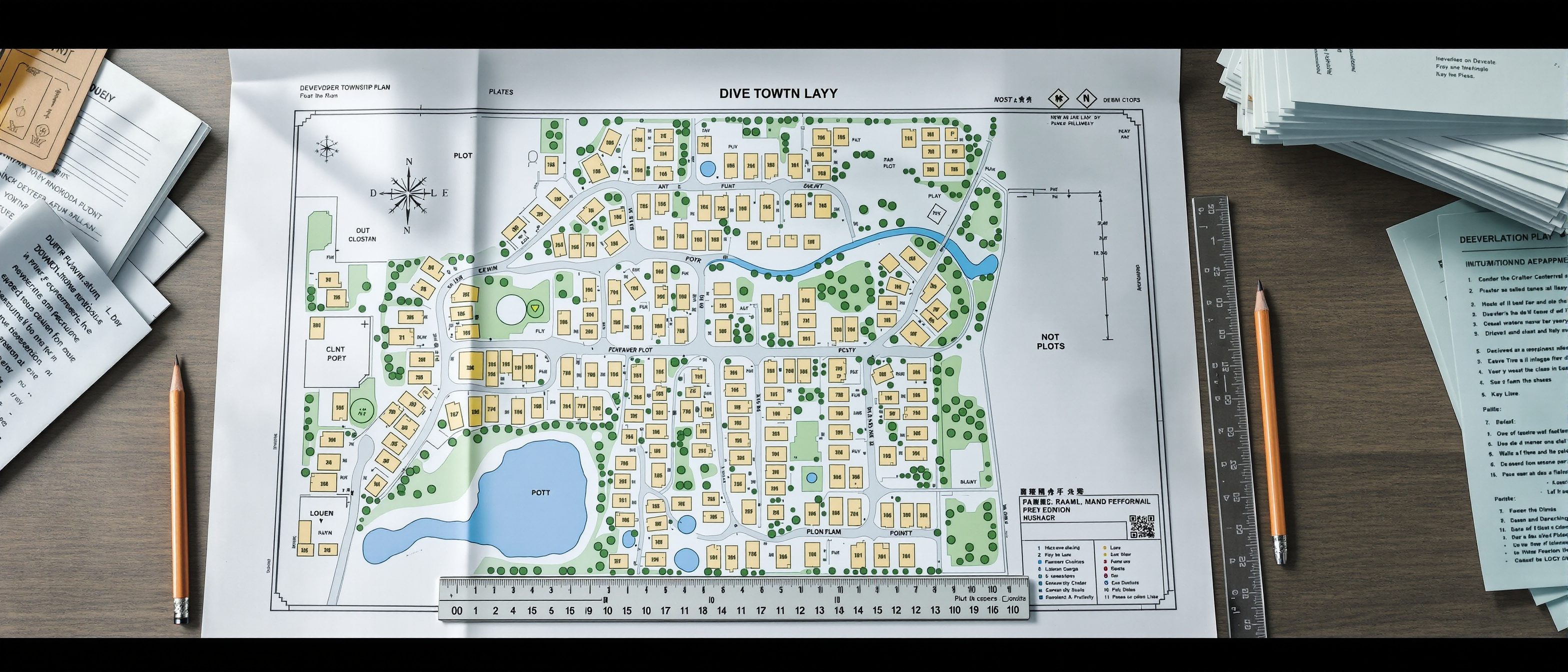
A LAYOUT divides land into PLOTS served by a ROAD NETWORK, INFRASTRUCTURE (water, sewerage, power, drainage) and OPEN SPACES, to mandated standards. Its EFFICIENCY is how much SALEABLE/usable area it wins from a given gross site after roads, open space and amenities are deducted — a small efficiency gain across a large layout is real money. The planning objectives are to make the layout legal, marketable, livable and profitable at once; over-roading or under-providing amenity both cost the developer.[1, 3]
Plans & approvals
The master plan and Detailed Development Plan govern what is permitted; and front-end approvals — sanction, environmental, NOCs and RERA registration — gate the cash flow, so they are early critical-path items.[3]
Master plan & DDP
Development is governed by a hierarchy of statutory plans: the MASTER PLAN / development plan sets the city's land use and intensity for ~20 years; the ZONAL or DETAILED DEVELOPMENT PLAN refines a precinct; and the DEVELOPMENT-CONTROL REGULATIONS set the buildable rules (FSI, coverage, setbacks, parking, heights). A developer reads these FIRST — what the land is zoned for and how much it permits decides what is even possible. Change of land use, where allowed, is itself a value-creating (and risky) development play.[3]
At a glance
| Aspect | Detail | Note |
|---|---|---|
| Value tracks | Buildable area (plot × FSI) | Not raw plot size |
| FSI rise | Plan change or TDR | Reprices the land overnight |
| Master plan | City, ~20 years | Land use + intensity |
| DDP | Precinct level | Refines the master plan |
| RERA registration | Required to sell | Escrow + disclosure (2016) |
Key terms
Saleable/usable area won from a gross site after roads, open space and amenity.
Permitted built-up floor area ÷ plot area — sets the buildable quantum and the value.
The ~20-year statutory land-use and intensity framework for a city.
The precinct-level statutory plan refining the master plan.
The Real Estate (Regulation & Development) Act, 2016 — registration to sell.
Sanctions and NOCs a project must hold before it can market or sell.
Studio task
Take a 2,000 m² plot with an FSI of 2.5 and compute the buildable area, then a 4,000 m² plot with an FSI of 1.0 — which is worth more, and why? List the front-end approvals a residential project must obtain in India before it can be marketed, putting RERA registration in its place, and explain why approvals are sequenced as early critical-path items.
Self-assessment
1. The number that most directly sets how much a developer can build is the —
2. Under India's RERA (2016), a developer of a sale project must —
3. Two plots of equal size can differ greatly in value mainly because of —
Recap
References & further reading
- [1]John Ratcliffe et al., Urban Planning and Real Estate Development — layout, planning gain, the regulatory system.
- [2]Miles, Berens & Weiss, Real Estate Development: Principles and Process — entitlements and approvals.
- [3]URDPFI Guidelines 2014, local development-control regulations and the Real Estate (Regulation & Development) Act, 2016.
- [4]Peiser & Frej, Professional Real Estate Development (ULI) — the approvals process and project structuring.
Further reading
- Ratcliffe et al. — Urban Planning and Real Estate Development.
- URDPFI Guidelines 2014 + the RERA Act, 2016.
- Miles, Berens & Weiss — Real Estate Development: Principles and Process.
Sources gathered and fact-checked June 2026. Published values vary by source, sample and method — treat as indicative and confirm against the cited standard before structural use.
The author
Amogh N P
Architect, interior designer, and creative polymath. Studio Matrx began in his notebooks — his vision of design made honest, useful, and open to everyone. Its Academy is written and taught in his memory, and free, forever.
More about Amogh →