
Materials & Making
What a product is made of, and the processes that make it real.
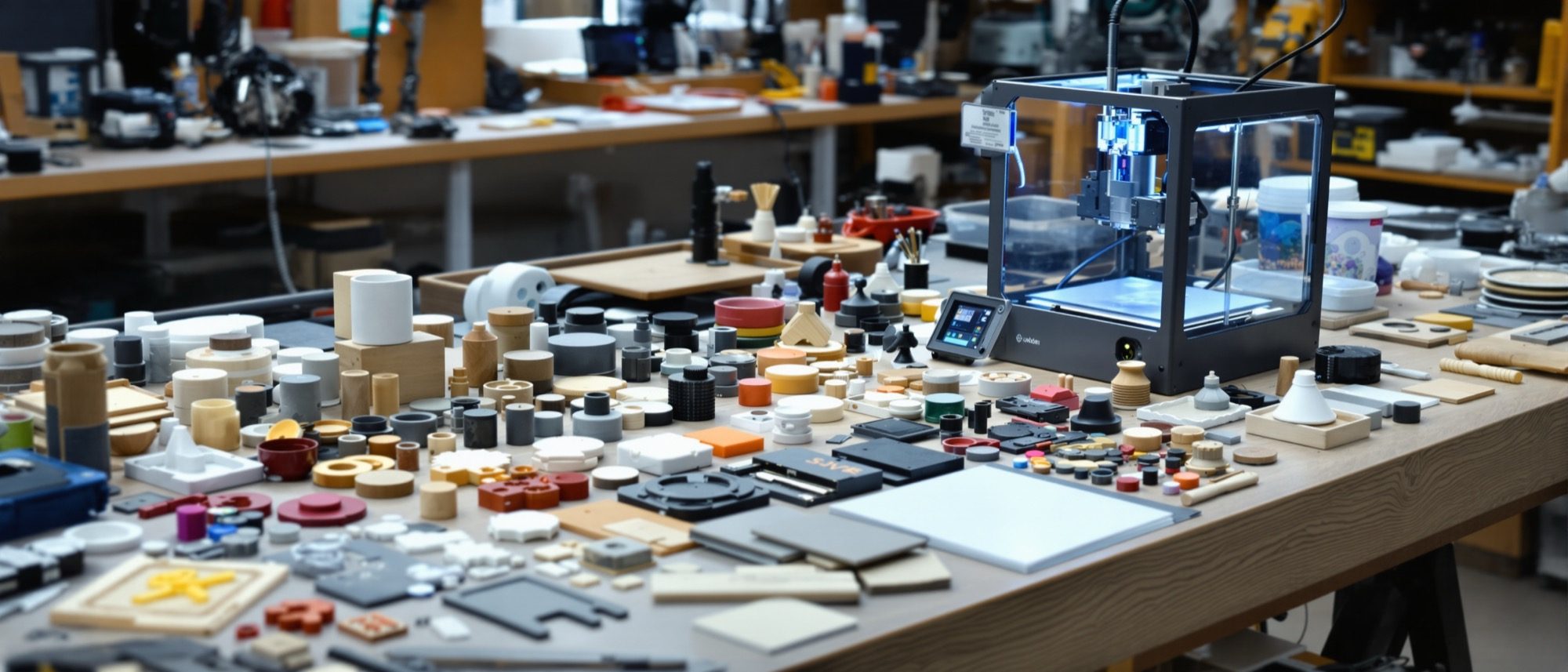
A concept becomes a product through material and process. This unit covers the material families and the criteria (after Ashby) that choose between them, then the manufacturing processes — injection moulding, casting, forming, machining and 3D printing — each suited to a volume and geometry, and the design-for-manufacture rules that keep a product makeable.
Learning objectives
By the end of this lesson, you will be able to — mapped to the course outcomes for Product Design:
Identify the material families and their character.
Select a material by function, cost, aesthetics and sustainability (Ashby).
Match a manufacturing process to a product's volume and geometry.
Apply design-for-manufacture basics.
Materials & selection
Choose a material by function, cost, aesthetics and sustainability — Ashby's charts and indices rank candidates against the design's constraints.[7]
The palette of making
Products are made from a handful of families: METALS (steel, aluminium, alloys — strong, stiff, recyclable); POLYMERS/PLASTICS (thermoplastics that re-melt vs thermosets that set permanently — cheap, mouldable, light); WOOD and natural materials (warm, renewable); CERAMICS and GLASS (hard, heat- and scratch-resistant, brittle); and COMPOSITES (e.g. carbon- or glass-fibre — high strength-to-weight). Each family carries a personality of strength, weight, cost, feel and end-of-life.[7]
Manufacturing & DFM
Match the process to volume and geometry, and design for manufacture — because making is part of the design, not a step after it.[7, 1]
How a product is made
Each process suits a volume and geometry. INJECTION MOULDING — molten polymer into a split mould; complex plastic parts at HIGH volume (high tooling cost, amortised over big runs). BLOW MOULDING — hollow thin-walled parts (bottles). VACUUM FORMING — heated sheet drawn over a mould; large, shallow, cheap-tooled parts. EXTRUSION — continuous constant cross-sections through a die (pipes, channels). DIE CASTING — molten metal into a steel die. SHEET-METAL forming — bending and stamping panels. CNC MACHINING — subtractive, low-volume, high-precision. 3D PRINTING — layer-by-layer, prototypes and low-volume complex parts.[7]
At a glance
| Aspect | One | The other |
|---|---|---|
| Plastic types | Thermoplastic: re-melts, recyclable | Thermoset: sets permanently, heat-stable |
| High vs low volume | Injection moulding / die casting: high volume | CNC / 3D printing: low volume, no tooling |
| Hollow vs profile | Blow moulding: hollow parts (bottles) | Extrusion: continuous cross-sections (pipes) |
| Selection (Ashby) | Rank by material index vs constraints | Balance function, cost, aesthetics, sustainability |
| DFM drivers | Volume & geometry | Material & tolerance |
Key terms
Plastics that re-melt (recyclable) vs those that set permanently when cured.
A material combining two phases (e.g. carbon-fibre + resin) for high strength-to-weight.
A ratio of properties that ranks materials for a given design objective (e.g. stiffness per weight).
Molten polymer into a split mould — complex plastic parts at high volume; high tooling cost.
Molten metal forced into a steel die — strong, precise metal parts at volume.
Subtractive shaping by a computer-controlled cutter — low-volume, high-precision, no tooling.
A slight taper on a moulded part so it releases cleanly from the mould — a DFM basic.
Shaping a part to be cheap and reliable to make — and design for assembly (DFA).
Studio task
For a product concept, choose a material and justify it by function, cost, aesthetics and sustainability; then pick a manufacturing process for it and name one design-for-manufacture change you would make so it can be made affordably.
Self-assessment
1. For a complex plastic part at very high volume, the usual process is —
2. A draft angle is added to a moulded part so that —
3. Ashby's material selection method ranks candidates using —
Recap
References & further reading
- [1]Karl T. Ulrich & Steven D. Eppinger, Product Design and Development (design for manufacture). McGraw-Hill.
- [7]Michael F. Ashby, Materials Selection in Mechanical Design. Butterworth-Heinemann; and Ashby & Johnson, Materials and Design.
Further reading
- Mike Ashby & Kara Johnson, Materials and Design. Butterworth-Heinemann.
- Chris Lefteri, Making It: Manufacturing Techniques for Product Design. Laurence King.
- Rob Thompson, Manufacturing Processes for Design Professionals. Thames & Hudson.
Sources gathered and fact-checked June 2026. Published values vary by source, sample and method — treat as indicative and confirm against the cited standard before structural use.
The author
Amogh N P
Architect, interior designer, and creative polymath. Studio Matrx began in his notebooks — his vision of design made honest, useful, and open to everyone. Its Academy is written and taught in his memory, and free, forever.
More about Amogh →