
Working Drawings & Approvals
The buildable instruction — and the sanction that unlocks it.
The drawings you made in studio were to persuade; the drawings practice runs on are to build. Learn working (construction) drawings — the complete, dimensioned, specified instruction a contractor builds from, and why they are a legal document; how to read and produce them to the office standard; the specifications that go with them; and the statutory approval and sanction process a project must clear before a single brick is laid.
Learning objectives
By the end of this lesson, you will be able to — mapped to the course outcomes for Practical Training:
Explain what working drawings are and why they are a legal instruction.
Read and produce working drawings to the office standard.
Explain the role of specifications.
Navigate the statutory approval and sanction process.
Working drawings & specs
Working drawings are a precise legal instruction — the building is built to them; and drawings plus specifications are a pair that together fully define the building.[1]
Instructions to build
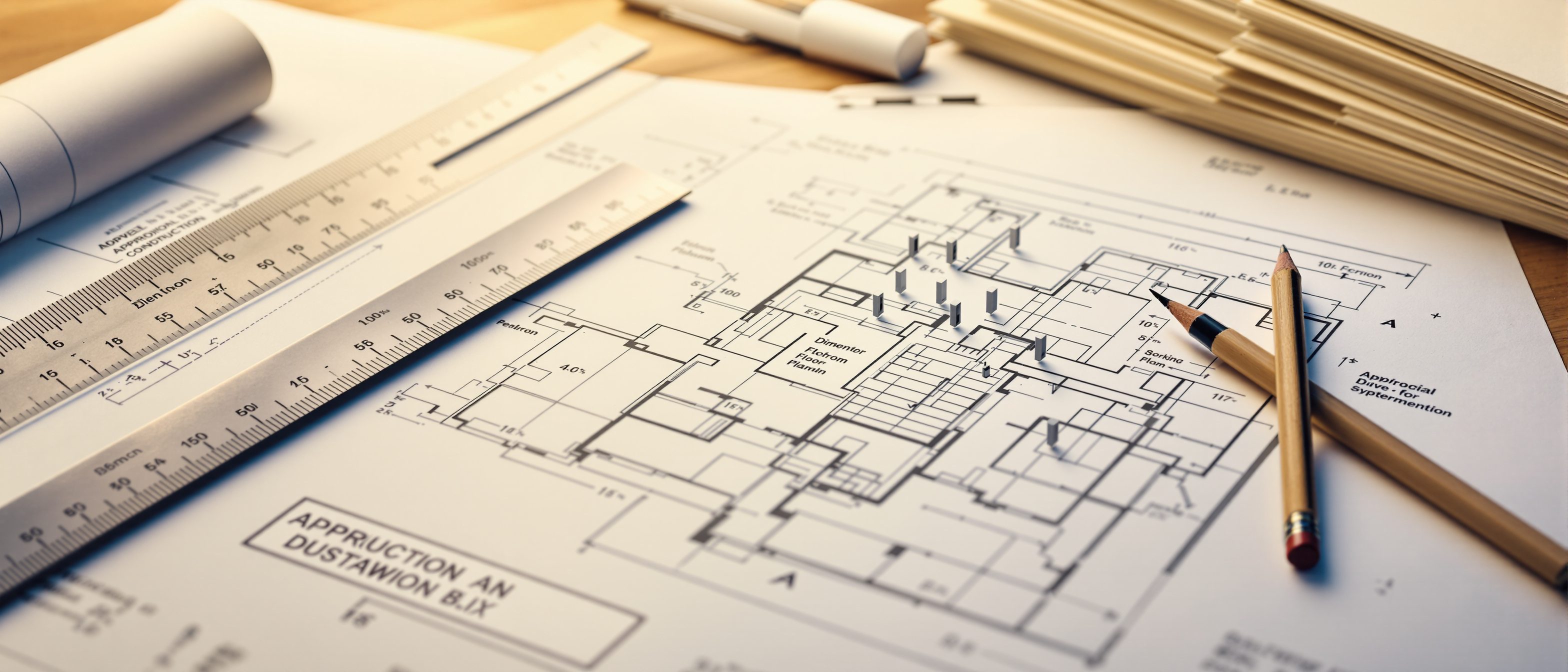
WORKING (construction) DRAWINGS are the complete, precise, dimensioned set a contractor builds from — plans, sections, elevations, details, schedules — every dimension, material and junction defined. They are a LEGAL instruction: the building is built to them, and an error in them becomes an error in concrete. Producing and checking them to the office STANDARD (line weights, conventions, dimensions, references) is the documentation core of your training. MISCONCEPTION→correct: 'working drawings are just neater versions of design drawings' — they are a different document with a different purpose: not to persuade, but to instruct precisely enough to build, leaving nothing to guess.[1]
The approval process
A project must obtain building sanction against the development-control rules before construction; and in working and sanction drawings a small error has real, costly consequences.[2, 1]
No sanction, no building
Before construction, a project must obtain BUILDING SANCTION (permission) from the local authority — the corporation, municipality or development authority. The office prepares a SANCTION SET of drawings showing compliance with the development-control rules (FSI, setbacks, height, parking, fire), submits them, answers queries, and receives the approved/sanctioned plan; some projects also need environmental, fire and other NOCs. Only then can building lawfully begin. MISCONCEPTION→correct: 'approval is a quick formality' — it can take months, shapes the design (you design to what is permitted), and a project built without sanction is illegal; learning the approval process is learning how real buildings get permission to exist.[2]
At a glance
| Aspect | Detail | Note |
|---|---|---|
| Design drawings | To persuade | A picture |
| Working drawings | To build | A legal instruction |
| Drawings + specs | Where & how big + what & quality | A pair; define the building |
| Sanction | Permission to build | Months, not a formality |
| A small error | Costs money or a rejected sanction | Precision is professionalism |
Key terms
The complete, dimensioned, specified set a contractor builds from — a legal instruction.
The conventions (line weights, dimensions, references) drawings must follow.
The materials, grades, finishes and workmanship that go with the drawings.
The authority's permission to build, against the development-control rules.
The drawings submitted to obtain building permission.
No-objection certificates (fire, environment, etc.) some projects also need.
Logbook task
Take one room and list what a working drawing of it must show that a design drawing would not (dimensions, materials, junctions, references), and three things its specification would add. Then outline the steps to get a small house sanctioned by your local authority, and one development-control rule it must satisfy.
Self-assessment
1. Working (construction) drawings differ from design drawings because they are —
2. Specifications are needed alongside drawings because they say —
3. Building sanction (approval) is —
Recap
References & further reading
- [1]Working-drawing and specification practice (e.g. office manuals, NBC) — construction documentation.
- [2]Local development-control regulations and the building-sanction process (corporation/municipality/authority).
- [3]The Architect's Handbook of Professional Practice — construction documents and approvals.
Further reading
- National Building Code of India (documentation and standards).
- The Architect's Handbook of Professional Practice (AIA).
- Office working-drawing standards / CAD-BIM manuals.
Sources gathered and fact-checked June 2026. Published values vary by source, sample and method — treat as indicative and confirm against the cited standard before structural use.
The author
Amogh N P
Architect, interior designer, and creative polymath. Studio Matrx began in his notebooks — his vision of design made honest, useful, and open to everyone. Its Academy is written and taught in his memory, and free, forever.
More about Amogh →