
Parametric Design & Environment
Buildings that move and respond — kinetic and responsive design.
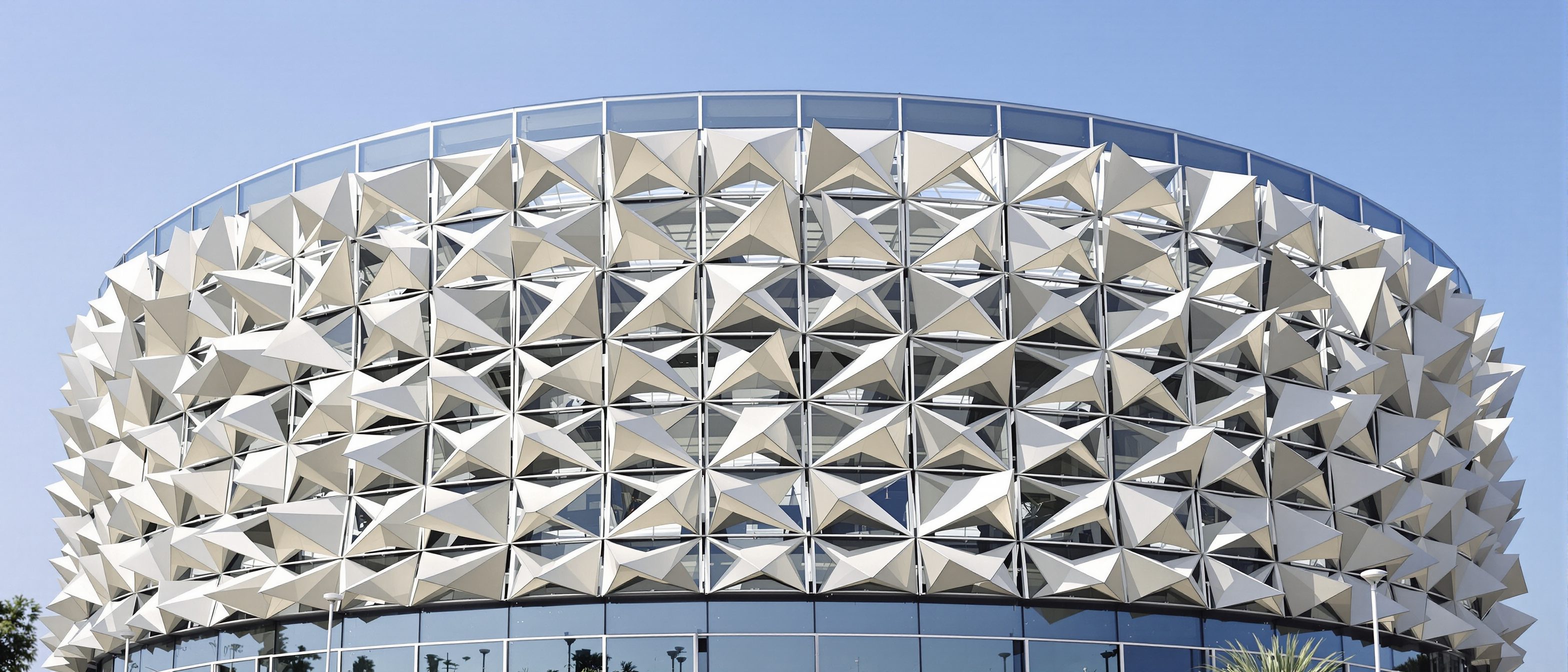
Parametric design comes alive when the building itself MOVES and RESPONDS to its environment. This unit covers kinetic design — architecture with parts that physically move — and responsive facades that change in real time based on behavioural and environmental aspects, like the Institut du Monde Arabe's aperture screen and Al Bahar Towers' folding mashrabiya. It also covers the materials of parametric design — including smart materials that bend and respond. Here the parametric model becomes a living, performing system.
Learning objectives
By the end of this unit, you will be able to — mapped to the course outcomes for Parametric Architecture & Modelling:
Explain kinetic design in architecture and its types of movement.
Describe responsive facades that change based on environmental/behavioural aspects.
Identify the materials used in parametric, kinetic and responsive design.
Distinguish a genuinely kinetic/responsive system from a merely complex static facade.
Kinetic & responsive
Kinetic architecture moves; a responsive facade senses and acts in a sense → decide → actuate loop — as in the IMA (1987) and Al Bahar Towers (2012).[2]
Architecture that moves
KINETIC architecture has parts that physically MOVE — rotating, folding, sliding, expanding, deploying. Movement may be for performance (track the sun, open for ventilation), for transformation (a hall that reconfigures), or for spectacle. Kinetic systems range from simple operable louvres to complex deployable structures, and they reintroduce TIME into architecture — the building is no longer one fixed state but a range of states.[2]
The materials
Complex form needs formable materials; smart materials (bimetal, shape-memory) can act as their own actuators — but a complex facade is not automatically responsive.[7, 8, 2]
What complex form needs
Parametric and complex geometry place new demands on MATERIALS: panels must follow curvature (flat, single- or double-curved), joints must absorb the variation of a non-repeating geometry, and structures must be efficient over free-form spans. Materials and methods that suit it include ETFE cushions, GFRP/GFRC and composite panels, bent and CNC-formed metal and timber, and 3D-printable materials — chosen for formability, lightness and the ability to be digitally fabricated (Unit V).[7, 8]
At a glance
| Aspect | One | The other |
|---|---|---|
| Kinetic vs static | Kinetic: parts physically move | Static: a fixed (if complex) pattern |
| Responsive loop | Sense the environment | → decide → actuate (shade/open) |
| Actuation | Motors & sensors | or smart materials (heat/humidity/current) |
| Famous example | IMA: aperture diaphragms (1987) | Al Bahar: folding mashrabiya (2012) |
| Complex facade | Myth: automatically responsive | Reality: most are static patterns |
Key terms
Architecture with parts that physically move — rotating, folding, sliding, deploying.
A facade that senses its environment and acts (shades, opens) in real time.
Sense → decide → actuate — the loop a responsive facade runs.
A traditional perforated screen; reworked digitally in Al Bahar Towers' folding shades.
Jean Nouvel (1987) — an early aperture/diaphragm responsive south facade.
The designed rules linking what a facade senses to how it moves.
A material that changes shape/property with heat, light, humidity or current — actuator-free kinetics.
Letting how a material cuts/bends/prints drive the buildable parametric form.
Studio task
Design a responsive shading screen for a hot west facade: describe what it senses (sun angle, temperature), the rule it follows, and how it actuates (motors? or a smart material?). Draw its open and closed states. Then say clearly whether your screen is genuinely responsive, merely operable, or a static parametric pattern — and why precision about this matters.
Self-assessment
1. A responsive facade differs from a merely complex static one in that it —
2. Al Bahar Towers (Abu Dhabi) uses a computer-controlled dynamic version of a traditional —
3. A 'smart material' such as a bimetal or shape-memory alloy enables kinetics by —
Recap
References & further reading
- [2]Ingels, Bjarke — Hot to Cold: An Odyssey of Architectural Adaptation (Taschen, 2015); case studies of kinetic/responsive facades (IMA, Al Bahar Towers).
- [5]Woodbury, Robert — Elements of Parametric Design (Routledge, 2010).
- [7]Iwamoto, Lisa — Digital Fabrications: Architectural and Material Techniques (Princeton Architectural Press, 2009).
- [8]Beorkrem, Christopher — Material Strategies in Digital Fabrication (Routledge).
Further reading
- Bjarke Ingels — Hot to Cold (2015).
- Christopher Beorkrem — Material Strategies in Digital Fabrication.
- Lisa Iwamoto — Digital Fabrications (2009).
Sources gathered and fact-checked June 2026. Published values vary by source, sample and method — treat as indicative and confirm against the cited standard before structural use.
The author
Amogh N P
Architect, interior designer, and creative polymath. Studio Matrx began in his notebooks — his vision of design made honest, useful, and open to everyone. Its Academy is written and taught in his memory, and free, forever.
More about Amogh →