
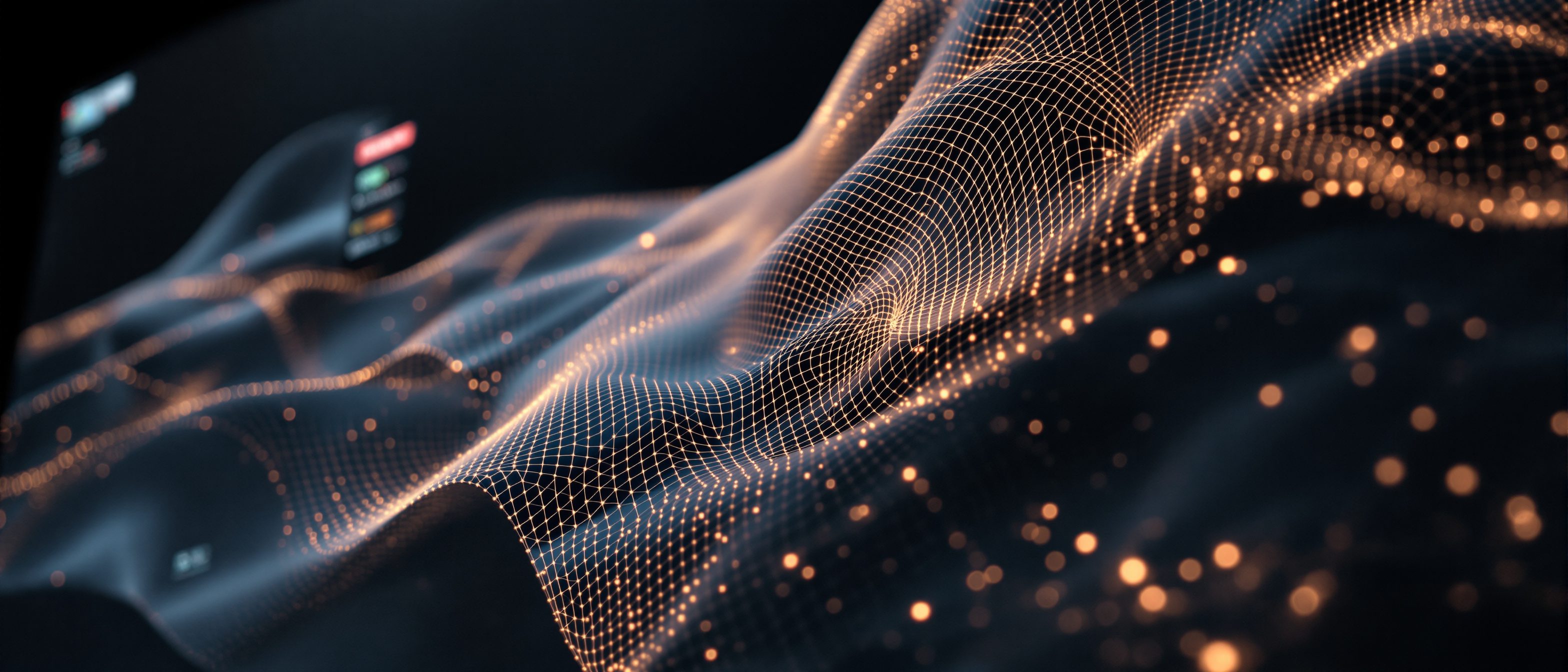
Geometric Modelling
Coordinates, surfaces, Booleans and meshes — the maths of digital form.
Behind every parametric model is geometric modelling — the mathematics of representing form in a computer. This unit builds the foundations: spatial coordinates and projections; the transformations that reposition geometry; Boolean operations that combine solids; free-form NURBS surfaces and how they are created and deformed; and discretization and MESHING that turn smooth surfaces into the triangles and panels a computer (and a fabricator) can handle. Understand the geometry, and the parametric tools stop being magic and become controllable.
Learning objectives
By the end of this unit, you will be able to — mapped to the course outcomes for Parametric Architecture & Modelling:
Explain spatial coordinates, projections and the basic geometric transformations.
Use Boolean operations to combine solids — union, difference, intersection.
Describe NURBS free-form surfaces and how they are created and deformed.
Explain discretization and meshing of surfaces for analysis and fabrication.
Coordinates, Booleans, surfaces
Transformations reposition geometry; Booleans combine solids by set logic; and NURBS surfaces give smooth free-form, shaped by control points.[5]
Where and how
Geometry lives in a COORDINATE system (x, y, z) with an origin and axes. The basic TRANSFORMATIONS reposition it: TRANSLATE (move), ROTATE, SCALE, MIRROR and SHEAR — each is a precise mathematical operation. PROJECTION maps 3-D onto 2-D (orthographic for drawings, perspective for views). In parametric modelling, transformations driven by parameters are how you array, rotate and scale elements into patterns — the bread and butter of a definition.[5]
Meshing & panelisation
Discretization and meshing turn smooth surfaces into the pieces analysis and fabrication need; panelisation makes a free-form surface buildable.[5, 7]
Smooth → pieces
DISCRETIZATION breaks a continuous, smooth surface into a finite set of discrete PIECES — points, segments, panels or cells. It is essential because a computer (for analysis) and a fabricator (for building) cannot handle a perfectly smooth infinity — they need a manageable, panelised approximation. How you discretize (the panel size, the pattern) is itself a parametric design decision with structural, visual and cost consequences.[5]
At a glance
| Aspect | One | The other |
|---|---|---|
| Boolean union vs difference | Union: fuse A + B | Difference: cut B out of A |
| Surface representation | NURBS: exact, smooth | Mesh: discrete net of faces |
| Mesh density | Fine: smooth but heavy | Coarse: light but faceted |
| Panels | Flat: cheap, faceted | Double-curved: follows form, costly |
| Prototyping vs reconstruction | Model → test virtually | Scan reality → rebuild geometry |
Key terms
A precise operation that repositions geometry — translate, rotate, scale, mirror, shear.
Combining solids by set logic — union, difference, intersection.
Non-Uniform Rational B-Spline — a smooth free-form surface defined by control points.
A handle that, when moved, smoothly deforms a NURBS curve/surface.
Boundary representation — a watertight volume with exact surfaces, good for Booleans.
A net of vertices, edges and (triangle/quad) faces approximating a surface.
Breaking a smooth surface into finite discrete pieces (points, panels, cells).
Tiling a free-form surface with buildable panels — flat, single- or double-curved.
Studio task
Sketch how you would model a free-form shell roof: which Boolean operations build the openings, how the NURBS surface is created (loft? sweep?), and how you would panelise and mesh it for fabrication (flat, single- or double-curved panels — and the cost trade-off). Then explain in two lines why a fine mesh is heavier but smoother than a coarse one.
Self-assessment
1. The Boolean operation that cuts one solid out of another is —
2. A NURBS surface is smoothly reshaped by moving its —
3. Discretization (meshing) of a smooth surface is necessary because —
Recap
References & further reading
- [5]Woodbury, Robert — Elements of Parametric Design (Routledge, 2010); standard computational-geometry texts.
- [7]Iwamoto, Lisa — Digital Fabrications: Architectural and Material Techniques (Princeton Architectural Press, 2009).
Further reading
- Robert Woodbury — Elements of Parametric Design (2010).
- Lisa Iwamoto — Digital Fabrications (2009).
- Rhino / Grasshopper geometry documentation.
Sources gathered and fact-checked June 2026. Published values vary by source, sample and method — treat as indicative and confirm against the cited standard before structural use.
The author
Amogh N P
Architect, interior designer, and creative polymath. Studio Matrx began in his notebooks — his vision of design made honest, useful, and open to everyone. Its Academy is written and taught in his memory, and free, forever.
More about Amogh →