
You cannot bring a compass
Read that again, because candidates read past it every year. Not you-should-not — you may not. The materials rules are austere and they are enforced at the gate, and at least one of them contradicts everything your school drawing classes taught you to pack.
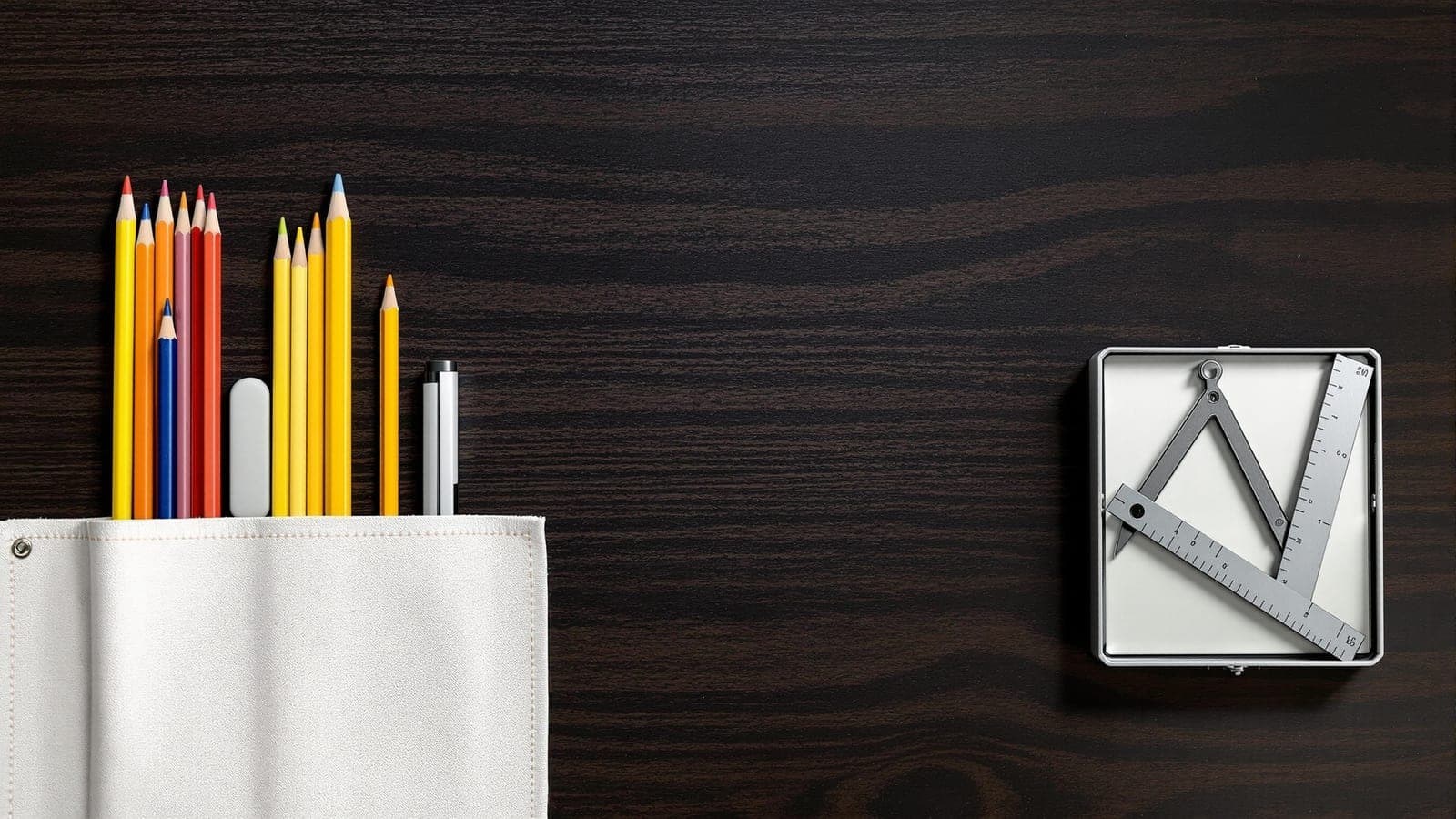
What you carry in
The permitted list is short: your downloaded original Appointment Card, an original photo ID, and then — pencils, a ball pen, an eraser, dry colours, and a scale up to 15 cm.
That is the list. Now the part that catches people. Appendix-II says, in as many words, do not bring any instruments. No compass. No set squares. No protractor. If your mental image of a drawing exam involves a geometry box, delete it.
Also barred: mobiles, Bluetooth devices, calculators, slide rules, log tables, electronic watches with calculator functions, and any textual material. The centres run under IP-camera surveillance with an alarm if a camera fails, so this is not a regime with much give in it.
Dry colours is the other word to sit with. Not watercolour, not poster paint, not markers loaded with ink — dry. Pencils, crayons, pastels. If your A1 practice has been in a wet medium, you have been practising a different exam.
The clock at the gate
Session 1 runs 10:00 to 13:00. Session 2 runs 13:30 to 16:30. Report by 09:00 or 12:30; gates open 09:15 or 12:45; formalities finish 09:45 or 13:15; and the gates close at 10:00 or 13:30.
Then the line that ends candidacies: no entry after 10:15 or 13:45, and no extra time is granted. There is no discretion in it, and no leaving early either — you are in until the session ends.
For Phase 2 specifically: 7 August is a Friday and carries the afternoon session only. 8 August is a Saturday and may carry both. Check which session your appointment card names, because turning up at 09:00 for a 13:30 sitting is a wasted morning, and assuming an afternoon start when you have been given a morning one is a wasted year.
What the centre gives you
Two things arrive from the invigilator rather than from your bag.
The A3 kit. Your question paper carries a kit code, the invigilator issues the matching kit — foam forms plus a 15 cm x 20 cm foam base sheet — and glue is provided. You do not bring this and you cannot know its contents in advance.
The photography. Your finished A3 model is placed in a shooting kit and photographed in three views with the barcode visible. You do not photograph it; you do not carry it out. The photographs are what gets marked.
There is also a ten-minute break permitted between Part A and Part B — but you may not leave the centre. Plan your water and your bathroom around that, not around an imagined walk outside.
The rules behind this
Sourced to the official brochure rather than restated here, so there is one place to correct when the Council revises it.
No instruments are permitted — no compass, no set squares — and no calculators, phones, or wet media.
Appendix-II states "Don't bring any instruments". Also barred: Bluetooth devices, slide rules, log tables, electronic watches with calculators, and any textual material. Numerical Ability is examined without a calculator.
Source · verified 2026-07-16
Bring: the downloaded original Appointment Card, an original photo ID, pencils, erasers, dry colours, and a scale up to 15 cm.
Source · verified 2026-07-16
Report by 09:00 for Session 1 or 12:30 for Session 2. Gates close at 10:00 / 13:30.
Gates open 09:15 / 12:45; registration formalities complete by 09:45 / 13:15.
Source · verified 2026-07-16
No entry after 10:15 (Session 1) or 13:45 (Session 2), and no extra time is granted.
No candidate may leave before the session ends (13:00 / 16:30). A 10-minute break between Part A and Part B is permitted, but the candidate may not leave the centre.
Source · verified 2026-07-16
The A3 foam kit is supplied at the centre. You do not bring one, and you cannot know its contents in advance.
The question paper carries a KIT CODE (D1, D2, D3...) and the invigilator issues the matching kit: a set of 3D forms made of foam plus a 15cm x 20cm foam base sheet. Glue is provided. The finished model is photographed at the centre in three views and uploaded.
Read this carefully: Consequence worth stating plainly: A3 cannot be rehearsed as an artefact, only as a capability. Anyone selling 'the NATA foam kit' is selling a proxy.
Source · verified 2026-07-16
What almost everyone believes
“It is a drawing exam, so I should bring my geometry box and my colours.”
Instruments are barred outright, and only dry colours are permitted.
Appendix-II states plainly not to bring any instruments — no compass, no set squares. And the permitted list names dry colours specifically, which rules out watercolour, poster paint and ink markers. Candidates who have spent months practising with wet media and drawing circles with a compass are not merely carrying the wrong bag on the day; they have trained months of technique they will not be allowed to use.
Depending on how long you have
Foundation
Understand the skill. Months out, or starting from zero.
Buy your materials now and use only those. If you own a geometry box, put it away for the duration — every hour you spend drawing with a compass is an hour training a skill the exam forbids. Get dry colours you actually like the feel of, and make them the only colour you touch.
Drill
The practice protocol. What to repeat, how often, how to score it.
Practise inside the real constraint set: pencils, ball pen, eraser, dry colours, a scale under 15 cm, nothing else. Freehand every circle and every straight line, because that is what the exam will ask for. If your practice work is neater than your exam work will be, your practice is lying to you.
Exam-Day
What to actually do under the constraint — 108 seconds, no instruments, one pass.
Pack the night before against the permitted list, item by item, and remove everything else from the bag — not the room, the bag. Check your appointment card for which session you are in. Aim to arrive at reporting time, not gate-close: the difference between 09:00 and 10:15 is the difference between a bad morning and no exam at all.
Try it
Ten minutes, tonight. This is the cheapest marks-per-minute on the whole site.
- 01Lay out everything you were planning to carry into the exam.
- 02Remove anything not on this list: appointment card, original photo ID, pencils, ball pen, eraser, dry colours, scale under 15 cm.
- 03Look at what is left over. For most candidates it includes a compass and set squares — the exact items Appendix-II bars.
- 04Check your appointment card and write the session time on your hand, figuratively. 7 August is afternoon only; 8 August may be either.
- 05Do one A1-style practice using only what survived step 2. If it feels wrong, you have just found out in July rather than in August.
The short version
No instruments, dry colours only, a 15cm scale, and a gate that shuts at 10:00 or 13:30 with no entry after 10:15 or 13:45. The kit and the glue come from the invigilator; the photographs are what get marked; the break does not let you leave. None of this is difficult — but all of it is the kind of thing that ends an attempt before a single mark is scored.
That completes Test Craft. The Part A modules go deeper on composition, colour and the 3D question itself.
Questions people actually ask
- Can I bring a compass or set squares to NATA?
- No. Appendix-II of the Test Center Manual states plainly not to bring any instruments. Permitted items are pencils, a ball pen, an eraser, dry colours and a scale up to 15 cm, alongside your appointment card and original photo ID.
- What colours can I use in the NATA drawing test?
- Dry colours only — pencils, crayons, pastels. Wet media such as watercolour and poster paint are not on the permitted list. If your practice has been in a wet medium, switch now.
- What time should I reach the NATA exam centre?
- Report by 09:00 for Session 1 (10:00-13:00) or 12:30 for Session 2 (13:30-16:30). Gates close at 10:00 and 13:30, and no entry is permitted after 10:15 or 13:45, with no extra time granted. For Phase 2, 7 August is afternoon only; 8 August may carry both sessions.
- Can I leave the room between Part A and Part B?
- A ten-minute break is permitted between the two parts, but you may not leave the centre, and no candidate may leave before the session ends at 13:00 or 16:30.