
One relationship, most of the marks
Double a cube's edge and its surface area goes up four times while its volume goes up eight. Length by n, area by n squared, volume by n cubed. That is it — one line, and it answers most scaling questions you will ever meet, in this exam and afterwards. It is also the reason ants can carry many times their weight and elephants have thick legs, which is a hint about why an architecture exam cares.
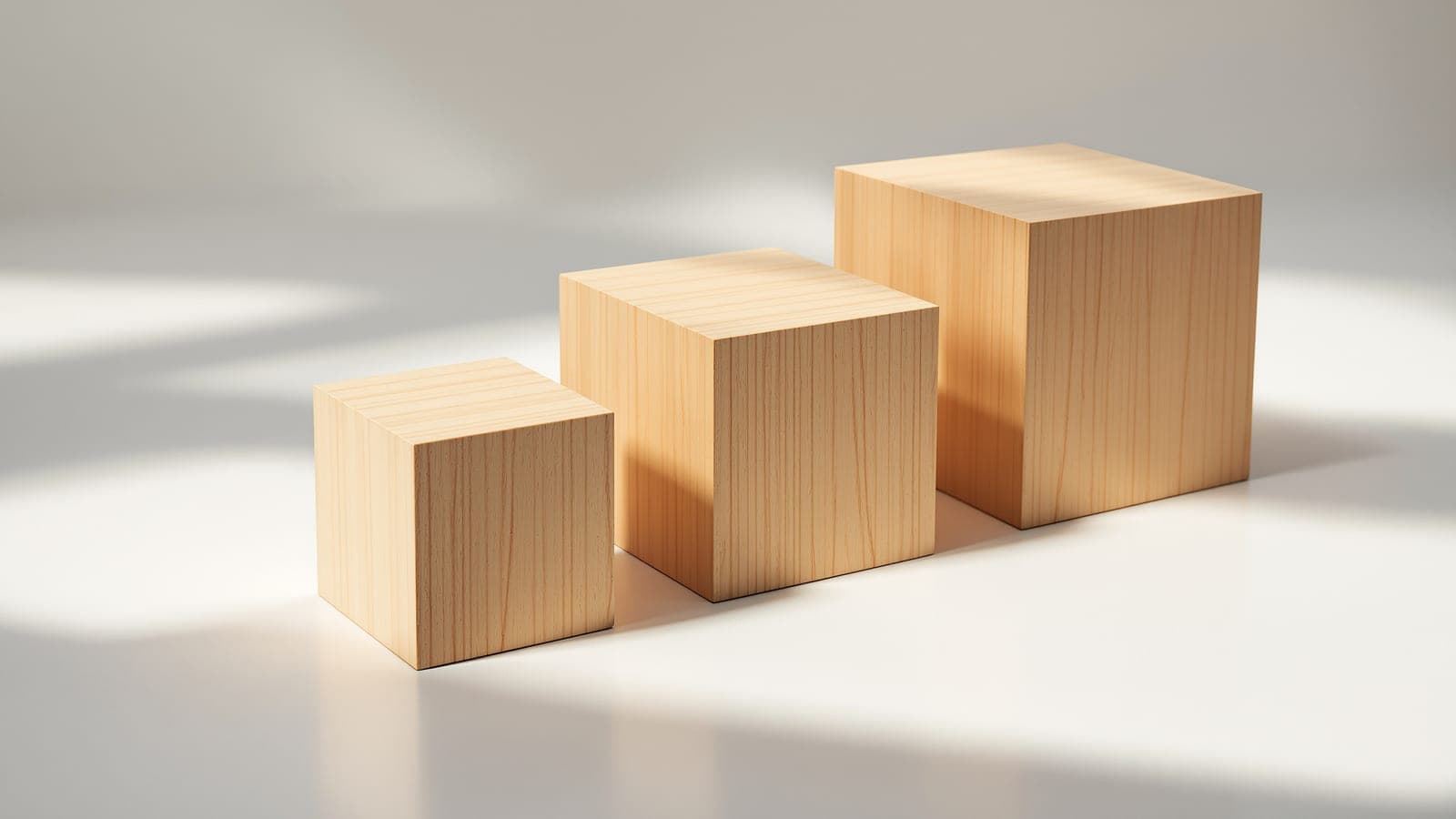
The square-cube law, and the trap inside it
Length scales by n. Area scales by n squared. Volume scales by n cubed.
Double the edge of a cube: length x2, area x4, volume x8. Triple it: x3, x9, x27.
The trap is that candidates apply the wrong power, and the options are always built to catch exactly that. Asked for the surface area of a doubled cube, the wrong answers will include 2 (length), 8 (volume), and 6 (a number that just feels relevant). Knowing which quantity you are being asked about is most of the question, and it takes one second of care.
So before computing anything, name the quantity. Is this a length, an area, or a volume? Then apply n, n squared, or n cubed. That is the whole method, and it is faster than any calculation.
And it is worth knowing as a fact, not a derivation. Deriving it under 108 seconds is possible and pointless.
Scale drawings: one multiplication and one conversion
The other half of this territory, and it is where architects live.
A drawing at 1:50 means one unit on paper is fifty in reality. A wall measuring 60 mm on the drawing is 60 x 50 = 3000 mm = 3 m. That is one multiplication and one unit conversion.
And almost every error here is the conversion, not the arithmetic. Candidates get 3000 right and then write 30 m, or 0.3 m, or leave it in millimetres when the options are in metres. The defence is procedural: do the multiplication first, convert once, at the end. Never convert mid-problem, and never convert twice.
A sense of the common scales is worth having, because it makes wrong answers feel wrong: 1:1 detail, 1:5 to 1:20 details and joinery, 1:50 to 1:100 plans and sections, 1:200 to 1:500 site plans, 1:1000 and beyond for context. If your answer implies a 30-metre door, the scale went wrong, and noticing that is faster than checking your arithmetic.
Ratio without the algebra
Ratio questions look algebraic and rarely need algebra.
Divide 240 in the ratio 3:5. Do not set up equations. Count the parts: 3 + 5 = 8 parts. One part is 240 / 8 = 30. So the answer is 90 and 150. Check by adding: 240. Done, in about ten seconds, no unknowns.
The part-counting method generalises to almost every ratio question you will meet, and it is dramatically faster than the algebra you were taught, because you never introduce a variable you then have to solve for.
And one habit that catches errors free: check by reconstructing. 90 + 150 = 240, and 90:150 does reduce to 3:5. That check costs three seconds and catches nearly every slip. On a one-way test where you cannot revisit anything, a three-second check that you can afford is worth more than a certainty you cannot revise.
The rules behind this
Sourced to the official brochure rather than restated here, so there is one place to correct when the Council revises it.
Part B examines six named areas: Visual Reasoning, Logical Derivation, General Knowledge/Architecture and Design, Language Interpretation, Design Sensitivity and Thinking, and Numerical Ability.
Visual Reasoning — understanding and reconstructing 2D and 3D composition. Logical Derivation — decoding a situation or context and drawing conclusions. General Knowledge, Architecture and Design — current issues, important buildings, historical progression, innovation in materials and construction. Language Interpretation — meaning of words and sentences, English grammar. Design Sensitivity and Thinking — observing and analysing people, space, product, environment; semantics, metaphor, problem identification. Numerical Ability — basic mathematics and its association with creative thinking; unfolding space using geometry.
Source · verified 2026-07-16
No instruments are permitted — no compass, no set squares — and no calculators, phones, or wet media.
Appendix-II states "Don't bring any instruments". Also barred: Bluetooth devices, slide rules, log tables, electronic watches with calculators, and any textual material. Numerical Ability is examined without a calculator.
Source · verified 2026-07-16
What almost everyone believes
“If I double the size of something, everything about it doubles.”
Length doubles, area quadruples, volume goes up eightfold. The three scale by different powers, always.
It is the most intuitive wrong idea in mathematics and the distractors are built directly on it — asked for the area of a doubled cube, the options will offer 2 and 8 alongside the correct 4. Naming the quantity before computing takes one second and defeats the entire family. It is also why the square-cube law matters beyond the exam: it is why structures cannot simply be scaled up, which is a fact you will use in every year of an architecture degree.
Depending on how long you have
Foundation
Understand the skill. Months out, or starting from zero.
Learn n, n squared, n cubed as a reflex, and then go and notice it in the world — why big animals are shaped differently from small ones, why a scale model feels wrong if you just enlarge it. This is the piece of maths that turns into architecture later, so it is worth more than exam marks.
Drill
The practice protocol. What to repeat, how often, how to score it.
On every scaling question, name the quantity before computing: length, area or volume. On every scale question, convert once, at the end. On every ratio question, count parts rather than writing equations. Those three habits cover almost all of this territory.
Exam-Day
What to actually do under the constraint — 108 seconds, no instruments, one pass.
Name the quantity first — the distractors are built from the other two powers. Convert units once, at the end, and sanity-check against the real world: if your answer implies a 30-metre door, the scale went wrong. Reconstruct ratio answers to check; it costs three seconds and you cannot come back.
Try it
Fifteen minutes, no calculator. Say each answer out loud before you work it.
- 01A cube's edge triples. What happens to its surface area? Its volume? (x9 and x27 — name the quantity first.)
- 02A wall is 45 mm on a 1:100 drawing. How long really? Convert once, at the end.
- 03Divide 350 in the ratio 2:5 by counting parts. Check by adding back.
- 04A model is built at 1:200. A 6 m room is how many mm on it?
- 05Last: a photograph is enlarged so its width doubles. How much more ink covers it? Note that this is an area question wearing a length costume — that recognition is the whole skill.
The short version
Length by n, area by n squared, volume by n cubed — one relationship that answers most scaling questions and builds every distractor in the family. Name the quantity before computing. On scale drawings, do the multiplication first and convert once at the end, because the conversion is where the errors live. Count parts rather than writing equations for ratios, and reconstruct to check — three seconds you can afford, on a paper you cannot revisit.
Next: estimation — deciding when an approximate answer is already the right one.
Questions people actually ask
- If a cube's edge doubles, what happens to its surface area?
- It quadruples. Length scales by n, area by n squared, volume by n cubed — so doubling gives x2, x4 and x8 respectively. The distractors in these questions are built from the other two powers, so naming the quantity before computing defeats the whole family.
- How do I convert scale drawing measurements?
- One multiplication, one conversion. At 1:50, a 60 mm line is 60 x 50 = 3000 mm = 3 m. Almost every error is the conversion rather than the arithmetic, so do the multiplication first and convert once, at the end — never mid-problem and never twice.
- What is the fastest way to do ratio questions?
- Count parts instead of writing equations. To divide 240 in the ratio 3:5: eight parts, one part is 30, answer 90 and 150. Then reconstruct to check — 90 + 150 = 240. It takes about ten seconds and introduces no unknowns to solve for.