
Every PUSH sticker is a confession
Somewhere near you is a door with a sign on it saying PUSH. That sign is not information. It is an apology. It means the door's shape told people to pull, they pulled, it did not open, and rather than change the handle somebody printed a word and stuck it on. Objects speak before any label does — and when the label has to contradict the object, the object has already lost.
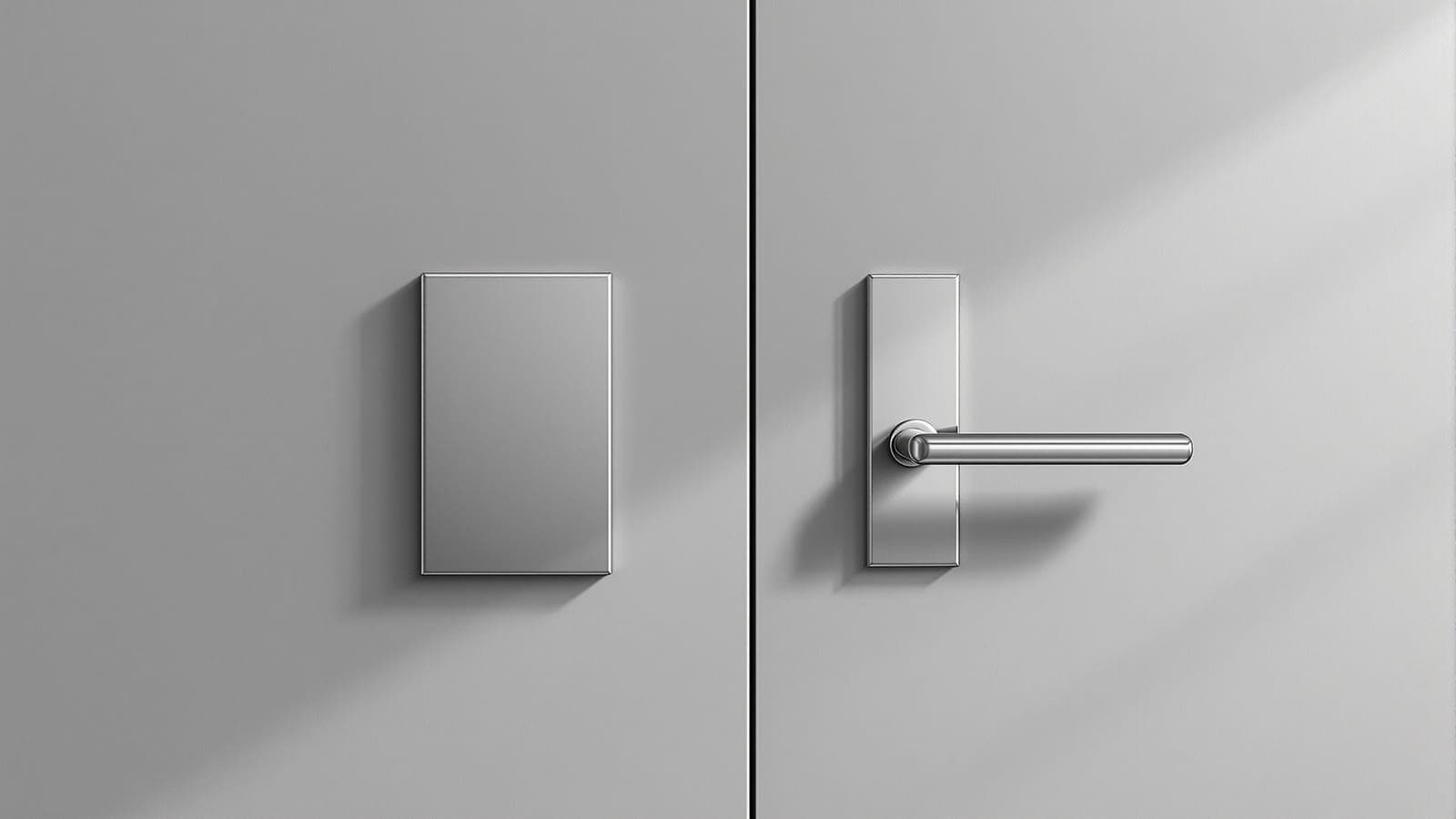
Form tells your hands what to do
A flat plate offers nothing to grip. Your hand cannot close around it. So you push it — not because you decided to, but because the shape refused every other option.
A bar invites a hand to wrap round it. So you pull. Again, no decision: the form made the choice before you arrived.
This is the core of the area and it is testable in a second: does the shape tell you what to do, or does a word have to? A well-designed thing needs no instruction, because the instruction is in the form. A badly designed thing needs a sticker.
And once you see this you will see it constantly — taps you cannot work out, hobs whose knobs do not match the burners, a handle on a sliding door. All of them are the same failure: the object said one thing and meant another.
Metaphor is how a new thing borrows a known one
The bulletin names semantics and metaphors specifically, which is unusual precision. Metaphor in design means one thing: making something new understandable by borrowing the shape of something already understood.
A chair with arms borrows the posture of an embrace, which is why armchairs read as comfortable before you sit in them. A building whose entrance is a deep recess borrows the shape of a cave mouth — shelter, threshold, a decision to go in. A handle shaped like the last handle you used borrows every hour you spent learning that one.
The useful question, then: what is this pretending to be, and does the pretence help? A metaphor earns its place when it makes the new thing legible instantly. It fails when it is decorative — a building shaped like the object it houses, a switch styled like a lever that does not lever.
That distinction — metaphor as communication versus metaphor as costume — is very likely what a question in this area is probing, because it is the difference between design and styling.
Read the object as an argument
Pulling it together: every designed thing is making a claim, and you can read it.
A bench with a fixed armrest at its exact midpoint claims to offer arm support and is in fact preventing sleep. A tap with two separate handles claims that hot and cold are different problems. A doorway two metres wide claims that two people will meet in it. A window at floor level claims you might sit down.
So the question is never only what is this? It is what is this arguing, and is the argument honest? Some things say what they do. Some say one thing and do another — and noticing that gap is precisely the sensitivity being tested, because it requires you to read intention and use as separate layers rather than assuming they agree.
Which connects straight back to wear. Wear tells you whether the argument won. A handle polished on one side is a claim that was accepted; a desire path worn across a lawn is a claim that was rejected by everyone who walked there.
The rules behind this
Sourced to the official brochure rather than restated here, so there is one place to correct when the Council revises it.
Part B examines six named areas: Visual Reasoning, Logical Derivation, General Knowledge/Architecture and Design, Language Interpretation, Design Sensitivity and Thinking, and Numerical Ability.
Visual Reasoning — understanding and reconstructing 2D and 3D composition. Logical Derivation — decoding a situation or context and drawing conclusions. General Knowledge, Architecture and Design — current issues, important buildings, historical progression, innovation in materials and construction. Language Interpretation — meaning of words and sentences, English grammar. Design Sensitivity and Thinking — observing and analysing people, space, product, environment; semantics, metaphor, problem identification. Numerical Ability — basic mathematics and its association with creative thinking; unfolding space using geometry.
Source · verified 2026-07-16
What almost everyone believes
“If a door has a PUSH sign, it is a well-labelled door.”
It is a broken door with an apology on it. The sign exists because the handle was telling people the opposite.
Labels are what you reach for when the form has already failed to communicate, so a sticker is evidence rather than information — and reading it as helpfulness rather than as failure means missing the entire principle. A flat plate cannot be gripped, so it is pushed with no decision required; a bar invites a hand, so it is pulled. When a word has to contradict the shape, the shape has already lost, and noticing that gap is exactly the sensitivity this area tests.
Depending on how long you have
Foundation
Understand the skill. Months out, or starting from zero.
Start collecting bad doors. Genuinely — photograph every PUSH sticker you meet and ask what the handle was saying that needed correcting. It is a small joke that turns into a real skill, because once you can see the failure you can see the principle behind it, and the principle is the examinable thing.
Drill
The practice protocol. What to repeat, how often, how to score it.
One object a day: what does its form tell your hands to do, and does it do that? What is it borrowing the shape of, and does the borrowing help or just decorate? Say the answers out loud — vagueness survives in your head and dies when spoken.
Exam-Day
What to actually do under the constraint — 108 seconds, no instruments, one pass.
When shown an object, ask what it tells your hands and whether the form and the function agree. Prefer the answer that reads intention and use as separate layers over the one that assumes they match — the questions in this area are usually built on the gap between them.
Try it
Fifteen minutes, out in the world. Bring a phone.
- 01Find three doors. For each, look at the handle and predict push or pull BEFORE trying it.
- 02Note which ones you got wrong, and what the handle was saying that misled you.
- 03Find one door with a PUSH or PULL sign. Ask: what shape would have made the sign unnecessary?
- 04Now find any object you use daily — a tap, a switch, a kettle. What is it borrowing the shape of? Does the borrowing help, or is it costume?
- 05Last: find some wear. A polished spot, a scuff, a hollow. Ask what argument won or lost there.
The short version
Form tells your hands what to do before any label does: a flat plate is pushed because it cannot be gripped, a bar is pulled because it invites a hand. So a PUSH sticker is not information, it is a confession that the handle lied. Metaphor is borrowing a known shape to make a new thing legible, and it earns its place only when it communicates rather than decorates. Read every object as an argument — and let wear tell you whether the argument won.
Next: problem identification — and the lawn that tells you the path is in the wrong place.
Questions people actually ask
- What is an affordance in design?
- It is what a form tells your hands to do. A flat plate offers nothing to grip, so you push it; a bar invites a hand to close round it, so you pull. The action is chosen by the shape before you decide anything. When a door needs a PUSH sign, the sign is an apology for a handle that said the opposite.
- What does NATA mean by semantics and metaphors?
- The bulletin names both specifically. Semantics is what an object says through its form. Metaphor is borrowing the shape of something already understood to make a new thing legible — an armchair borrowing the posture of an embrace, a recessed entrance borrowing a cave mouth. A metaphor earns its place when it communicates and fails when it is merely costume.
- How do I tell good design from styling?
- Ask whether the form and the function agree, and whether any borrowed shape helps you understand the thing or just decorates it. Then check the wear: it tells you whether the object's argument was accepted or rejected by the people who actually used it.