
Nobody stands in the middle of the room
Watch any party, waiting room or station concourse. The centre is empty and the edges are full. People take the walls, the columns, the corners, the thing they can put their back against or their drink on. This happens everywhere, in every culture, with no coordination at all — and once you notice it you have a tool for reading any space in about four seconds.
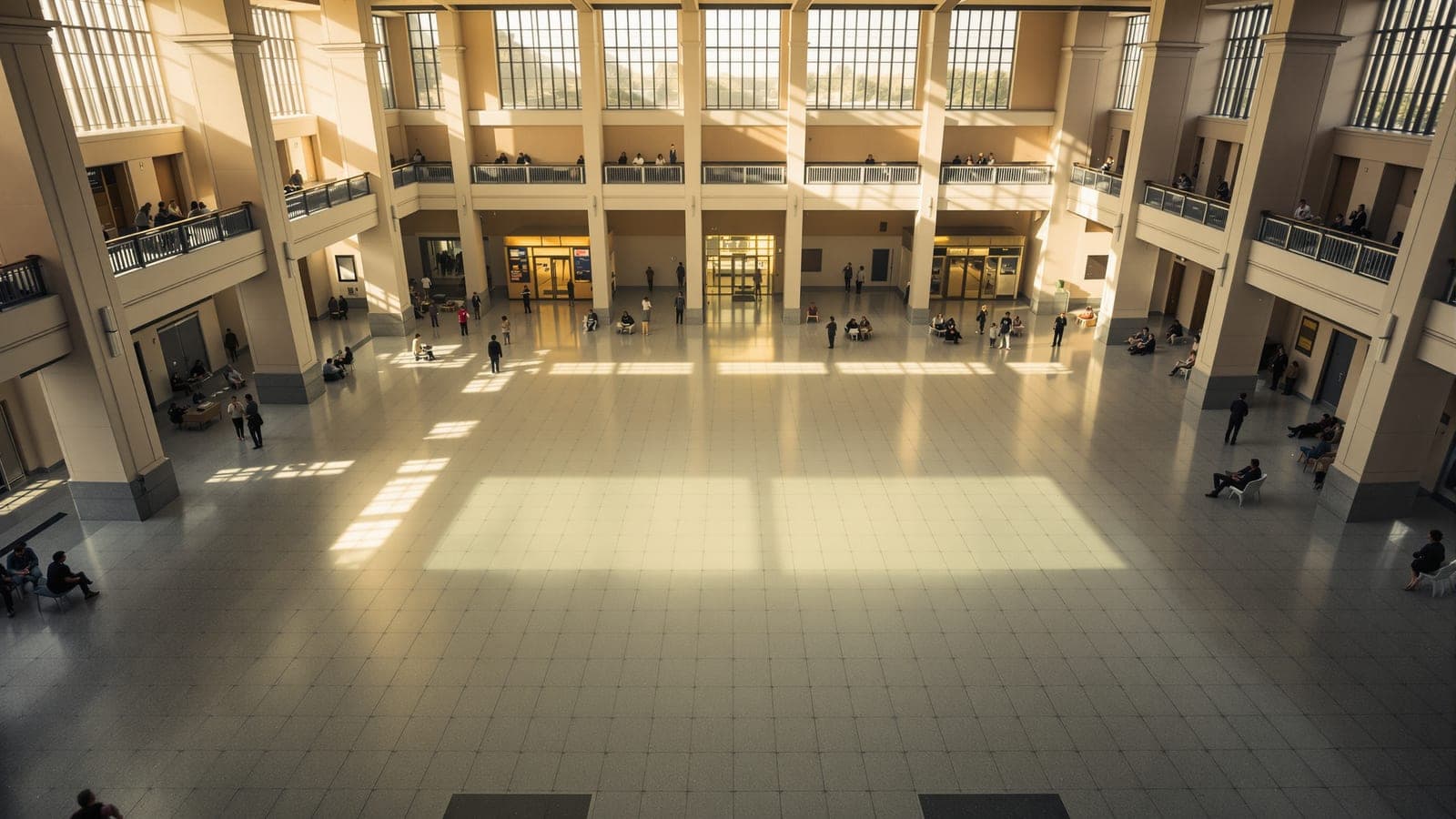
The edge is where people live
The centre of a room offers nothing: no back protection, nothing to lean on, nowhere to look but at other people, and no reason to be there rather than anywhere else. So it stays empty, and it stays empty in a way that is remarkably consistent across cultures and building types.
The edge offers everything. Something behind you. Something to lean against. A view of the room without being in it. An exit within reach. Somewhere to put a cup.
So a plaza with nothing at its perimeter stays empty, however beautiful the paving, because a plaza is not a floor — it is an edge with a middle attached. And a courtyard with a low wall around it fills up, because the wall is a seat, and a seat is a reason.
The practical question this gives you: where are the edges, and does anything happen at them? That single question predicts whether a public space will be used far better than its size, its budget or its plan.
See without being seen
The second pattern, and it explains what the first one is for.
People reliably choose positions where they can see a lot while being exposed a little. The table in the corner with a view of the room. The seat with its back to the wall. The balcony over the courtyard. The window seat, which is the whole thing in one piece of furniture — a small enclosure, looking out at a big view.
This is not a preference; it is closer to a reflex, and it predicts behaviour better than almost anything else you can measure. It is also why the window seat is the most reliably loved architectural device there is: it delivers both halves at once, and it is why every child in every house finds it.
So, second question for any space: can you see without being seen? Rooms that offer both fill up and are described as cosy or welcoming, words people use without ever knowing what caused them. Rooms that offer exposure without shelter empty out and get called cold, however warm they are.
The room is already telling you
Putting it together into something usable under 108 seconds.
Any question showing you people in a space is really asking: why are they there and not somewhere else? And the answer is almost always one of a handful of things — the edge, the shelter, the view, the light, the thing to lean on, the way out.
So when you meet such a question, do not describe what you see. Ask what the space offered that made people choose it. If everyone is on one side of a room, something is on that side, and finding it is the question.
And the inverse is the more valuable half: emptiness is also evidence. A space nobody uses is not neutral; it is failing, and it is telling you which of the offers it does not make. A plaza with no edge. A corridor with no reason to pause. A bench facing a wall.
Which lands where the whole module has been heading: people's behaviour in space is not noise around the architecture. It is the reading of the architecture, and it is free to anyone who looks.
The rules behind this
Sourced to the official brochure rather than restated here, so there is one place to correct when the Council revises it.
Part B examines six named areas: Visual Reasoning, Logical Derivation, General Knowledge/Architecture and Design, Language Interpretation, Design Sensitivity and Thinking, and Numerical Ability.
Visual Reasoning — understanding and reconstructing 2D and 3D composition. Logical Derivation — decoding a situation or context and drawing conclusions. General Knowledge, Architecture and Design — current issues, important buildings, historical progression, innovation in materials and construction. Language Interpretation — meaning of words and sentences, English grammar. Design Sensitivity and Thinking — observing and analysing people, space, product, environment; semantics, metaphor, problem identification. Numerical Ability — basic mathematics and its association with creative thinking; unfolding space using geometry.
Source · verified 2026-07-16
What almost everyone believes
“People cluster at the edges of a room because they are shy or antisocial.”
They are responding to what the space offers. The edge gives back protection, something to lean on, a view of the room, and an exit — and the centre gives none of it.
Reading it as personality misses that it happens everywhere, across cultures and building types, with no coordination — which is the signature of architecture rather than temperament. Treating it as behaviour to be corrected produces plazas that stay empty however good the paving, because a plaza is not a floor, it is an edge with a middle attached. Treating it as information produces a courtyard with a low wall, which fills, because a wall is a seat and a seat is a reason.
Depending on how long you have
Foundation
Understand the skill. Months out, or starting from zero.
Sit in public places and watch where people go. Cafes, stations, parks, waiting rooms. Do not judge, just count: how many at the edge, how many in the middle. You will find the same answer everywhere, and finding it yourself rather than reading it here is what makes it stick.
Drill
The practice protocol. What to repeat, how often, how to score it.
For every space you enter, run two questions: where are the edges and does anything happen at them, and can you see without being seen? Then predict where people will be before you look. Track your hit rate — it climbs fast, and when it is high you have the reflex the exam is after.
Exam-Day
What to actually do under the constraint — 108 seconds, no instruments, one pass.
For any question about people in a space, ask what the space offered rather than describing what you see. Edge, shelter, view, light, something to lean on, a way out. And treat emptiness as evidence — a space nobody uses is telling you which offer it fails to make.
Try it
Twenty minutes in any public space. A cafe, a station, a park.
- 01Before entering, predict where people will be. Then look.
- 02Count: how many at the edges, how many in the open middle? The ratio will surprise you the first time and never again.
- 03Find the most popular seat in the place. Ask what it offers — back protection, a view, light, a way out. Usually several at once.
- 04Now find the least used spot. Ask which of those offers it fails to make. Emptiness is the more informative half.
- 05Last: find a window seat, if there is one, and check whether it is occupied. It nearly always is, and now you know why.
The short version
Nobody stands in the middle, everywhere, in every culture — which makes it architecture rather than temperament. The edge offers back protection, something to lean on, a view of the room and a way out; the centre offers nothing, so a plaza is not a floor but an edge with a middle attached. People choose to see without being seen, which is why the window seat is the most reliably loved device there is. And emptiness is evidence: a space nobody uses is telling you which offer it fails to make.
That completes Design Sensitivity. The questions in this area reward looking at the world, which is the only preparation that also makes you an architect.
Questions people actually ask
- Why do people avoid the middle of a room?
- Because the centre offers nothing — no back protection, nothing to lean on, no view of the room without being in it, and no exit within reach. The edge offers all of those. It happens across cultures and building types with no coordination, which is the signature of architecture rather than personality.
- Why do some public plazas stay empty?
- Usually because nothing happens at the perimeter. A plaza is not a floor; it is an edge with a middle attached. A courtyard with a low wall around it fills up, because the wall is a seat and a seat is a reason to be there. Where the edges are, and whether anything happens at them, predicts use better than size or budget.
- What is the fastest way to read a space?
- Two questions. Where are the edges, and does anything happen at them? And can you see without being seen? Rooms offering both fill up and get called cosy; rooms offering exposure without shelter empty out and get called cold, however warm they are.