
Two minutes of doing nothing is the best investment you have
Part A is 90 minutes for three questions. However you slice it, A3 gets about thirty — and thirty minutes is enough, but only if you spend the first two of them with your hands off the foam. Because glue does not come undone, and the most expensive thing you can do in this question is commit to a composition you had not finished thinking about.
The budget, and where it goes
Ninety minutes, three questions, 80 marks. There is no per-question timing published, so how you split it is yours to decide — but the marks give you a hint: 25, 25, 30. Roughly even, with A3 slightly ahead.
A workable A3 shape looks like this. Two minutes reading and laying out — the brief, and every form out of the bag where you can see it. Three minutes dry-composing — arranging without glue, trying the axis, finding the protagonist. Twenty minutes building. Five minutes checking and finishing — the frontal view, the gaps, anything unresolved.
Notice that a sixth of the budget goes before anything is fixed. That feels wrong under pressure and it is the correct allocation, because of the next section.
Glue is a one-way door
Every other question on the paper is forgiving in a way A3 is not. A pencil line can be erased. A colour can be worked over. A wrong answer in Part B costs you one question.
Glue costs you the composition. Once a form is fixed in the wrong place, you have three options and all of them are bad: build around the mistake and accept a compromised hierarchy, tear it off and damage both the form and the base, or start again with time you do not have.
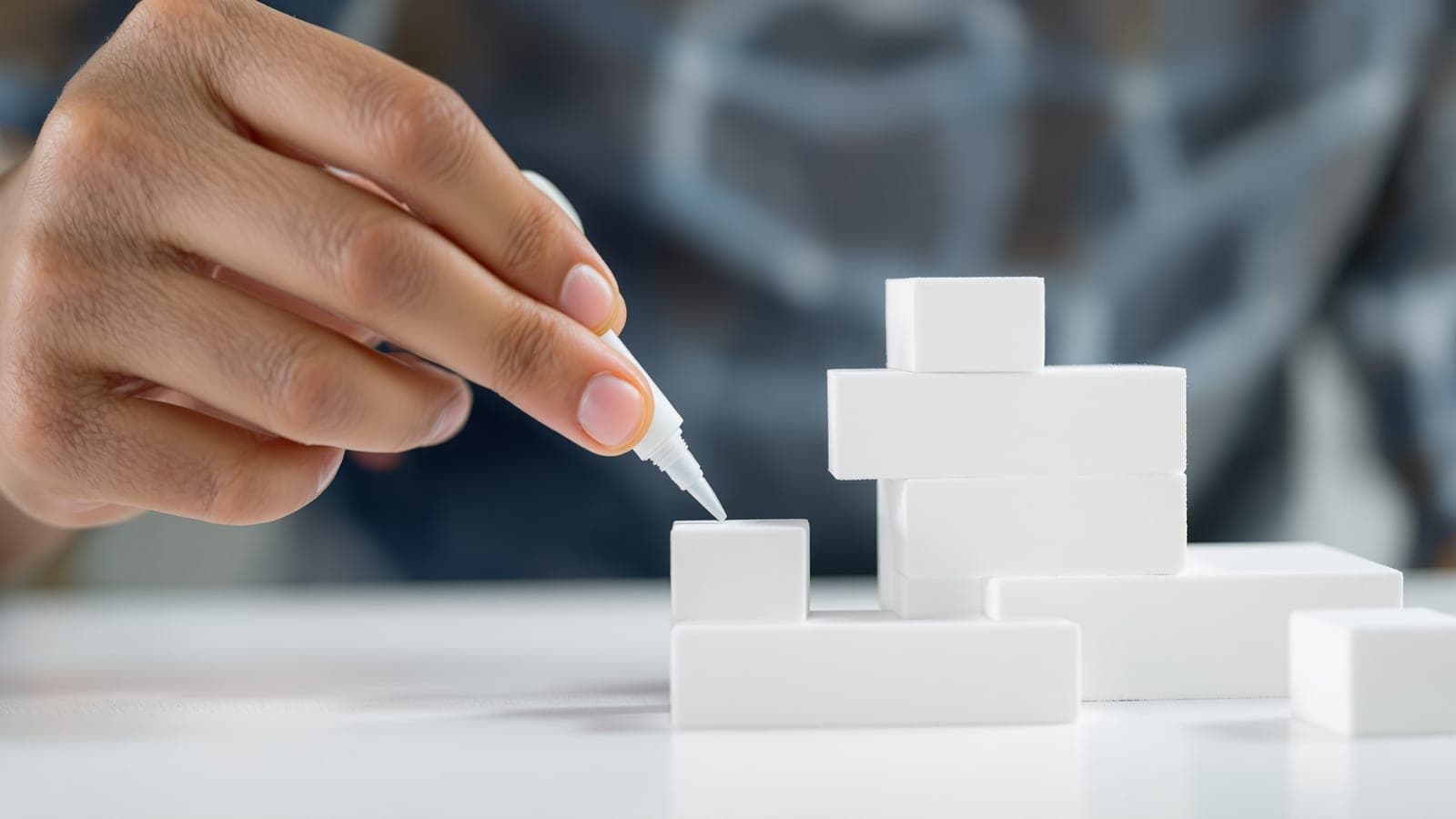
This single asymmetry is why the dry-compose phase is not optional. Those three minutes of arranging without glue are the only place in the question where mistakes are free. Skipping them to save time is the most expensive thing in the whole module — you are trading the free phase for the irreversible one.
A useful discipline: do not glue anything until you can see the finished composition. Not roughly. Actually see it. If you cannot, keep arranging — you are still in the phase where being wrong costs nothing.
Finish, always
One rule outranks the rest at the thirty-minute mark: an unresolved composition photographs badly, and there is no partial credit for intent.
The examiner sees three photographs. They cannot see that you had a better idea and ran out of time. They cannot see that the ambitious diagonal would have been magnificent. They see what is on the base.
So when time is tight, the correct move is almost always to simplify and complete rather than to persist and fail. A simpler composition, resolved, with a clear hierarchy and deliberate gaps, will score better than an ambitious one abandoned halfway. This runs against every instinct — abandoning the good idea feels like giving up — but the photograph does not know it was a good idea.
Decide your bail-out point before you sit down. If at twenty-five minutes it is not coming together, stop adding and start resolving what is there.
The rules behind this
Sourced to the official brochure rather than restated here, so there is one place to correct when the Council revises it.
NATA 2026 is two parts on the same day: Part A offline on paper (80 marks, 90 min), Part B adaptive on computer (120 marks, 90 min). Total 200 marks over three hours.
Part A is taken first, then Part B. A ten-minute break is permitted between them, but the candidate may not leave the centre.
Source · verified 2026-07-16
Part A is three questions: A1 Composition and Colour (25), A2 Sketching and Composition in Black and White (25), A3 3D Composition (30).
Eighty marks across three questions means each is worth roughly 13% of the whole exam. There is no salvaging a bad question by volume, the way a 50-question paper allows.
Source · verified 2026-07-16
The A3 foam kit is supplied at the centre. You do not bring one, and you cannot know its contents in advance.
The question paper carries a KIT CODE (D1, D2, D3...) and the invigilator issues the matching kit: a set of 3D forms made of foam plus a 15cm x 20cm foam base sheet. Glue is provided. The finished model is photographed at the centre in three views and uploaded.
Read this carefully: Consequence worth stating plainly: A3 cannot be rehearsed as an artefact, only as a capability. Anyone selling 'the NATA foam kit' is selling a proxy.
Source · verified 2026-07-16
What almost everyone believes
“Thirty minutes is tight, so I should start building immediately and not waste time.”
The first two minutes without glue are the highest-value minutes in the question, because they are the only ones where being wrong is free.
Glue is irreversible. A form fixed in the wrong place leaves you with a compromised hierarchy, a damaged model, or a restart you cannot afford — and the candidate who started fastest is the one most likely to be in that position. Starting immediately feels productive and converts free mistakes into permanent ones. The dry-compose phase is not a luxury bolted on to the front; it is the only error-correction the question offers.
Depending on how long you have
Foundation
Understand the skill. Months out, or starting from zero.
Do not practise A3 under time yet. Build slowly and well; learn what a resolved composition even looks like. Speed added to a skill you do not have produces fast bad work. The timer belongs in the drill phase, once composing feels natural rather than effortful.
Drill
The practice protocol. What to repeat, how often, how to score it.
Thirty minutes, hard timer, forms you did not choose, every time. Enforce the phases out loud: two minutes hands-off, three dry, twenty building, five checking. Track how often you glued something you later wished you had not — that number falling is the whole point of the exercise, more than any judgement of the result.
Exam-Day
What to actually do under the constraint — 108 seconds, no instruments, one pass.
Hands off the glue for two minutes, whatever the pressure says. Dry-compose until you can see the finished thing. Then build, and at roughly twenty-five minutes stop adding and start resolving. Finish. A simple resolved composition beats an ambitious abandoned one, every single time, because the photograph cannot see your intent.
Try it
Thirty minutes. This is the full-dress rehearsal — do it weekly once you can compose.
- 01Get forms you did not choose, your 15 x 20 base, and glue. Set a hard 30-minute timer.
- 02Minutes 0-2: hands off. Read the brief, lay every form out, look. Touch nothing.
- 03Minutes 2-5: dry-compose. Arrange, try an axis, find the protagonist. No glue.
- 04Minutes 5-25: build. At 25, stop adding — whatever state it is in, start resolving.
- 05Minutes 25-30: check the frontal view, fix the gaps, finish. Then photograph three views and note every piece you wish you had not glued.
The short version
About thirty minutes for A3, and glue is a one-way door. Spend the first two doing nothing and the next three composing dry, because that is the only phase where mistakes are free — and the candidate who starts building fastest is the one most likely to be stuck with a fixed error. At twenty-five minutes, stop adding and resolve. A simple finished composition beats an ambitious abandoned one, because the photograph cannot see what you meant.
That completes A3. The A1 and A2 modules take on the other 50 marks of Part A — colour, line and tone, under the same clock.
Questions people actually ask
- How long do I get for A3 in NATA?
- Part A is 90 minutes for all three questions and no per-question split is published, so it is yours to allocate. The marks — 25, 25, 30 — suggest roughly even thirds with A3 slightly ahead, so about 30 minutes is a sensible working budget.
- What if my A3 composition is not finished when time is called?
- An unresolved composition photographs badly and there is no credit for intent — the examiner sees three photographs and nothing else. When time is tight, simplify and complete rather than persist and fail. A simpler resolved composition with clear hierarchy scores better than an ambitious abandoned one.
- Is the glue provided in the NATA exam?
- Yes. The Test Center Manual states the kit and glue are supplied at the centre. You glue the base sheet to the question paper and build your composition on it. Because it is irreversible, the dry-compose phase before any glue goes down is the only error-correction the question gives you.