
Your medium has opinions. Learn them before August.
Dry colours only. That is the rule, and it sounds like a small administrative detail until you notice what it does: it removes the one thing wet media are good at, which is covering large areas fast. You have twenty-five minutes and a page to fill, and your materials are physically slower than the ones you probably practise with. That constraint should shape everything about how you work.
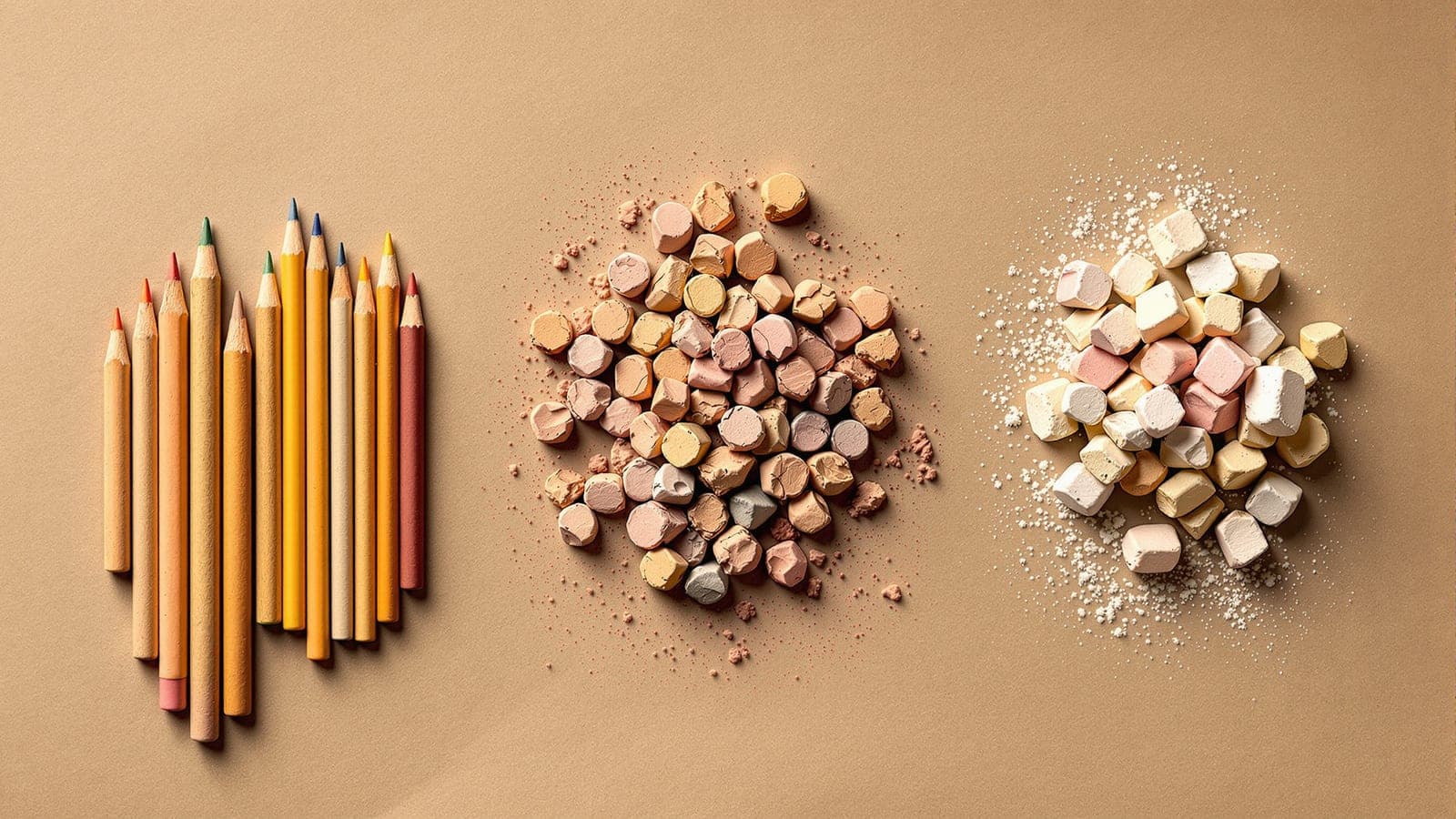
What dry actually rules out
The permitted list is explicit: pencils, ball pen, eraser, dry colours, and a scale up to 15 cm. Read it as a boundary rather than a suggestion.
Out: watercolour, poster paint, acrylic, gouache, ink washes, and markers loaded with liquid ink. Anything that flows.
In: coloured pencils, crayons, oil and soft pastels, charcoal — anything that deposits pigment by friction.
The difference is not aesthetic, it is mechanical. Wet media cover by flooding. A wash puts an even tone across a hand-sized area in one second. Dry media cover by abrasion, one stroke at a time, and there is no shortcut. If your mental picture of a finished A1 involves a smoothly graded sky, ask yourself how many strokes that is, and whether you have twenty-five minutes to spare.
Three media, three personalities
They are not interchangeable, and choosing without testing is choosing blind.
Coloured pencils are precise, controllable and layer beautifully. They are also, for large areas, agonisingly slow. Excellent for a focal point; ruinous if you intend to fill a page with them.
Crayons and oil pastels cover fast and are blunt. You will not get a fine edge, and detail beyond a certain scale is simply unavailable. But a page can be blocked in quickly, which under a clock is worth a great deal.
Soft pastels cover fastest of all and blend with a finger, which is close to a superpower for skies and large tonal fields. They are also filthy, they smudge everything they touch including your other work, and they will lift if you rest a hand on them.
Most candidates who work well under time use a combination: something fast and blunt for the big masses, something precise for the focal point. That is a decision to make now, at home, by testing — not at 10:15 on the morning.
Work light to dark, and leave the paper alone
Two habits do most of the work in dry media, and both run against instinct.
Light to dark. Dry media are additive and only weakly reversible — an eraser will lift graphite reasonably and coloured pencil poorly and oil pastel not at all. So you cannot recover a light from a dark the way you can in paint. Establish your lights first, keep them, and build darks on top. A candidate who blocks in a heavy dark early has permanently lost every light inside it.
Leave the paper alone. The white of the page is your brightest value and it is free. It costs zero strokes and zero seconds. Candidates cover every square millimetre out of a sense of duty and destroy their own highlights in the process — and then wonder why the page reads flat, which it does, because they deleted the top of their value range.
Under a clock these two habits compound: working light to dark and letting the paper carry the lights is both the better-looking approach and the faster one. That is rare, and worth taking.
The rules behind this
Sourced to the official brochure rather than restated here, so there is one place to correct when the Council revises it.
Bring: the downloaded original Appointment Card, an original photo ID, pencils, erasers, dry colours, and a scale up to 15 cm.
Source · verified 2026-07-16
No instruments are permitted — no compass, no set squares — and no calculators, phones, or wet media.
Appendix-II states "Don't bring any instruments". Also barred: Bluetooth devices, slide rules, log tables, electronic watches with calculators, and any textual material. Numerical Ability is examined without a calculator.
Source · verified 2026-07-16
What almost everyone believes
“I should fill the whole page — white paper showing through looks unfinished.”
The white of the paper is your brightest value, it is free, and covering it out of duty destroys the top of your value range.
Dry media are additive and weakly reversible, so once a light is covered it is gone — an eraser lifts graphite passably, coloured pencil poorly and oil pastel not at all. Candidates who cover everything end up with a page whose lightest value is a mid-tone, which reads as flat no matter how vivid the hues are, and they have spent minutes they did not have doing it. Reserved white is simultaneously the better-looking choice and the faster one.
Depending on how long you have
Foundation
Understand the skill. Months out, or starting from zero.
Test everything now, while it is cheap. Buy a small range, and find out how each medium behaves — how fast it covers, whether it erases, how it layers, how filthy it gets. You are looking for the combination you will still be using in August. This is a week of work that will quietly improve every attempt you make afterwards.
Drill
The practice protocol. What to repeat, how often, how to score it.
Practise in the exact kit you will carry, every time. Not a similar set — that set. You want the coverage speed of your specific crayons in your hands as physical knowledge, so that when you look at a page you already know whether you can fill it in the time left. That estimate is worth more than any technique.
Exam-Day
What to actually do under the constraint — 108 seconds, no instruments, one pass.
Block the big masses with your fast medium first, and let the paper hold your lights. Do not start with the focal point, however tempting — start with the largest area, because that is the thing most likely to run you out of time. Never cover the whole page out of duty; the white is your brightest value and it is free.
Try it
Thirty minutes, and it is a materials test rather than a drawing. Do it once, benefit all year.
- 01Take an A4 sheet and divide it into three columns: pencils, crayons/oil pastels, soft pastels.
- 02In each column, time yourself covering a hand-sized area with an even tone. Write the seconds down.
- 03Now try to erase part of each. Note honestly what lifts and what does not.
- 04Layer a dark over a light in each, then try the reverse. Note which directions work.
- 05You now know your media's actual limits, in numbers. Choose your exam combination from this sheet — fast and blunt for masses, precise for the focal point — and never revisit the decision.
The short version
Dry means covering by abrasion, one stroke at a time, with no flooding and no shortcut — so coverage speed is a real constraint on a 25-minute page. Pencils are precise and slow, crayons fast and blunt, soft pastels fastest and filthiest; most people who work well under time combine them. Work light to dark because you cannot recover a light, and leave the paper alone, because white is your brightest value and it is free.
Next: colour relationships — what actually reads at a glance, and what quietly turns to mud.
Questions people actually ask
- What colours am I allowed in NATA?
- Dry colours only. The permitted list names pencils, a ball pen, an eraser, dry colours and a scale up to 15 cm. That rules out watercolour, poster paint, acrylic, gouache, ink washes and liquid markers. Coloured pencils, crayons, oil and soft pastels and charcoal are all dry.
- Which dry medium is best for NATA A1?
- There is no official answer and it depends on how you work. Coloured pencils are precise but slow over large areas; crayons and oil pastels cover fast but are blunt; soft pastels cover fastest and blend with a finger but smudge everything. Most candidates who work well under time combine a fast medium for big masses with a precise one for the focal point.
- Should I fill the entire page in A1?
- No. The white of the paper is your brightest value and costs nothing to use. Covering everything out of a sense of completeness deletes the top of your value range and makes the page read flat, and it consumes minutes you do not have in a dry medium that covers by abrasion.