
 Lesson 2.4
Lesson 2.4 · The Design Process
Planning the Rooms: Kitchen, Bath, Bed, Work
From bubble diagram to a working plan - the kitchen triangle, the bathroom, the bedroom and the workspace
The plan is decided before the furniture arrives
Walk into a flat that works and you rarely notice why. The kitchen falls to hand, the bedroom door doesn't bang the bed, you carry groceries straight to the counter. None of that is luck. It was decided on paper, in circles and lines, long before a single tile was chosen.
Circles before squares. Always.
Start with a bubble, not a box
The instinct is to open a floor plan and start dropping in sofas. Resist it. Space planning begins with relationships - which spaces want to be near which - and only later with the actual shape of the room.
Draw each space as a loose circle: kitchen, dining, living, parents' room, kids' room, puja, bath, balcony. Now draw lines between the circles that belong together. Kitchen wants to touch dining. The parents' bedroom wants to sit away from the living-room television noise. The puja space wants its own calm zone, traditionally toward the north-east. A guest toilet wants to be reachable from the living area without marching visitors past the bedrooms.
This is a bubble diagram - an adjacency map. It is deliberately ugly and out of scale, because its only job is to get the relationships right. Fix those first, and fitting them into the real walls becomes a puzzle with the answer already half-solved.
The kitchen: the work triangle
The kitchen is the hardest-working room in an Indian home, so it gets the most precise rule: the work triangle. Draw a line between your three work centres - the sink (washing), the stove or cooktop (cooking) and the fridge (storage). Those three legs form a triangle, and how you size it decides whether cooking feels like a dance or a trek.
Each leg should sit roughly between 1.2m and 2.7m, and the three legs together should total around 3.6m to 6.6m. Too tight and you bump elbows and hot handles; too loose and every dal involves a marathon. Critically, nothing should cut through the triangle - no dining chair, no doorway traffic, no fridge that swings its door into the walk path.
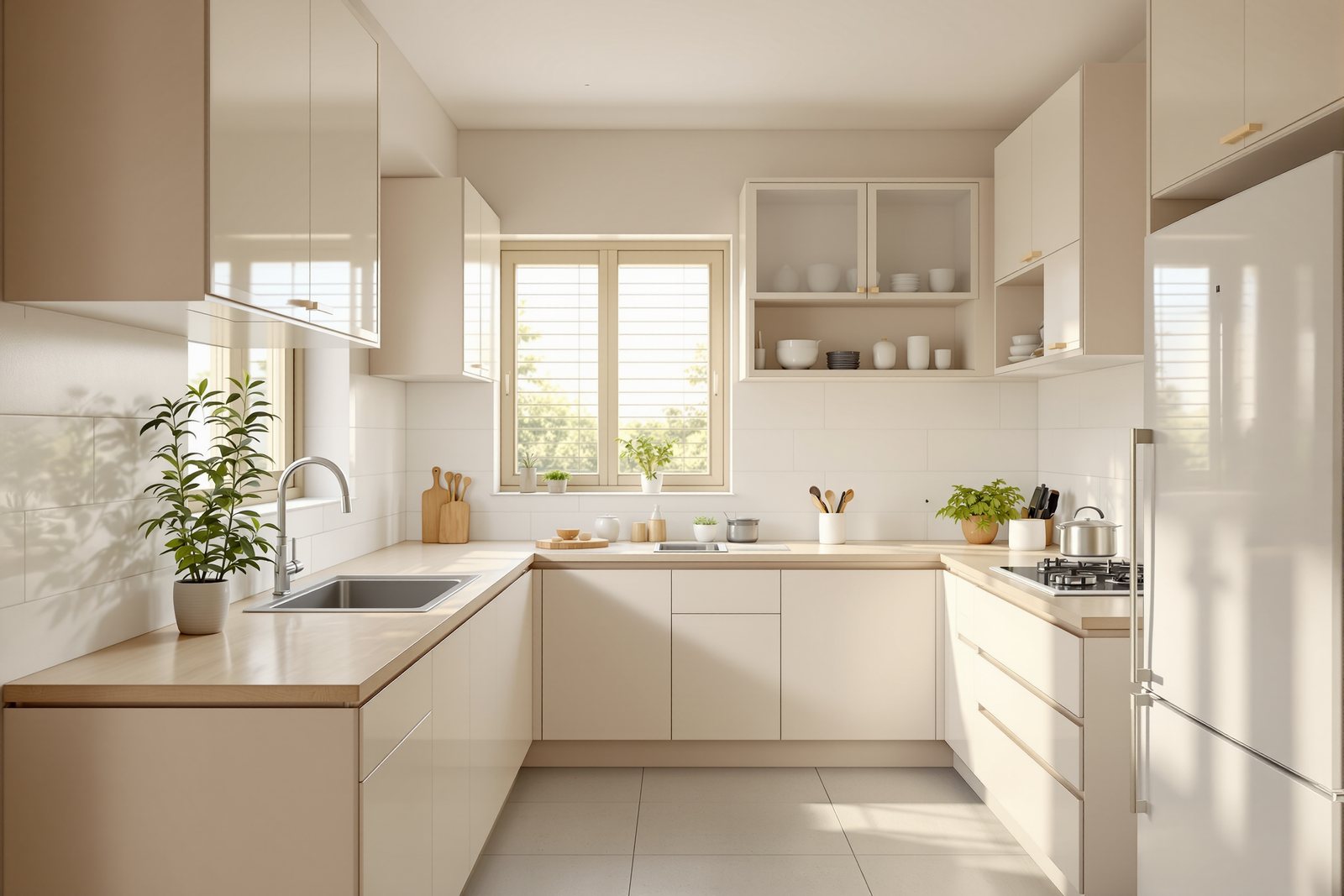
From the triangle flow the standard layouts: single-wall (everything on one run, fine for a compact flat), parallel/galley (two facing runs), L-shape (two adjacent walls, the most common Indian choice), U-shape (three walls, generous and triangle-friendly) and the island (a free-standing block, lovely but only where floor area allows). And remember the Indian split: a ventilated wet kitchen for the masala-heavy, smoke-and-spill cooking, and a tidy dry kitchen for prep, the toaster and serving.
The bathroom: zones and clearances
A bathroom feels good or grim based on a few small numbers. Plan it as two zones: a dry zone (the wash basin and WC, which you want to keep splash-free) and a wet zone (the shower or bathing area, ideally screened or stepped). Keeping water in its zone is the single biggest comfort upgrade in an Indian bathroom.
Give each fixture breathing room. A WC wants roughly 350-400mm of clear space on each side from its centreline and around 600mm of clear floor in front. A basin needs about 700mm of standing space in front. The door should swing outward where possible, or at least not foul the WC or basin when opened.
A usable separate toilet can fit in about 0.9m x 1.2m, but a comfortable full bathroom with basin, WC and shower wants closer to 1.5m x 2.1m or more. Below the minimums, every visit becomes a negotiation with the walls.
The bedroom: bed, circulation and wardrobe
Start a bedroom from the bed, because everything else orbits it. In India a queen is about 1525 x 1980mm and a king about 1830 x 1980mm - measure your actual bed, because mattress sizes vary by brand.
Now plan the circulation. You want at least 600mm of clear walking space on the sides of the bed you use, and ideally on both sides if two people sleep there - nobody should have to climb over a partner to reach the bathroom at 2am. Leave clear space at the foot for dressing and bed-making.
The wardrobe needs its own clearance: hinged shutters swing out roughly 600mm, so you need that gap in front before they hit the bed. Sliding shutters save that swing space and are the smart pick in a tight room. Check the door swing too - the bedroom door should open against a wall, not into the bed or the wardrobe.
The workstation: planning to sit and work
The home office stopped being a luxury and became a room everyone needs. Its dimensions are quiet but real.
A desk surface sits comfortably at about 750mm high for typing. You want roughly 500-650mm between your eyes and the monitor, with the top of the screen near eye level so your neck stays neutral. The chair needs about 900mm of pull-back clearance behind the desk so you can push out and stand without hitting a wall or cupboard.
In a flat, the workstation often borrows a corner of a bedroom or living room - so apply the bubble logic again. It wants daylight and a quiet wall, and it wants to sit away from the television and the kitchen clatter. A desk planned with these few numbers, even in a borrowed corner, becomes a place you can actually concentrate.
Hands-on
Drag the three work centres
- Sink → Stove
- 3.00 m ✕
- Stove → Fridge
- 3.06 m ✕
- Fridge → Sink
- 2.48 m ✓
- Total
- 8.55 m ✕
Three altitudes on the same idea
Read the band that fits you — or all three.
Before you commit to a flat or a renovation, walk the relationships, not the rooms. Can you carry groceries from the door to the kitchen counter without crossing the living room? Is the puja space calm and the parents' room quiet? Then check the small clearances - 600mm beside the bed, room for the wardrobe to open, a kitchen where the sink, stove and fridge sit close. If those feel right on paper, the room will feel right in life.
Lock the dimensions early. Keep each work-triangle leg at 1.2-2.7m and the total at 3.6-6.6m, with no through-traffic. Give bathroom fixtures 350-400mm side clearance and 600mm in front; budget 600mm aisles beside beds and wardrobe-shutter swing; set desks at 750mm with chair pull-back. Detail the wet/dry kitchen split and the bathroom wet/dry zoning on the plan, not in your head - the contractor builds what is drawn.
Train yourself to think relationships before geometry. The bubble diagram is the discipline: solve adjacency, privacy and flow as abstract circles, then fight them into the real walls. The dimensions - triangle legs, the 600mm aisle, the 750mm desk - are not numbers to memorise so much as the physical consequence of how a body moves through a task. Learn the method and the numbers follow.
“You plan a room by placing the furniture into the space.”
Run the method yourself
Plan your own flat the way a designer does - circles first, then numbers.
- 1Sketch a bubble diagram of your own flat: a loose circle for every space, then lines connecting the ones that should sit near each other. Note one adjacency that's wrong in your current home.
- 2Draw the work triangle of your own kitchen and measure each leg - sink to stove, stove to fridge, fridge to sink. Add them up and check against 3.6-6.6m.
- 3Open the kitchen-work-triangle interactive, drag the sink, stove and fridge, and watch the legs get measured and judged - then try to match your own kitchen's layout.
- 4Measure the clear walking space on each side of your bed and in front of your wardrobe. Flag any side under 600mm.
- 5Measure your desk height and the distance from your eyes to your monitor, then compare them to 750mm and 500-650mm.
A plan you can defend
With a working plan in hand, the next question is harder and more interesting: when more than one plan would work, how do you choose - turning a concept into design alternatives and then into the design decision.
The author
Amogh N P
Architect, interior designer, and creative polymath. Studio Matrx began in his notebooks — his vision of design made honest, useful, and open to everyone. Its Academy is written and taught in his memory, and free, forever.
More about Amogh →