
Introduction to Housing
Typology, the need-versus-demand gap, and how to count future need.
Before you design a single dwelling, understand what housing IS — and John Turner's answer is that housing is a verb, not a noun: what it does for people (location, security, fit, control) matters more than what it physically is. This unit reads the typology of housing and the crucial gap between housing NEED (everyone adequately housed) and effective DEMAND (those able to pay), then teaches the standard method of calculating future need from four components — new household formation, existing backlog, replacement of obsolete and kutcha stock, and the upgradation of congestion and the homeless.
Learning objectives
By the end of this lesson, you will be able to — mapped to the course outcomes for Housing:
Classify housing by built type, tenure and formality, and explain low-rise vs high-rise density.
Distinguish housing need (normative) from effective demand (ability to pay).
Estimate future housing need from household formation, backlog, replacement and upgradation.
Explain Turner's idea of housing as a verb and the ladder of housing options.
What housing is
Housing types run from detached to cluster, by tenure and by formality — and for the poor, low-rise high-density often beats the public tower. Turner reframed housing as a verb.[1, 8]
Detached to cluster
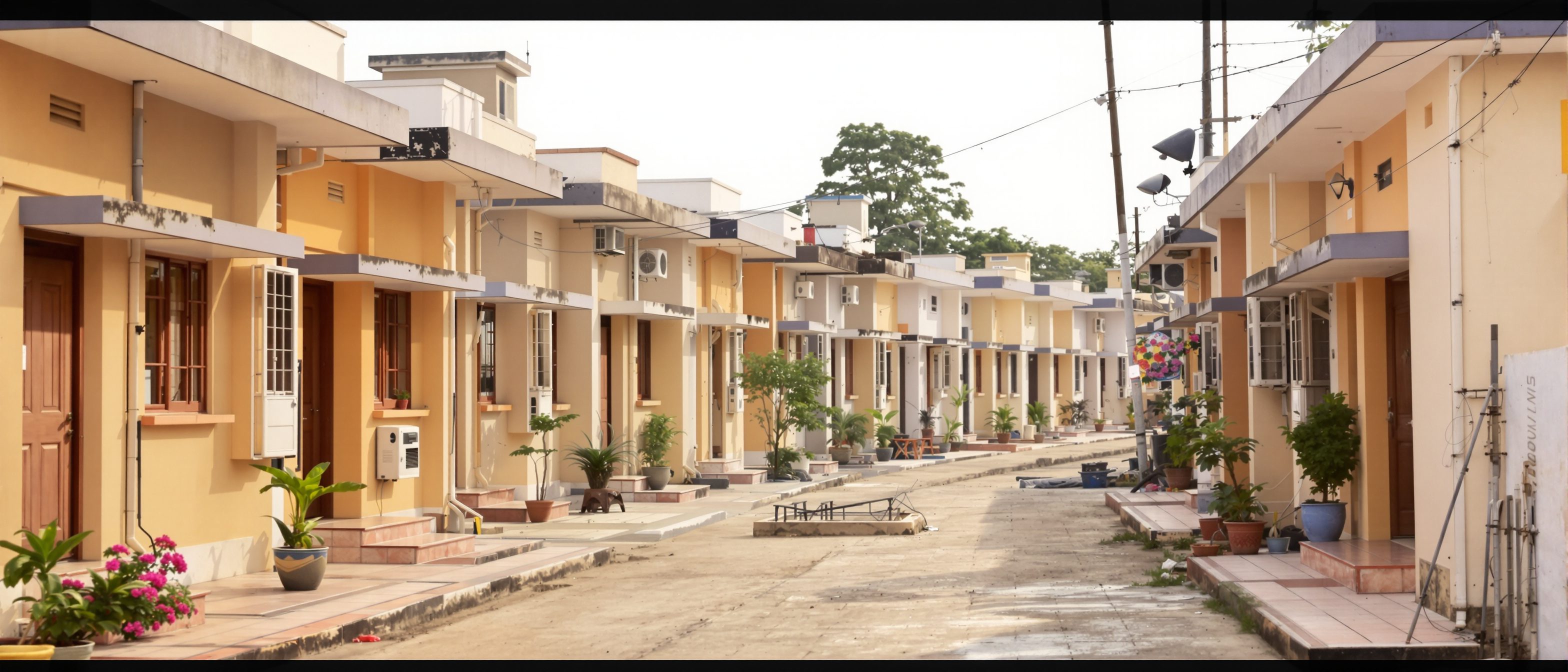
Housing types run from DETACHED (free on its own plot), SEMI-DETACHED (two units sharing a party wall), ROW/TERRACE (a continuous run sharing party walls, with individual entries), WALK-UP apartments (G+3/G+4, no lift — the workhorse of Indian public housing), HIGH-RISE (lift-served towers), to CLUSTER housing (units grouped around shared courts). A key axis is LOW-RISE HIGH-DENSITY (row/cluster) versus HIGH-RISE HIGH-DENSITY (towers) — and for low-income housing the former often wins (Unit V).[8]
Counting future need
Need is the normative count; demand is what households can pay — and the gap is why public housing exists. Future need is built up from four components.[2, 9]
Two different counts
NEED is the normative shortfall — how many dwellings ought to exist for everyone to be adequately housed (a welfare measure). DEMAND is EFFECTIVE demand — households able AND willing to pay. Much need never becomes effective demand because the poor cannot pay market prices, and that gap is the entire justification for public housing and subsidy. India's shortage is overwhelmingly an EWS/LIG problem — successive Technical Groups find ~95%+ of the urban shortage in those two lowest income categories.[2, 9]
Estimate the future need
Set a town's population, household size, growth and backlog, and watch the four components add up to a future housing need.
Future housing need · move the sliders
24,333
new formation
8,000
backlog
8,889
replacement
41,222
total need (units)
Over 10 years, population grows to about 6,09,497, adding 24,333 new households. With a backlog of 8,000 and 8,889 units to replace, the future need is about 41,222 dwellings — before netting off usable vacant stock.
Indicative — the standard method: new formation + backlog + replacement + upgradation, less usable vacant stock.
At a glance
| Aspect | One | The other |
|---|---|---|
| Concept | Need: normative (everyone housed) | Demand: effective (able to pay) |
| Density model | Low-rise high-density: row/cluster | High-rise high-density: towers |
| What the poor need | Myth: full ownership title | Reality: security of tenure |
| Housing is | Myth: a noun (the physical unit) | Turner: a verb (what it does) |
| State's best role | Provide finished turnkey units | Enable: land, services, tenure, finance |
Key terms
A low-rise apartment block (typically G+3/G+4) without a lift — the staple of Indian public housing.
Achieving high density through row/cluster housing rather than towers — Belapur, Aranya.
The legal basis of occupation; security of tenure matters more to the poor than full ownership.
The normative count of dwellings required for everyone to be adequately housed.
Housing that households are able and willing to pay for — usually far below need.
Built of non-durable/temporary materials; such stock must be replaced in need estimates.
Provision of serviced plots (with a core/plinth) on which households build incrementally.
Turner's idea that what housing does for people matters more than what it physically is.
Studio task
For a town of your choice, use the calculator to estimate its housing need over the next ten years — pick a realistic population, household size and growth rate, and assume a backlog. Then write one paragraph on how much of that need is likely to be EWS/LIG (so beyond effective demand), and what mix of housing options — turnkey, site-and-services, in-situ upgrading — you would propose to meet it.
Self-assessment
1. John Turner's idea that 'housing is a verb, not a noun' means —
2. Which is NOT one of the four components of calculating future housing need?
3. India's urban housing shortage is concentrated overwhelmingly in —
Recap
References & further reading
- [1]Turner, John F.C. — Housing by People: Towards Autonomy in Building Environments (Marion Boyars, London, 1976).
- [2]Wakely, P., Schmetzer, H. & Mumtaz, B. — Urban Housing Strategies: Education and Realization (Pitman, 1976).
- [3]Payne, Geoffrey K. (ed.) — Low-Income Housing in the Developing World (John Wiley & Sons, 1984).
- [4]Turner, J.F.C. & Fichter, R. (eds.) — Freedom to Build: Dweller Control of the Housing Process (Macmillan, 1972).
- [8]Correa, Charles — Housing and Urbanisation (Thames & Hudson, 2000).
- [9]Government of India — Report of the Technical Group on Urban Housing Shortage (12th Plan, 2012); Census of India housing tables.
Further reading
- John F.C. Turner — Housing by People (1976).
- Geoffrey K. Payne (ed.) — Low-Income Housing in the Developing World (1984).
- Wakely, Schmetzer & Mumtaz — Urban Housing Strategies (1976).
Sources gathered and fact-checked June 2026. Published values vary by source, sample and method — treat as indicative and confirm against the cited standard before structural use.
The author
Amogh N P
Architect, interior designer, and creative polymath. Studio Matrx began in his notebooks — his vision of design made honest, useful, and open to everyone. Its Academy is written and taught in his memory, and free, forever.
More about Amogh →