
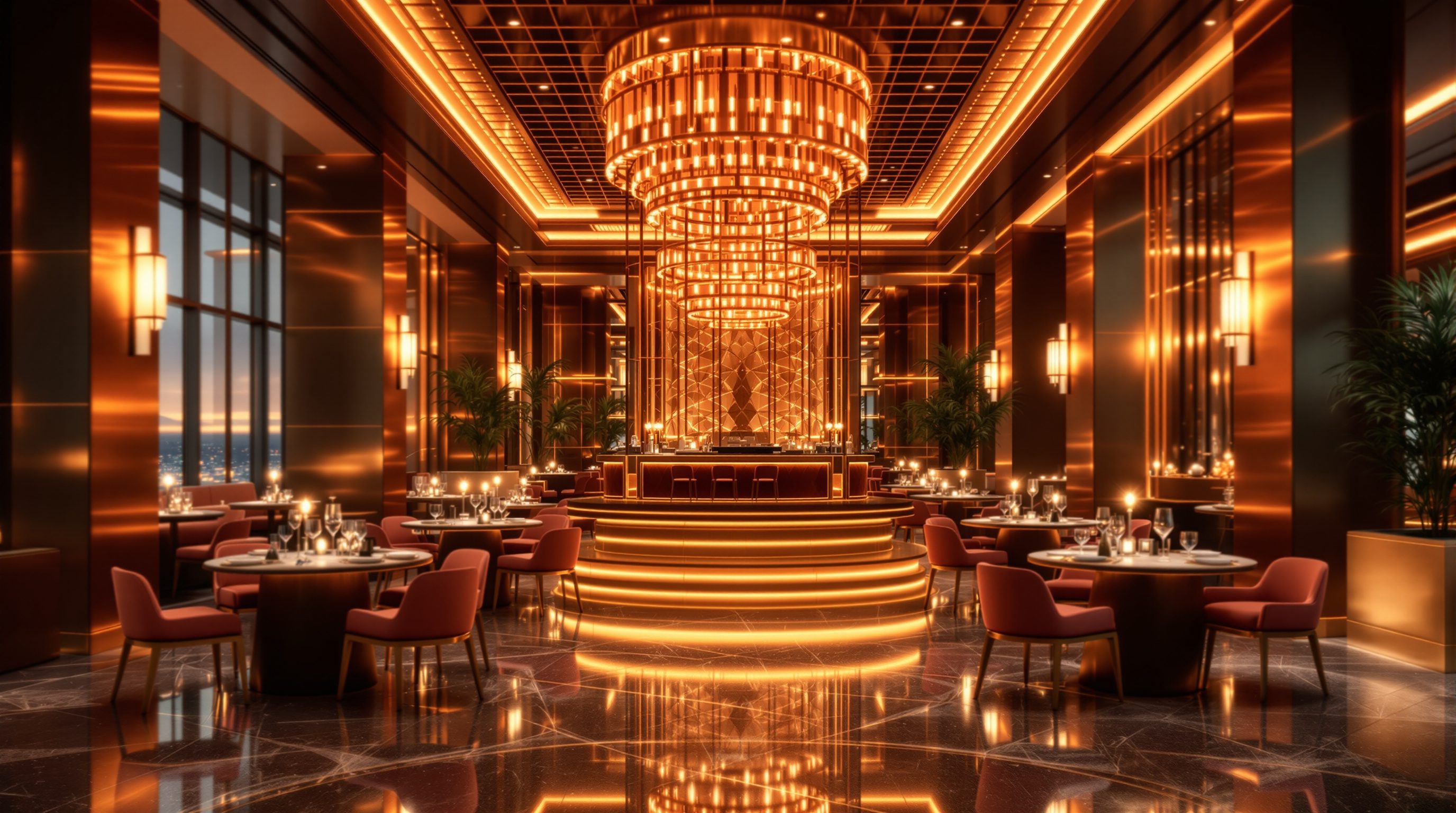
 Lesson 10.1
Lesson 10.1 · Delivery, Sustainability & the Future
Brand Standards & the Operator
Behind most hotels stand three parties and one thick rulebook - and learning to design a vivid welcome inside, and around, the operator's brand standards is a craft in itself
Before you draw a single line, someone hands you a manual hundreds of pages thick that tells you how wide the bed must be, how bright the lobby, and how the guest must be greeted. Welcome to designing a branded hotel.
Walk into two hotels of the same brand in two different cities and you feel, uncannily, the same welcome - the same ease at check-in, a bed and bathroom that behave the way you expect, a bar that hits the same note. That sameness is not an accident and it is not laziness; it is the whole promise of a brand, and it is enforced by a document most guests never hear of: the brand standards manual. It is the operator's detailed design-and-operations rulebook, and on a branded project it is the most powerful thing in the room - more powerful, often, than the designer's taste or even the owner's wishes.
To design hospitality in the real world you have to understand that most hotels are not one person's vision realised freely. They are the product of three parties - an owner who puts up the money and holds the asset, an operator who runs the hotel under a brand, and the designer who serves both - bound together by contracts and by that manual. This lesson maps that relationship, explains the spectrum from a free independent to a hard-branded flag, and - most usefully for you - shows how the best designers express a real, distinctive welcome inside the rulebook, and know when and how to push on it. It is the reality behind most of the glamour.
Three clients, one thick manual. Master the rules, then design in the gaps they leave.
What a brand standards manual actually is
A brand standards manual is the operator's codification of its brand, turned into design and operating rules. For a major hotel brand it can run to hundreds of pages across many volumes, and it reaches far further than a logo and a colour. It will typically specify room sizes and the key mix, the bed build down to the mattress and the number of pillows, the bathroom layout and amenities, the finishes and their durability, lighting levels in each space, signage and graphics, the technology in the room, acoustic performance, fire and life-safety minima, back-of-house provision and ratios, even the kitchen and laundry equipment. Increasingly it also scripts the experience itself: the arrival ritual, the scent in the lobby, the music playlist, the words staff use. It is, in effect, the brand made into a specification.
Why so prescriptive? Because a brand is a promise of consistency, and a guest pays for that promise. Someone booking a familiar flag in an unfamiliar city is buying the certainty that the bed, the shower, the breakfast and the safety will meet a known standard - and one bad property, leaking one-star reviews, damages every other hotel that shares the name. The manual is how the operator protects that promise across dozens or hundreds of properties it does not design individually. It also encodes hard-won operational knowledge: the ratios and provisions that let housekeeping and the kitchen actually work, learned across a whole portfolio.
For the designer, the manual is both a constraint and a gift. A constraint, obviously: large parts of your palette are decided before you start, and an operator's design team will review your drawings against the standard and send back anything that deviates. But it is also a gift - it carries real expertise, removes a thousand arguments, and gives you a tested baseline for the things that must simply work, freeing your energy for the things that make this property special. Treat the manual as you treat a building code in this course: principles and benchmarks to respect and verify against the current version, not something to fight for its own sake.
The manual decides the bed, the lux level, the scent. Your art is the welcome it cannot script.
Owner, operator, designer: who is really the client?
The single most confusing thing for a designer new to branded hospitality is working out who the client actually is - because there are at least three, and they do not always want the same thing. The owner (often an investor, a developer, a family business, a REIT) puts up the capital, owns the real estate, and ultimately pays your fee; their instinct is to control cost and maximise return. The operator (the brand - think of the global flags and the great Indian hotel companies) runs the hotel day to day under a management agreement or licenses its name under a franchise, and cares above all that the brand standard is met so the promise holds. You, the designer, are usually appointed by the owner - but your work must satisfy the operator, whose approval the owner needs.
That triangle is the source of most of the politics on a hospitality project. The owner may want to value-engineer a finish the operator insists on; the operator may demand a room count or an amenity the site cannot easily give; and you sit between them, translating. A skilled hospitality designer learns to read the room: to understand the owner's financial model and the operator's non-negotiables, to know which standards are genuinely fixed and which have flex, and to find the solution that lets the owner spend wisely while the operator signs off. You are not only a designer here; you are a diplomat and an interpreter.
The structures vary. In a managed hotel the operator runs everything and the standards are tightest. In a franchise the owner operates it themselves under the brand's name and rules. A soft brand or collection lets an individually designed hotel keep its own character while plugging into a big operator's booking system and loyalty programme - a middle path prized by designers because it loosens the rulebook. And an independent hotel has no operator brand at all: the owner carries every risk and every freedom. Knowing which model you are in tells you, before you draw anything, how much room you have.
Independent vs branded - the spectrum of freedom
Branded and independent are not two boxes but a spectrum, and where a project sits on it decides the whole character of your work. At one end, the pure independent - a founder-led boutique hotel, a family heritage property, a one-off restaurant - gives the designer the most freedom and the most exposure: no manual, no operator review, but also no safety net and no booking machine behind you. Every decision is yours to make and yours to get right, and the place lives or dies on the strength of a singular vision. This is where much of the most celebrated, most personal hospitality design happens.
At the other end, the hard-branded managed hotel gives you the least freedom and the most support. The manual is thick, the operator's review is exacting, and your job is to realise a known brand brilliantly on this particular site - expressing its identity through local material, light and story while hitting every standard. That is not a lesser craft; doing something fresh and site-specific inside tight rules is genuinely hard, and a dull box that merely complies is a failure even when it passes review. In between sit franchises, soft brands and collections, each loosening the rulebook a little in exchange for a little less of the machine.
India shows the whole spectrum vividly. The great heritage palaces turned hotels are near-independents whose character is the product; global flags run hard-branded properties in every metro; and homegrown operators run everything from tightly standardised business hotels to softly branded collections of characterful properties. For the designer, the lesson is to read the model first. Ask early: is there an operator, and on what terms; how thick is the manual; who approves the design; what is genuinely fixed. Your ambition, your process and even your fee should be calibrated to the answer - because designing an independent and designing a flag are, in practice, two different jobs wearing the same name.
Designing a welcome inside - and around - the rules
So how do you make something that feels alive and specific when a manual has pre-decided so much? The answer is the real skill of branded hospitality design, and it rests on a simple distinction: the manual mostly governs the performance and the kit - how big, how bright, how durable, how the bed is built - but it rarely owns the soul - the story of this place, the local material and craft, the art, the particular quality of light, the way the welcome feels here and nowhere else. The standard tells you the lobby must hit a certain lux level and hold certain functions; it does not tell you that your lobby borrows the rhythm of a local courtyard house, or smells faintly of a regional flower. That gap is your canvas.
The best designers work the rules in three moves. First, they master the manual so thoroughly that they know exactly where it is fixed and where it is silent, and pour creativity into the silences. Second, they express the brand rather than merely comply - a global brand means something, and a great property dramatises that meaning through local lens, so it is unmistakably the brand and unmistakably of this place. Third, they negotiate intelligently: when a standard genuinely fights the site or the concept, they go to the operator early with evidence and an alternative that still meets the intent, and win considered exceptions - a far better path than quietly breaking a rule and being caught at review.
Keep the course's through-line in view. A brand standard exists, ultimately, to protect the guest's experience - consistency is a kind of care. So treat the manual not as an enemy of the welcome but as one input to it, and hold yourself to the higher bar: not merely "does this pass the operator's review" but "does a tired traveller arriving here feel genuinely, specifically welcomed." Defer the binding specifics - fire and life-safety, food-safety, accessibility, systems capacities - to the current codes, the specialists and the manual itself. But never let compliance become the ceiling of your ambition. The rulebook sets the floor; the welcome is still yours to raise.
Brand standards manual (operator)
Room/key mix, FF&E, finishes, lighting levels, BOH ratios, service scripts
The operator's current manual governs; always work to the latest version and the operator's technical-services review. Illustrative benchmarks calibrate to the brand - never copy a figure between brands.
Fire & life-safety (NBC 2016)
Egress, compartmentation, detection - even where a brand sets its own minima
Statutory code and the fire authority prevail over any brand standard. Defer binding values to the current code and a life-safety specialist. See the Fire & Life-Safety course.
Accessibility & food-safety
Barrier-free provision; kitchen hygiene where the brand specifies equipment
Brand kit lists do not replace statutory accessibility and FSSAI/food-safety requirements; the stricter of brand and code applies. Defer dimensions to the standards and specialists.
Workshop — reverse-engineer a brand's standard
You cannot read a real brand standards manual (they are confidential), but you can infer one by observation - which is exactly how a designer learns what a brand will and will not allow. In this workshop you will deduce a brand's rulebook from its hotels, then design a move that honours the brand and the place at once.
Observation, research and a notebook - no drawing software needed, though a quick sketch of your move helps.
Goal: infer a brand's standards and find the room to design
Inputs: one hotel brand you can visit or research across 2-3 properties + this lesson + a notebook
Time: ~60 minutes
- 1Pick a brand present in more than one location (a global flag or an Indian operator). Gather what you can on two or three of its properties - your own stays, photos, reviews, the brand's own pages.
- 2List the CONSTANTS: everything that looks the same across the properties - the arrival sequence, the room and bathroom layout, the bed, the lighting mood, the materials, the service tone. These are almost certainly in the manual.
- 3List the VARIABLES: what changes property to property - the local art, a material, a motif, the building itself, a signature space. This is the room the manual leaves for place and designer.
- 4Infer three likely RULES (for example, a minimum room size, a lighting level, a mandated amenity) and mark each as probably-fixed or probably-flexible, with your reasoning.
- 5Design ONE move for a new property of this brand in a city you know: something that unmistakably expresses the brand AND could only be this place, using only the variables you identified. Sketch or describe it, and note which rule you might ask the operator to flex and the evidence you would bring.
You’ll walk away with
A one-page inferred brand standard: the constants, the variables, three deduced rules marked fixed or flexible, and one designed move that honours both the brand and the place - plus the one exception you would negotiate and why. Keep it as a model of how to read any operator before you design for them.
Three altitudes on the same idea
Read the band that fits you — or all three.
The operator's standards shape the base-build long before the interiors - so you must read the manual at concept, not hand-over. Room sizes and the key mix drive the floorplate and the tower; back-of-house ratios, kitchen and laundry provision, fire and life-safety minima and floor-to-floors are often set or strongly steered by the brand. Get these into the massing and the grid from day one, coordinate early with the operator's technical-services team and the specialists, and flag any clash between the standard and the site while it is still cheap to resolve. Treat brand minima like code minima: verify the current version, defer binding capacities to the consultants, and design the shell so the operator's promise can actually be delivered.
This is where you live: the manual governs the guest-facing interiors most tightly, and also where your art to transcend it matters most. FF&E spec, bed build, finishes, lighting levels, bathroom layout, amenities, signage - expect much of this to be pre-decided and reviewed against the standard. Your craft is to express the brand and the place through the freedoms the manual leaves: local material and craft, art, the quality of light, the story. Know the manual cold so you spend creativity where it is allowed, build a relationship with the operator's design reviewers, and bring them evidence-backed alternatives when a standard fights the concept. Aim past compliance to a welcome that could only be this property.
A surprise for most students: professional hospitality design is rarely a blank page - an operator's rulebook usually governs it, and learning to work within constraints is the real skill. Do not imagine this as a loss of creativity; designing something fresh inside tight rules is harder and more valuable than a free-for-all. Learn to ask, of any hotel, whether it is independent or branded and how hard-branded it is - you will start to see the manual's fingerprints everywhere. Practise the mindset: master the constraints, find the freedoms, express the brand through place, and judge your work by the guest's welcome, not merely by whether it would pass a review.
“A hotel's design is the creative vision of its designer (or its owner) - they decide how it looks and feels, the way an architect shapes a private house.”
Do it yourself
No tools needed - reason it through.
- 1What is a brand standards manual, and name four different kinds of thing it can specify.
- 2Who are the three parties behind most branded hotels, and what does each one want?
- 3Explain the difference between a managed hotel, a franchise, a soft brand and an independent in terms of how much freedom the designer has.
- 4Why is a brand so prescriptive about consistency - what is it protecting, and how does one bad property hurt the others?
- 5Describe the three moves a designer uses to create a distinctive welcome inside a brand's rulebook.
The one line to carry out
Peer-reviewed journals & authoritative standards
- 01Franchising and brand licensing — Wikipedia — Franchising, 2026.
- 02Brand and the promise of consistency — Wikipedia — Brand, 2026.
- 03The hotel manager and operator — Wikipedia — Hotel manager, 2026.
- 04Hotel rating and standards — Wikipedia — Hotel rating, 2026.
Knowing who the client is and what rulebook governs the work, we can follow the project itself - the long road from that first concept to the night the first guest arrives.
The author
Amogh N P
Architect, interior designer, and creative polymath. Studio Matrx began in his notebooks — his vision of design made honest, useful, and open to everyone. Its Academy is written and taught in his memory, and free, forever.
More about Amogh →