
 Lesson 1.3
Lesson 1.3 · Understanding the Existing Building
Spotting Problems - Damp, Cracks & Decay
A building in trouble speaks in symptoms - stains, cracks, soft timber, rusting steel - and the renovator's skill is to read those symptoms, resist the urge to treat them on sight, and diagnose the cause before a single repair is made
A damp patch, a crack, a patch of crumbling timber - these are not problems to be covered over, but messages to be decoded.
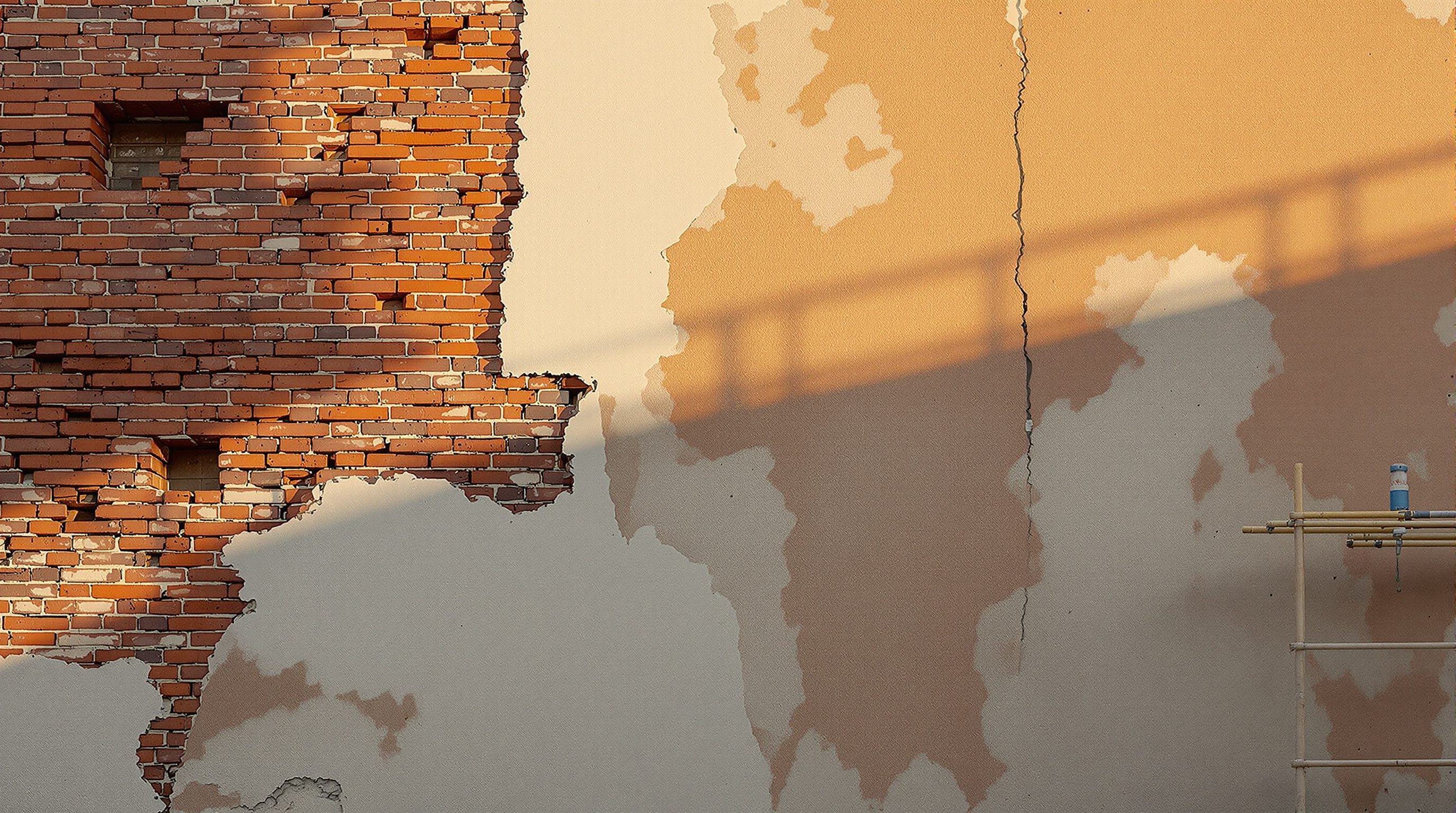
Older buildings, and plenty of younger ones, are full of symptoms: a brown tide-mark low on a wall, a diagonal crack over a doorway, a skirting board that crumbles at the touch, a rust stain weeping from a concrete ceiling. The untrained response is to treat what you can see - repaint the stain, fill the crack, replace the skirting - and move on. The trained response is to treat each symptom as a message about a cause you cannot yet see, and to read it carefully before deciding what, if anything, to do. This is the diagnosis discipline of the whole course, applied to the building's own complaints.
The governing rule is simple and unforgiving: diagnose the cause before you treat the symptom. A damp patch painted over returns, worse, because the water is still arriving. A crack filled without understanding why it opened will reopen, because whatever moved is still moving. This lesson teaches you to recognise the major categories of problem - the three kinds of damp, the spectrum from harmless to structural cracking, and the common forms of decay and corrosion - well enough to read the symptom intelligently and describe it precisely. What it will not do is let you self-diagnose the serious ones: damp investigation, structural cracking and significant decay are for a surveyor or structural engineer, and knowing which is which is the skill that matters most.
Every stain, crack and rotten board is a message. Read it, find the cause, fix the cause. Defer the serious diagnosis.
The three kinds of damp - and why the difference matters
Damp is the single most common and most misdiagnosed problem in existing buildings, and the reason is that three quite different things produce similar-looking stains - so the cure for one is useless, or harmful, for another. Learning to tell them apart by pattern, location and context is the first diagnostic skill a renovator needs.
Rising damp is groundwater drawn up into a wall by capillary action, through a missing, failed or bridged damp-proof course. Its signature is that it is low on the wall and stops at a fairly level height - a tide-mark, often around half a metre up, sometimes with a band of salts or crumbling plaster at the top edge. It is worst near the ground, affects ground-floor walls, and is made worse by raised external ground or a path that bridges the damp-proof course. Penetrating damp comes *inwards through the fabric* from outside - a leaking roof or gutter, a cracked render, a failed window seal, a burst or weeping pipe, driving rain on an exposed wall. Its signature is a localised patch that corresponds to a defect, often higher up or mid-wall, that worsens after rain and can appear anywhere the water gets in. Condensation, by far the commonest in modern homes and flats, is not water coming *in* at all but moisture in the indoor air condensing on cold surfaces - cold corners, behind furniture on an external wall, around windows - wherever warm, moist air (from cooking, bathing, drying clothes, and simply breathing) meets a cold enough surface and poor ventilation. Its signatures are black mould in cold corners, water running down windows, and a pattern that follows cold spots and poor airflow rather than any external defect.
Why labour the distinction? Because the treatments diverge completely and expensively. Rising damp may need the damp-proof course addressed and external ground lowered; penetrating damp needs the specific external defect found and repaired; condensation needs ventilation, heating and insulation - more airflow and warmer surfaces - and no amount of waterproofing will touch it. Get it wrong and you spend money injecting a wall that was actually suffering condensation, or painting over a leak that keeps arriving. And real buildings often suffer more than one at once, with salts and monsoon rain complicating the picture in Indian conditions. So read the pattern, note the context, and - for anything beyond the obvious - get a damp specialist or surveyor to diagnose before you spend, because misdiagnosed damp is one of renovation's classic money pits.
Rising = low tide-mark from the ground. Penetrating = patch from a defect, worse after rain. Condensation = mould on cold surfaces, poor airflow.
Cracks - harmless, or a warning?
Nearly every building has cracks, and the renovator's task is not to panic at all of them nor to ignore any of them, but to read them - because some are cosmetic and some are the building reporting movement in its load path. The reassuring truth is that most cracks are harmless: fine hairline cracks in plaster, cracks that appear as a building or an extension 'settles in' during its first couple of years, and cracks caused by the normal thermal and moisture movement of materials are usually cosmetic, confined to the finish, and stable. They can be monitored and, once proven stable, simply made good.
The cracks that warrant attention have a different character, and a few features raise the flag. Width: very fine cracks are usually cosmetic, while wider cracks (a common rule of thumb treats anything past a few millimetres as worth investigating, though width alone never decides it) deserve a closer look. Direction and shape: vertical hairlines are often benign, but diagonal cracks, tapering cracks (wider at one end), and 'stepped' cracks that follow the mortar joints in a staircase pattern frequently signal movement such as differential settlement. Path: a crack that runs *through* bricks or blocks, rather than around them in the mortar, suggests more serious force. Location: cracks radiating from the corners of openings, at changes in height or material, or where an extension meets the original, are worth noting. And above all, movement over time: a crack that is actively widening, or that reappears after being filled, is telling you the cause is still at work.
The crucial discipline is to record, not diagnose. Note each significant crack's location, direction, width (put a coin or ruler in the photo), path and whether it steps through mortar or cuts through brick; where you can, monitor it over weeks - a dated photograph, or a simple telltale across the crack - to see whether it is stable or moving. Then, for anything that looks structural - wide, diagonal, stepped, through-brick, growing, or accompanied by bulging walls, sloping floors or sticking doors - stop and hand it to a structural engineer. Cracking is the building's most important language, and while you can and should learn to read the obvious signs, the binding judgement of whether a crack is structural, what is causing it, and how to remedy it, is an engineer's work, not a guess from a photograph. The cost of that opinion is trivial beside the cost of treating a moving crack as a decorating job.
Hairline, stable, in plaster = usually fine. Wide / diagonal / stepped / through-brick / growing = STOP, get an engineer.
Decay and corrosion - when materials break down
Beyond damp and cracking, a building's materials can themselves break down, and the two you will meet most are timber decay and corrosion of embedded steel - both driven, almost always, by persistent moisture, which is why they so often accompany the damp you have already learned to read. Spotting them early, and understanding that they are consequences of a cause, is what keeps a small problem from becoming a structural one.
Timber decay is the rotting of wood by fungi that need moisture to live - so dry, well-ventilated timber does not rot, and timber that is rotting is, by definition, getting wet. The signatures are wood that is soft, spongy, darkened or crumbling, that may be cracked into cubes or carry a musty smell, and that gives way when probed with a screwdriver or a key. It attacks exactly where moisture lingers: embedded joist ends in damp walls, skirtings and door frames near rising or penetrating damp, timber under a leaking bathroom or flat roof, and poorly ventilated floor voids. Some forms spread aggressively through damp masonry and are serious; distinguishing the types, and judging whether structural timber is affected, is a job for a timber/damp specialist, but the renovator's contribution is early detection and, above all, finding and fixing the moisture source. India's additional hazard is the termite, which hollows out timber from within and leaves tell-tale mud tubes and a papery surface; a suspected infestation needs specialist treatment, not a DIY guess.
Corrosion mainly concerns the steel inside reinforced concrete. When water and air reach the reinforcing bars - through cracks, porous or carbonated concrete, or chloride contamination - the steel rusts, and because rust occupies far more volume than the steel it replaces, it pushes the surrounding concrete apart. The visible symptoms are rust-coloured staining, cracking that follows the line of a hidden bar, and 'spalling' where lumps of concrete detach and sometimes expose the rusting steel beneath - common on older RCC balconies, sunshades (chajjas), beams and flat-roof soffits, especially in coastal and polluted air. This is a genuinely structural matter: exposed, rusting reinforcement is losing the very thing that gives the concrete its strength, and its assessment and repair belong to a structural engineer. The renovator's job, once again, is to notice it, record it, resist the temptation to simply plaster over it, and get the right professional - because spalling concrete patched without treating the corrosion will spall again, and on a balcony or sunshade that is not merely a cosmetic failure.
Diagnose the cause, then treat - and know when to defer
Everything in this lesson converges on one rule that deserves to be stated on its own, because breaking it is the most expensive habit in renovation: diagnose the cause before you treat the symptom. A symptom - a stain, a crack, a patch of rot, a rust weep - is the visible end of a chain that runs back to a cause you usually cannot see: water arriving from somewhere, movement in the structure, a material breaking down. Treat the visible end alone and you have changed nothing about the cause, so the symptom returns - the damp bleeds back through the new paint, the filled crack reopens, the replaced timber rots again, the patched concrete spalls - only now it is hidden behind finished work and discovered later, at far greater cost. Worse, a covered symptom can let the underlying cause do real structural damage unseen.
The correct sequence mirrors the whole course. First observe and record the symptom precisely - what, where, how big, what pattern, and (crucially) what it correlates with: rain, a bathroom above, a cold corner, a nearby tree, a recent change. Then find the cause, which for the serious problems means bringing in the right professional: a damp specialist or building surveyor for persistent or puzzling damp; a structural engineer for any crack, movement or spalling that might be structural, and for embedded-steel corrosion; a timber/pest specialist for rot or termites. Only once the cause is understood do you fix the cause and then make good the symptom - in that order. This is not timidity; it is the difference between a repair that lasts and a cosmetic patch that fails.
Knowing the limits of your own diagnosis is the real competence here. You can and should learn to recognise the three damps, to read a crack's width, direction and path, and to spot soft timber and spalling concrete - that literacy lets you survey intelligently, describe problems accurately, and brief professionals well. But the binding diagnosis of damp, structural cracking, significant decay and corrosion is not yours to make, and confident self-diagnosis here is exactly the overreach this course warns against. The golden rule applies with full force: when in doubt about damp, movement or decay, stop and get a qualified surveyor or structural engineer - the opinion costs a fraction of the mistake. Read the symptoms; respect the causes; defer the diagnosis that matters.
Observe -> find the cause (often a professional) -> fix the cause -> make good. Never just cover the symptom.
Which kind of damp?
Rising vs penetrating vs condensation - and the cure
The three have different causes and opposite cures; misdiagnosis wastes money and the damp returns. For anything persistent or unclear, a damp specialist or building surveyor should diagnose before you spend.
Is this crack structural?
Wide, diagonal, stepped, through-brick or growing cracks; cracks with bulging/sloping/sticking
You record width, direction, path and movement; you do NOT judge significance. Any possibly-structural crack is a structural engineer's determination before any repair. Module 3.
Timber decay and termites
Soft, crumbling or musty timber; mud tubes; papery surfaces
Find and fix the moisture source, and get a timber/pest specialist for suspected rot or infestation - especially where structural timber or active termites may be involved.
Concrete spalling and rebar corrosion
Rust staining, cracking along bars, concrete lumps detaching (balconies, chajjas, beams, soffits)
Exposed rusting reinforcement is a structural matter - assessment and repair belong to a structural engineer. Patching over corrosion without treating it guarantees it spalls again.
Workshop - a symptom-and-cause log
This workshop builds the habit at the heart of the lesson: recording symptoms precisely and reasoning toward - without prematurely deciding - their causes. Using a real building, you will log its visible problems and, for each, propose a likely cause and the right professional to confirm it.
A phone camera, a coin or small ruler for scale, a screwdriver or key for probing timber, and a notebook. No invasive opening-up, no damp meters relied on alone - and nothing here replaces a professional diagnosis.
Goal: a symptom-and-cause log for a real building, with each serious item flagged for the right professional
Inputs: a building you can observe, a phone camera, a coin or small ruler for scale, a notebook
Time: ~50 minutes
- 1Hunt for damp and classify it by PATTERN: for each damp area, note whether it reads as rising (low, level tide-mark), penetrating (a patch matching an external defect, worse after rain) or condensation (mould on cold surfaces, poor airflow) - and write what you would fix for that cause.
- 2Log every notable crack: location, direction, approximate width (photograph with a coin or ruler for scale), whether it steps through mortar or cuts through brick, and whether anything suggests it is moving (reopened filler, sticking doors, sloping floor).
- 3Check timber and concrete: probe accessible timber (skirtings, frames, any exposed joist) for softness and note any musty smell or termite mud tubes; look at any RCC balcony, sunshade or soffit for rust staining, cracking along a bar line, or spalling.
- 4For EACH symptom, write a two-column line: 'most likely cause' and 'who confirms it' (yourself / damp specialist / structural engineer / timber-pest specialist). Be honest about which you cannot diagnose yourself.
- 5Pick the single most serious item and draft the two or three sentences you would send the relevant professional, describing the symptom precisely enough that they know what to come and look at.
You’ll walk away with
A symptom-and-cause log: each visible problem with its precise description and photograph, a proposed likely cause, and the professional who must confirm it - plus one drafted brief to a surveyor or engineer for the most serious item. Keep it with your condition survey.
Three altitudes on the same idea
Read the band that fits you — or all three.
Your reputation rests on not designing beautiful work over undiagnosed defects - so the condition survey's symptoms must drive the scope before the drawings do. Read damp, cracking, decay and spalling as information about causes, and commission the right investigation - structural engineer for movement and embedded-steel corrosion, damp/timber specialist for persistent damp and rot - before you finalise a scheme or a cost. On RCC buildings, treat spalling balconies, chajjas and beam soffits as structural until an engineer says otherwise, and never let a finishes package hide an active cause. Your value is sequencing diagnosis ahead of design and specifying repairs that address the cause, with the specialist's report behind them - not cosmetic patches that will fail and take your detailing with them.
Damp, cracks and decay are the silent killers of interior work, because a finish applied over an unaddressed cause fails fastest of all - and it is your finish that gets blamed. Train your eye to spot the three damps (especially condensation, which plagues modern flats and is cured by ventilation and warmth, not waterproofing), to flag cracks that look more than cosmetic, and to notice soft timber and rust weeps. Then resist the client's pressure to 'just make it look good now': insist the cause is found and fixed first, bringing in a surveyor or engineer for anything structural or persistent. Your craft is finishes that last, and finishes only last on a sound, dry, diagnosed substrate - so protect your work by refusing to cover an undiagnosed symptom.
Learning to read a building's symptoms is detective work, and it is one of the most satisfying skills this course teaches - but its first lesson is humility. Practise naming what you see: is that damp rising (low tide-mark), penetrating (a patch from a defect) or condensation (mould on cold surfaces)? Is that crack fine and stable, or wide, diagonal and stepped? Is that timber sound or soft; is that concrete staining and spalling? Build the vocabulary of symptoms and their likely causes. Then internalise the rule that separates a competent renovator from a dangerous one: you recognise and record, but the binding diagnosis of damp, structural cracking and significant decay belongs to a surveyor or engineer. Reading symptoms well, and knowing when to defer, is exactly the judgement real practice rewards.
“There is a damp patch and a crack in the wall - I will just treat the wall with a damp-proof coating and fill the crack with filler, then repaint. Problem solved, and cheaply too.”
Do it yourself
No building needed - reason it through.
- 1Name the three kinds of damp and give the signature pattern of each, then say why telling them apart matters.
- 2Which cure suits condensation, and why would a waterproof coating fail to solve it?
- 3List four features of a crack that would make you suspect it is structural rather than cosmetic.
- 4Why are timber decay and embedded-steel corrosion both, at root, moisture problems - and what are the visible signs of each?
- 5State the golden sequence for dealing with any symptom, and name one problem you would always defer to a structural engineer.
The one line to carry out
Peer-reviewed journals & authoritative standards
- 01Damp (structural) — Wikipedia - Damp (structural), 2026.
- 02Rising damp — Wikipedia - Rising damp, 2026.
- 03Dry rot — Wikipedia - Dry rot, 2026.
- 04Subsidence — Wikipedia - Subsidence, 2026.
- 05Efflorescence — Wikipedia - Efflorescence, 2026.
Reading symptoms is far easier when you know what kind of building you are looking at - because different eras were built differently and suffer characteristic problems. Next we use the age and era of a home as a diagnostic shortcut to how it was built and what typically goes wrong.
The author
Amogh N P
Architect, interior designer, and creative polymath. Studio Matrx began in his notebooks — his vision of design made honest, useful, and open to everyone. Its Academy is written and taught in his memory, and free, forever.
More about Amogh →