
Green Building Codes & Certification
The rating systems — and rating vs code.
Buildings consume more than a third of the world's energy, and a whole machinery has grown to push them lower. Learn what a green building is and its benefits; the major rating systems — LEED, GRIHA and IGBC in focus, with BREEAM, CASBEE, Green Star, Estidama Pearl and WELL abroad; and the distinction that organises the field — a voluntary, aspirational rating versus a mandatory, minimum code. Try the rating-system comparator.
Learning objectives
By the end of this lesson, you will be able to — mapped to the course outcomes for Green Buildings & Code Compliance:
Define a green building and state its environmental, economic and social benefits.
Identify the major rating systems and what each assesses.
Distinguish a voluntary rating from a mandatory code.
Explain why a green certificate is not a guarantee of performance.
Green building, rating & code
A green building cuts lifetime energy, water and material impact while staying healthy; a voluntary rating awards tiers above the mandatory code floor — and a certificate is a predicted-design proxy, not proof.[1, 3, 4]
A green building, and the stakes
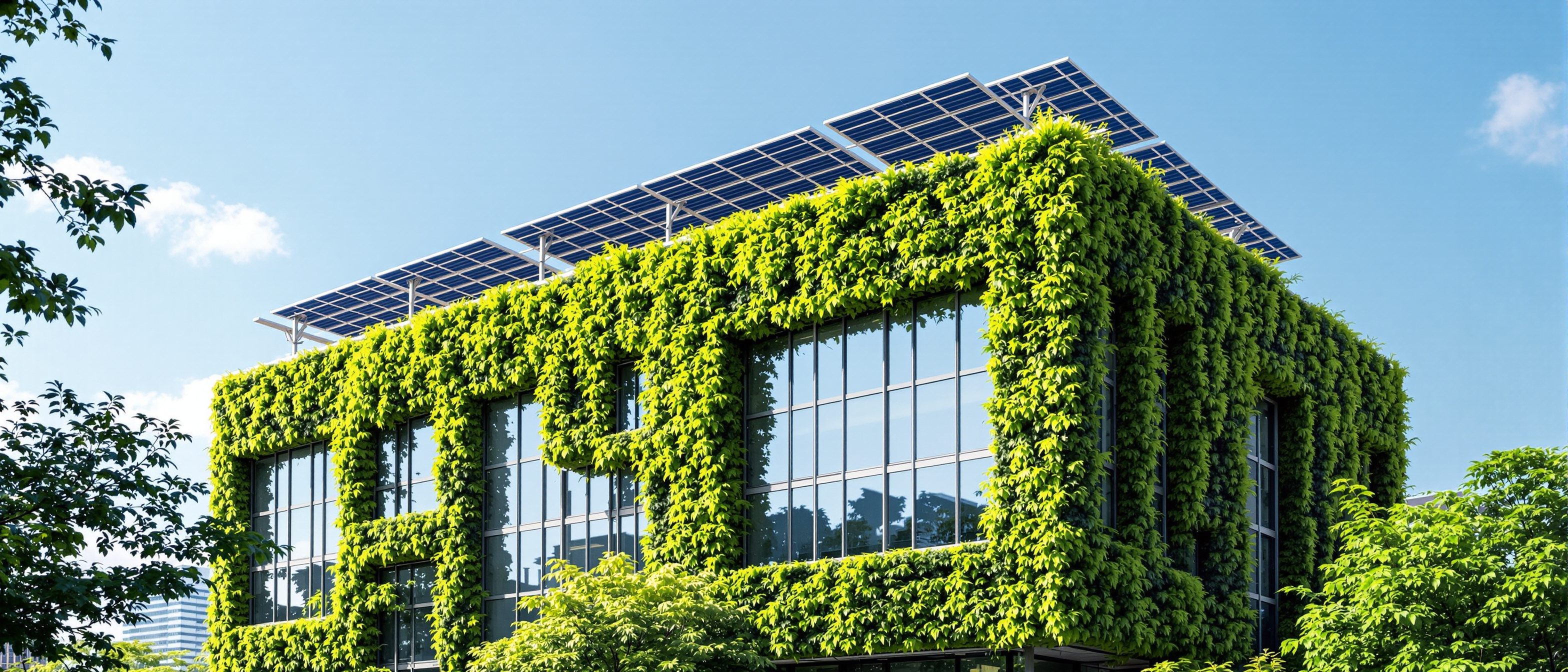
A GREEN BUILDING reduces its environmental impact across its life — energy, water, materials, waste, indoor environment and site — while remaining healthy and comfortable to use. The stakes are large: buildings account for about 34–37% of global energy use and energy-related emissions (UNEP/IEA), so even small per-building gains compound enormously. The BENEFITS are a triple bottom line — environmental (lower energy/water/carbon), economic (lower running cost, higher value) and social (healthier, more productive occupants).[1, 5]
The world's rating systems
India's three — LEED, GRIHA (national, stars) and IGBC (CII, levels) — sit among the world's systems from BREEAM to WELL, each covering many building types including existing buildings.[2]
LEED, GRIHA, IGBC
Three systems dominate Indian practice. LEED (USGBC, USA, the world's most-used) is applied widely in India. GRIHA is India's NATIONAL system (TERI + MNRE), performance- and climate-based, rated 1–5 stars. IGBC (Confederation of Indian Industry) is LEED-DERIVED and India-adapted, rated Certified/Silver/Gold/Platinum, with 30-plus schemes for homes, factories, townships and more. MISCONCEPTION→correct: 'GRIHA and IGBC are the same' — GRIHA is national/TERI-MNRE with stars; IGBC is CII, LEED-derived, with Certified-to-Platinum levels.[2, 3]
Compare the systems
Pick a rating system and read its origin, administering body, certification levels and focus — and see why their scales (stars, levels, Pearls, BEE ratio) cannot be naively cross-mapped.
Rating systems · pick one
LEED — Leadership in Energy and Environmental Design
Levels: Certified · Silver · Gold · Platinum (out of 110 pts)
Focus: The world's most widely used voluntary green-building rating system; many building-type schemes (BD+C, ID+C, O+M, Homes, Cities).
Don't cross-map levels naively — BREEAM, LEED, GRIHA, CASBEE and Pearl all use different scales.
At a glance
| Aspect | Rating | Code |
|---|---|---|
| Nature | Rating: voluntary, aspirational | Code: mandatory, a floor |
| Result | Rating: tiers / stars | Code: pass / fail |
| Indian examples | Rating: GRIHA, IGBC, LEED | Code: ECBC, ECO-NIWAS Samhita |
| Body | GRIHA: TERI/MNRE · IGBC: CII | ECBC: BEE (Ministry of Power) |
| Guarantee? | Predicted design + documentation | Not a guarantee of real performance |
Key terms
A building that reduces its lifetime environmental impact while staying healthy to use.
A voluntary, tiered scheme awarding levels/stars for going beyond the minimum.
A mandatory, pass/fail minimum standard (e.g., ECBC) where adopted.
The difference between a building's certified design and its real operating performance.
Environmental, economic and social benefits considered together.
A rating of human health and wellbeing — distinct from environmental ratings.
Studio task
Pick a green building you have heard of and find which rating(s) it holds. Using the comparator, write three sentences on what that rating measures, who certifies it, and what its top level means. Then explain in one line why holding a certificate does not by itself prove the building is low-energy in operation.
Self-assessment
1. The key difference between ECBC and LEED is that —
2. GRIHA differs from IGBC because GRIHA is —
3. The WELL Building Standard primarily rates —
Recap
References & further reading
- [1]UNEP Global Status Report for Buildings and Construction / IEA — buildings' share of energy and emissions.
- [2]USGBC (LEED), GRIHA Council, IGBC/CII, BRE (BREEAM), IBEC (CASBEE), GBCA (Green Star), IWBI (WELL) — official rating-system documentation.
- [3]GRIHA Council, GRIHA v2019 Manual; IGBC rating-system overviews — the Indian systems.
- [4]Bureau of Energy Efficiency (BEE) — Energy Conservation Building Code (ECBC) 2017 and ECO-NIWAS Samhita.
- [5]TERI / MNRE green-building resources and case studies — Indian context.
Further reading
- GRIHA Council — GRIHA v2019 Manual.
- USGBC — LEED v4.1 Reference Guide.
- Nayak & Prajapati — Handbook on Energy Conscious Buildings (IIT-B / MNRE).
Sources gathered and fact-checked June 2026. Published values vary by source, sample and method — treat as indicative and confirm against the cited standard before structural use.
The author
Amogh N P
Architect, interior designer, and creative polymath. Studio Matrx began in his notebooks — his vision of design made honest, useful, and open to everyone. Its Academy is written and taught in his memory, and free, forever.
More about Amogh →