
Green Building Case Studies & Design
Indian exemplars — and how the rating shapes the design.
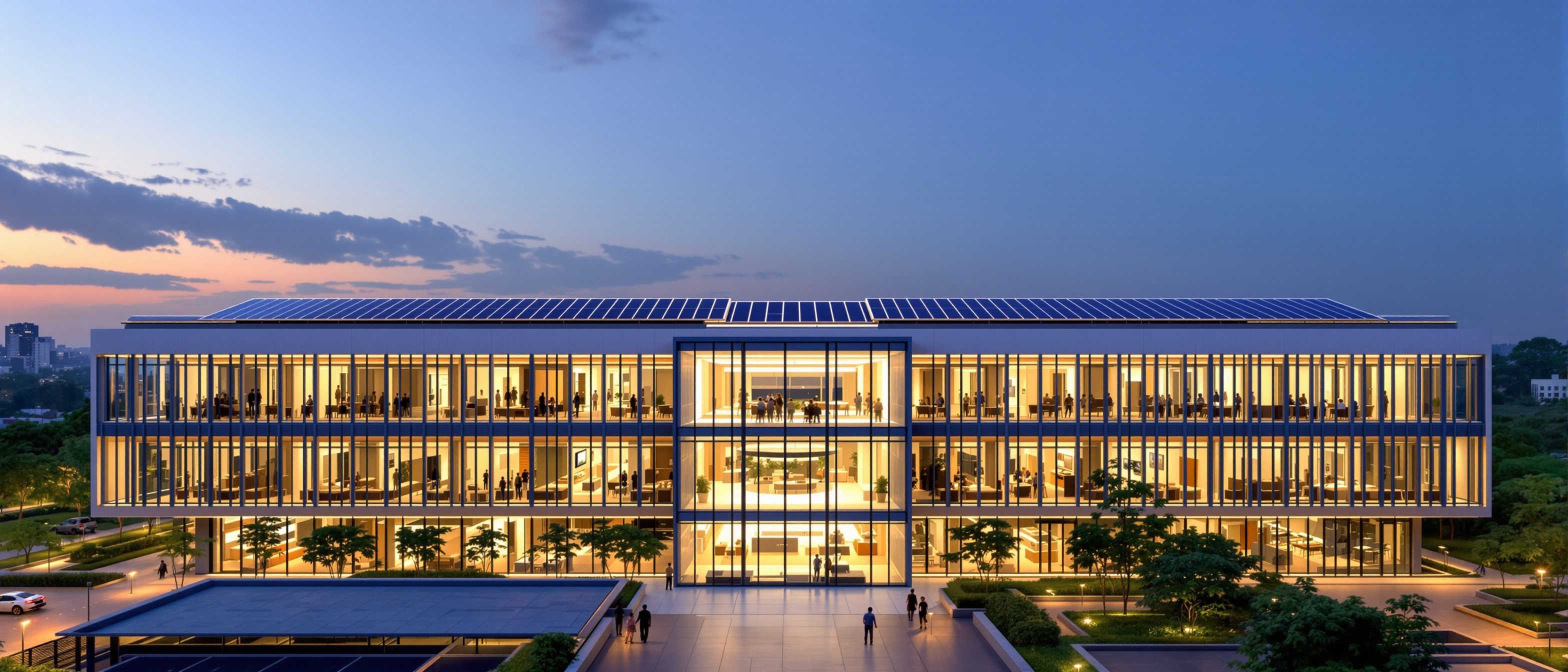
Ratings come alive in real buildings. Learn India's landmark green buildings and the choices behind their certificates — the CII–Sohrabji Godrej Green Business Centre (India's first LEED Platinum, and the first outside the USA, 2003); the ITC Green Centre; Suzlon One Earth; and Indira Paryavaran Bhawan (GRIHA 5-star, India's first net-zero government building). Then green-design requirements pulled together — and the honest difference between a high rating and net-zero performance.
Learning objectives
By the end of this lesson, you will be able to — mapped to the course outcomes for Green Buildings & Code Compliance:
Read India's landmark green buildings and their ratings.
Trace the design choices that earned each certificate.
Pull together green-building design requirements.
Distinguish a high rating from genuine net-zero performance.
India's landmark green buildings
From the first LEED Platinum outside the USA (Godrej GBC, 2003) to India's first net-zero government building (Indira Paryavaran Bhawan, EPI ≈ 24), the exemplars share the same green-design moves.[1, 2, 3, 4]
Godrej GBC & ITC
Two buildings put Indian green building on the world map. The CII–SOHRABJI GODREJ GREEN BUSINESS CENTRE in Hyderabad (architect Karan Grover, 2003) was India's FIRST LEED Platinum building — and the first LEED Platinum building ANYWHERE outside the USA — combining a courtyard, heavy shading, a green roof and efficient systems; it later reached net-zero. The ITC GREEN CENTRE, Gurgaon (2004) was, at the time, the largest LEED Platinum building in the world, saving over half its energy versus a conventional baseline.[1, 2]
Green design & the honest caution
The ratings reward a recurring set of design requirements — shaded daylit form, efficient systems, renewables, water reuse, healthy air — but a high rating is not the same as a measured net-zero energy balance.[1, 5]
What the ratings ask for
Across the case studies the same design moves recur — and they are, in effect, the green design REQUIREMENTS the ratings reward: a climate-responsive, well-shaded, daylit form; a controlled window-to-wall ratio; an efficient envelope, HVAC and lighting; on-site renewable energy; rainwater harvesting and water reuse; low-impact and local materials; healthy indoor air; and metering to prove it. Green design is not a bolt-on; it is the brief, set early, when the cost of getting it right is lowest.[1, 5]
At a glance
| Building | Rating | Note |
|---|---|---|
| CII Godrej GBC | First LEED Platinum (2003) | First outside the USA |
| ITC Green Centre | LEED Platinum (2004) | Then world's largest |
| Suzlon One Earth | LEED Platinum | + GRIHA 5-star |
| Indira Paryavaran Bhawan | GRIHA 5-star + LEED Platinum | First net-zero govt building, EPI ≈ 24 |
| High rating | Scored well on criteria | ≠ net-zero (a separate claim) |
Key terms
India's first LEED Platinum, and the first outside the USA (Hyderabad, 2003).
GRIHA 5-star; India's first net-zero government building (Delhi, 2014); EPI ≈ 24.
A building generating as much energy as it uses over a year — a measured claim.
Climate-responsive form, efficient envelope/systems, renewables, water and healthy air.
A high score against criteria vs measured energy balance — not the same.
The five elements; Indira Paryavaran Bhawan's five blocks are named for them.
Studio task
Pick one of the four exemplar buildings and list five design choices that earned its rating, mapping each to a credit category (energy, water, materials, indoor environment, site). Then explain, in two sentences, what extra it would take for a Platinum or 5-star building to also be NET-ZERO — and why most certified buildings are not.
Self-assessment
1. India's first LEED Platinum building (and the first outside the USA) is —
2. Indira Paryavaran Bhawan is notable as —
3. A LEED Platinum or GRIHA 5-star building is —
Recap
References & further reading
- [1]USGBC / IGBC project profiles — CII–Sohrabji Godrej Green Business Centre, ITC Green Centre, Suzlon One Earth.
- [2]CII–IGBC — Indian green-building case studies and certification records.
- [3]GRIHA Council / MNRE — Indira Paryavaran Bhawan, Suzlon One Earth case studies.
- [4]Central Public Works Department (CPWD) — Indira Paryavaran Bhawan net-zero design and performance data.
- [5]TERI / BEE — green-building design guidelines and energy-conscious design.
Further reading
- CII–IGBC — Green Building case-study compendium.
- GRIHA Council — GRIHA exemplary-project case studies.
- Nayak & Prajapati — Handbook on Energy Conscious Buildings.
Sources gathered and fact-checked June 2026. Published values vary by source, sample and method — treat as indicative and confirm against the cited standard before structural use.
The author
Amogh N P
Architect, interior designer, and creative polymath. Studio Matrx began in his notebooks — his vision of design made honest, useful, and open to everyone. Its Academy is written and taught in his memory, and free, forever.
More about Amogh →