
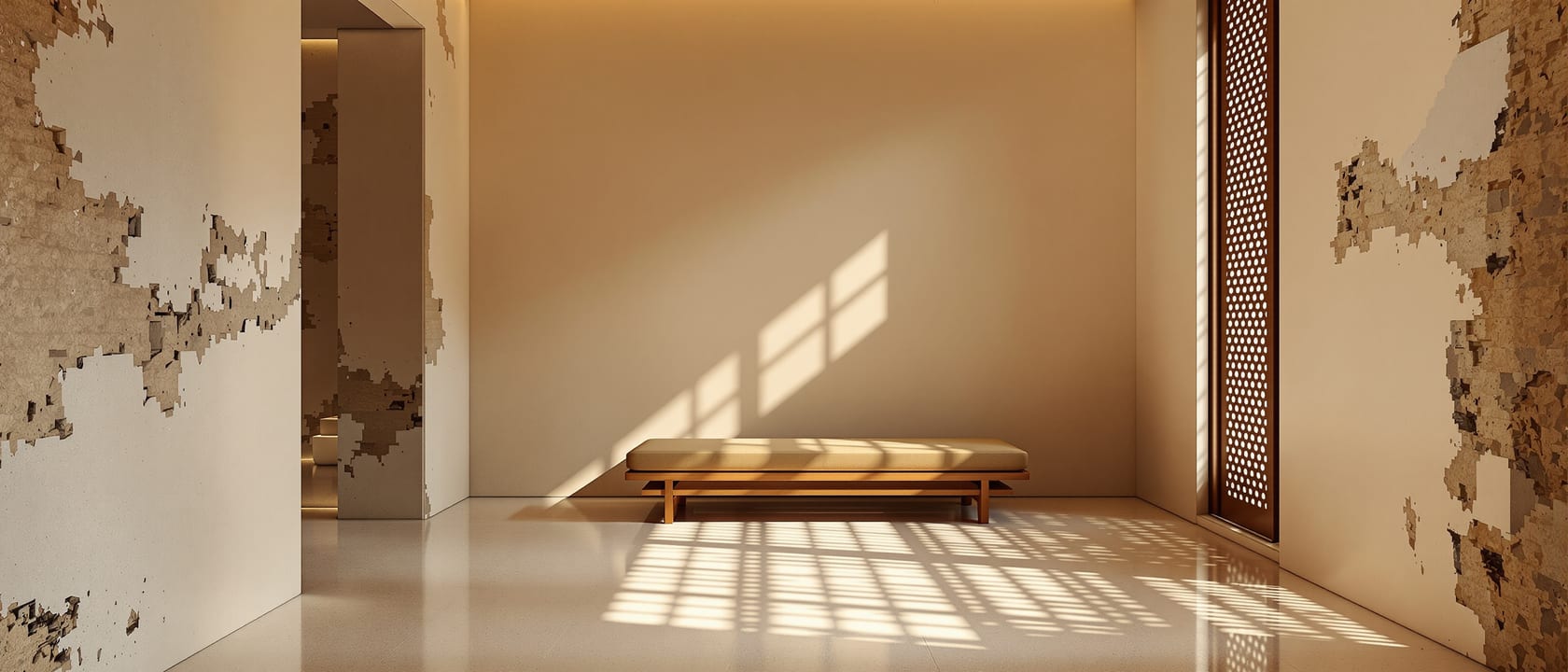
Contemporary Indian Interiors
Liberalisation, the handmade-modern turn, and the identity question.
The hinge is 1991 liberalisation, which floods in the glass corporate office, branded retail, the mall and boutique hospitality — and with them global interior norms. The defining tension is globalisation versus identity, and the powerful counter-movement is the handmade-modern / new-vernacular turn: a return to craft, local material and climate, deployed with contemporary rigour. Three threads — craft as design content, sustainability and adaptive reuse, and the identity spectrum from kitsch pastiche to rigorous new-vernacular.
Learning objectives
By the end of this lesson, you will be able to — mapped to the course outcomes for Evolution of Interiors II:
Explain how 1991 liberalisation reshaped Indian interior programmes and norms.
Describe the handmade-modern / new-vernacular turn and its leading practices.
Assess craft revival, sustainability and adaptive reuse as contemporary strategy.
Locate work on the identity spectrum and present contested cases as live debates.
The handmade-modern turn
Liberalisation’s global interiors, answered by a return to the hand of the maker, local material and passive climate — attributed to practices, not lone heroes.[1, 2]
Global interiors arrive
The hinge is 1991 ECONOMIC LIBERALISATION. New capital and new programmes flood in — the glass CORPORATE OFFICE and IT campus, branded RETAIL and the mall, five-star and boutique HOSPITALITY, the branded urban APARTMENT and the airport — and with them arrive GLOBAL interior norms (open-plan offices, hotel-brand standards, imported systems furniture). The defining tension of contemporary Indian interior design is therefore GLOBALISATION vs. IDENTITY: does an Indian interior in the 2020s look like an interior ANYWHERE, or does it carry something rooted? The vast middle of the field is globally-generic corporate and retail interiors — which is exactly what the new-vernacular movement reacts against.[1, 2]
Three threads for a designer
Craft as design content, sustainability and adaptive reuse as environmental strategy, and the identity spectrum — with Central Vista, the IIM-A interventions and the Hall of Nations demolition held as live debates, not verdicts.[3, 4]
Recovery, not import
Two threads run together. The REVIVAL OF CRAFT in the interior is a conscious re-engagement with Channapatna lacquerware, Athangudi tiles, araish/lime, Kutch textiles, terracotta, Longpi stoneware and handmade brass — as design CONTENT, not nostalgia, and often as artisan-livelihood and low-carbon strategy (connecting directly to Unit II). SUSTAINABILITY, passive climate and ADAPTIVE REUSE bring the indigenous devices back as environmental strategy — jaali skins, courtyards, stepwell-cooling and thermal mass (Pearl Academy) — plus the reuse of colonial and industrial fabric (Bikaner House Delhi; the Dr. Bhau Daji Lad Museum restoration, Mumbai; forts-to-hotels like Alila Fort Bishangarh; mills-to-malls in Mumbai). Frame sustainability as RECOVERY of Units I–II devices, not a Western import.[1, 4]
The whole arc, unbroken
Return to the explorer and trace the through-line — courtyard, jaali, floor-culture and the ordering grid, running from the temple to the present.
Indian style explorer · the interior through time
Buddhist rock-cut
c. 2nd c. BCE – 7th c. CE
- The idea
- Interiors SUBTRACTED from living rock — the chaitya prayer-hall and the vihara monastery.
- The interior
- A barrel-vaulted hall imitating lost timber, a stupa to circumambulate, and (at Ajanta) walls of immersive mural.
- Exemplars
- Karla chaitya · Ajanta · Ellora Kailasa
A handful of Indian devices — the courtyard, the jaali, floor-culture and the ordering grid — run unbroken from the temple to the present.
At a glance
| Aspect | One side | The other |
|---|---|---|
| Contemporary Indian interior | Myth: Mughal/'ethnic' pastiche for hotels | Reality: that is one pole; the serious field is new-vernacular |
| Studio Mumbai | Myth: one architect's vision | Reality: a workshop-collective; authorship is shared |
| Reviving craft | Myth: nostalgic, anti-modern | Reality: a contemporary material, livelihood and low-carbon strategy |
| Sustainable Indian interiors | Myth: a Western import | Reality: recovery of indigenous devices (jaali, court, stepwell-cool) |
| Central Vista / Hall of Nations | Myth: settled 'improvements' / still standing | Reality: live, contested debates — flag, don't adjudicate |
Key terms
The economic hinge that brought global programmes (office, mall, hotel, airport) and norms into the Indian interior.
The counter-movement returning to craft, local material and climate with contemporary rigour.
A craftsman-collective that designs by hand-building on site — the interior as artisanal object.
Rahul Mehrotra's idea of the informal, temporary, ever-shifting Indian city.
Re-inhabiting colonial/industrial fabric (forts-to-hotels, mills-to-malls) — sustainability as recovery.
Global-generic ↔ kitsch-national ↔ rigorous new-vernacular — a lens for locating contemporary work honestly.
Study task
Find one recent Indian interior you admire and trace its lineage back through this course — does it use the courtyard, the jaali, floor-culture, or the ordering grid? Then write a short, honest paragraph placing it on the identity spectrum from kitsch-national pastiche to rigorous new-vernacular, and say what makes the difference.
Self-assessment
1. The economic event that reshaped contemporary Indian interior programmes was —
2. Studio Mumbai's design method is distinctive because it —
3. Contested cases like Central Vista and the Hall of Nations demolition should be taught as —
Recap
References & further reading
- [1]Rahul Mehrotra, Architecture in India Since 1990 — the essential contemporary survey by a practitioner-scholar.
- [2]Peter Scriver & Amit Srivastava, India: Modern Architectures in History — carries the story credibly to the present.
- [3]Marg / Architecture + Design (A+D India) / Domus India / AD India — current journals for project attributions and interviews (verify each project).
- [4]Kaiwan Mehta (editor, Domus India) — critical contemporary framing; monographs on Studio Mumbai (2G / El Croquis) and Studio Lotus.
Further reading
- Rahul Mehrotra — Architecture in India Since 1990.
- Peter Scriver & Amit Srivastava — India: Modern Architectures in History.
- 2G / El Croquis — Studio Mumbai (Bijoy Jain) monograph issues.
Sources gathered and fact-checked June 2026. Published values vary by source, sample and method — treat as indicative and confirm against the cited standard before structural use.
The author
Amogh N P
Architect, interior designer, and creative polymath. Studio Matrx began in his notebooks — his vision of design made honest, useful, and open to everyone. Its Academy is written and taught in his memory, and free, forever.
More about Amogh →