
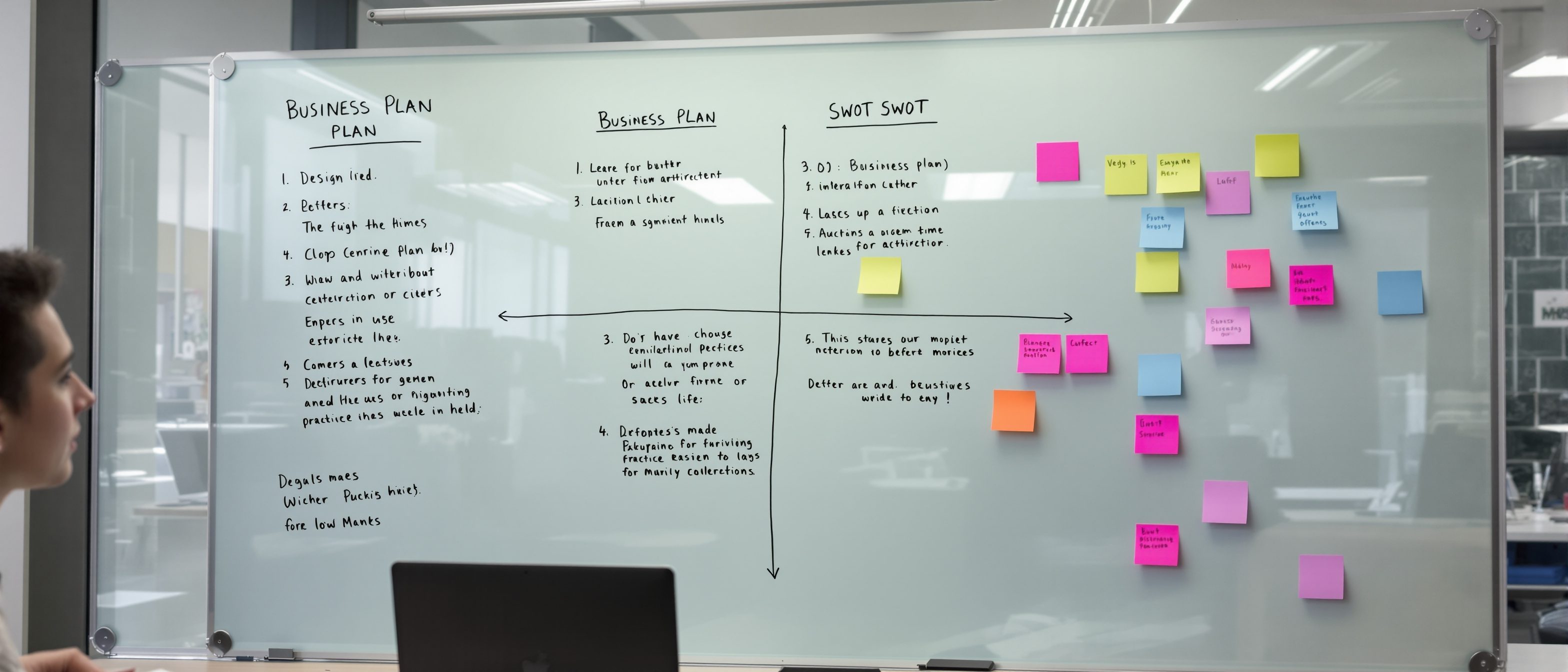
Business Planning & Strategy
Turning an idea for a practice into a venture.
An idea is not a business until it has a plan. Learn the components of a business plan that turn "I want to start a firm" into something fundable; SWOT analysis — reading your strengths, weaknesses, opportunities and threats honestly; project and venture feasibility; and the start-up ecosystem of incubators, mentors, finance and networks a new practice can draw on.
Learning objectives
By the end of this lesson, you will be able to — mapped to the course outcomes for Entrepreneurship Skills for Architects:
List and explain the components of a business plan.
Conduct a SWOT analysis for a practice.
Test the feasibility of a venture.
Describe the start-up ecosystem a new practice can use.
The plan & the SWOT
A business plan clarifies your thinking, not just a bank's; and a SWOT, done honestly, turns vague worry into a strategy — build on strengths, hedge weaknesses, seize opportunities.[1]
From idea to venture
A BUSINESS PLAN turns an idea into a venture you can test, fund and run. Its components: an executive SUMMARY; the CONCEPT (what the practice does and for whom); the MARKET (who the clients are, how big, who the competitors are); the SERVICES and what makes them distinct; the MARKETING approach; the TEAM and structure; the FINANCIALS (costs, revenue, break-even, funding need); and the MILESTONES. Even a one-person practice benefits from writing it — it forces honest thinking. MISCONCEPTION→correct: 'a business plan is just for raising money' — its real value is clarifying YOUR thinking; the plan is a tool to think with, useful even if you never show it to a bank.[1, 2]
Feasibility & the ecosystem
Feasibility tests market, money, delivery and legality before you commit; and a new practice draws on the start-up ecosystem — incubators, mentors, finance and networks — to share the risk.[2, 3]
Will it actually work?
FEASIBILITY tests whether the venture can really succeed before you commit. It asks: is there a MARKET (enough clients who will pay), is it FINANCIALLY viable (will the revenue exceed the costs with a margin), is it OPERATIONALLY possible (can you deliver with the team and resources), and is it LEGALLY clear? A feasible idea that you can deliver and that pays is a business; an exciting idea that fails any of these is a hobby. MISCONCEPTION→correct: 'passion is enough to start' — passion is necessary but not sufficient; a venture that is not feasible (no market, no margin) will exhaust the passion and the savings. Test first.[2]
At a glance
| Aspect | Detail | Note |
|---|---|---|
| Idea | A wish | Not yet a business |
| Business plan | Concept → finances → milestones | A tool to think with |
| SWOT | Internal S/W, external O/T | Derive a strategy, not a list |
| Feasibility | Market + margin + delivery + legal | Test before committing |
| Ecosystem | Incubators, mentors, finance | Share the risk and knowledge |
Key terms
The concept, market, services, team, finances and milestones of a venture.
Strengths, Weaknesses (internal), Opportunities, Threats (external).
Is there a market, a margin, the ability to deliver, and legal clarity?
The point where revenue covers costs — a key plan number.
Incubators, mentors, finance, co-working and networks a venture can use.
Funding a venture from its own revenue and the founder's savings.
Practice exercise
Do a real SWOT for a practice you might start: two items in each box, and one strategy you would derive (match a strength to an opportunity). Then list the four feasibility tests and answer each honestly for your idea. Note one start-up scheme or incubator you could approach in India.
Self-assessment
1. In a SWOT analysis, 'Opportunities' and 'Threats' are —
2. The real value of writing a business plan is —
3. A venture's feasibility depends on —
Recap
References & further reading
- [1]Kuratko, Entrepreneurship — the business plan and SWOT analysis.
- [2]Barringer, Entrepreneurship: Successfully Launching New Ventures — feasibility analysis.
- [3]Start-up India / MSME resources — incubators, finance and the Indian start-up ecosystem.
Further reading
- Kuratko — Entrepreneurship: Theory, Process, and Practice.
- Barringer — Entrepreneurship: Successfully Launching New Ventures.
- Drucker — Innovation and Entrepreneurship.
Sources gathered and fact-checked June 2026. Published values vary by source, sample and method — treat as indicative and confirm against the cited standard before structural use.
The author
Amogh N P
Architect, interior designer, and creative polymath. Studio Matrx began in his notebooks — his vision of design made honest, useful, and open to everyone. Its Academy is written and taught in his memory, and free, forever.
More about Amogh →