
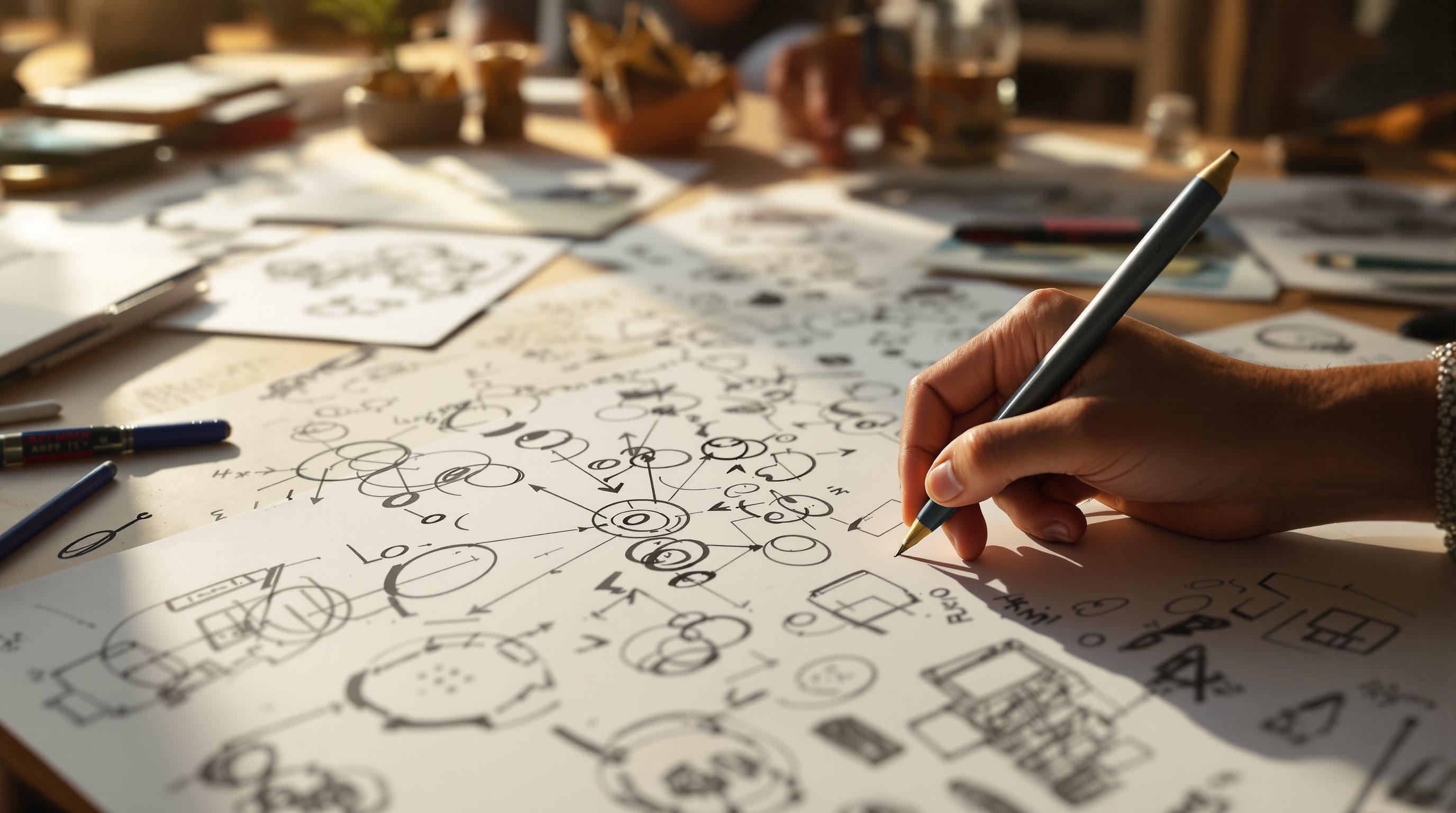
 Lesson 3.4
Lesson 3.4
Sketch-thinking
The hand as a thinking tool
The hook'I can't draw' is the most common sentence a design student says, and it quietly cripples them. The sketches that matter aren't pretty — they're ugly, fast, private scribbles nobody sees. Their purpose isn't to show an idea, it's to have one. The pencil is how you think the thought in the first place.
Two different activities called 'drawing'
Presentation drawing — the polished render you show a client — is a skill that takes years. Thinking drawing — the rough, fast, ugly sketch you make for yourself while figuring something out — requires almost no skill; a child can do it, nobody sees it. The first communicates a finished idea; the second generates the idea. This lesson is the second kind.
Why the hand thinks faster than the mind
The mind has a tiny workbench (Simon's bounded rationality) — try to mentally arrange seven rooms with their adjacencies, the sun, and circulation and your head overflows. The sketch is external memory: it holds the whole arrangement outside your skull. The hand makes the vague specific — the pencil won't let an idea stay fuzzy, and that forced specificity is where you discover problems ('if the prayer corner is there, it blocks the only window'). And the eye answers back — you draw, you look, and the drawing tells you something you didn't know you knew. This draw-see-react-redraw loop is the design method made physical, sped to seconds.
The vocabulary of thinking-sketches
A blob is a space or activity. An arrow is movement, sightline, the sun, or a force. A thick line is solid (a wall); a thin/dashed line is soft or movable (a screen, a 'maybe'). A squiggle is texture or 'stuff here, figure it out later.' A stick figure reminds you of scale and reintroduces the body and persona. A section cut lets you think in the vertical dimension the plan hides. The most useful technique is trace paper — sketch, lay a fresh translucent sheet on top, draw the next version, keep what works; the iteration loop made physical.
Why hand-sketching beats jumping to the computer
The computer is a converging tool — it demands precision before you're ready, makes things look finished before they're good (triggering premature attachment), and is slow to change radically. It pressures you to settle. The hand is a diverging tool — fast, loose, comfortable with vagueness, free to throw away, and it resists polish. The rule: sketch by hand to diverge; move to the computer to converge. Jumping to the computer too early kills ideation.
The ugliness is functional — a rough sketch signals 'provisional, change me' and invites pushback; a polished render signals 'decided' and shuts down feedback. Sketch in multiples, never singles — twenty rough variants side by side let the field do the diverging; a single careful sketch is converging in disguise. And learn to think in section, not just plan — the plan hides the entire vertical dimension where some of the best spatial ideas live, especially in tight Indian homes where you grow upward and downward when you can't grow outward. A designer who only thinks in plan is thinking in two dimensions about a three-dimensional problem.
1. Write at the top of a page: 'these are ugly thinking-sketches, nobody will see them, they're for having ideas.' Then believe it. Fill a page with ten rough blob-plans of one space, each under thirty seconds, each different, none nice. Cut one section through your most interesting plan — notice what the vertical dimension reveals. Then write three things the drawings told you that you didn't know before you drew them.
Check yourself
3 quick questions — pick an answer to see why.
Q1What is the difference between presentation drawing and thinking drawing?
Q2Why does the hand 'think faster than the mind' while sketching?
Q3What is the rule about hand-sketching versus the computer?
Key terms
- Thinking drawing
- The rough, fast, ugly sketch made for oneself to generate an idea, requiring almost no skill — distinct from polished presentation drawing.
- External memory
- The sketch as a place to hold a whole spatial arrangement outside the mind's limited workbench.
- Draw-see-react-redraw loop
- The cycle where you draw a mark, the eye reads it back, the mind reacts, and you redraw — the design method made physical.
You've generated dozens of options — but a full field is paralysing. When every option has merit, how do you converge fairly and rigorously, without just picking your favourite?
The author
Amogh N P
Architect, interior designer, and creative polymath. Studio Matrx began in his notebooks — his vision of design made honest, useful, and open to everyone. Its Academy is written and taught in his memory, and free, forever.
More about Amogh →