
 Lesson 1.4
Lesson 1.4
Cultural empathy
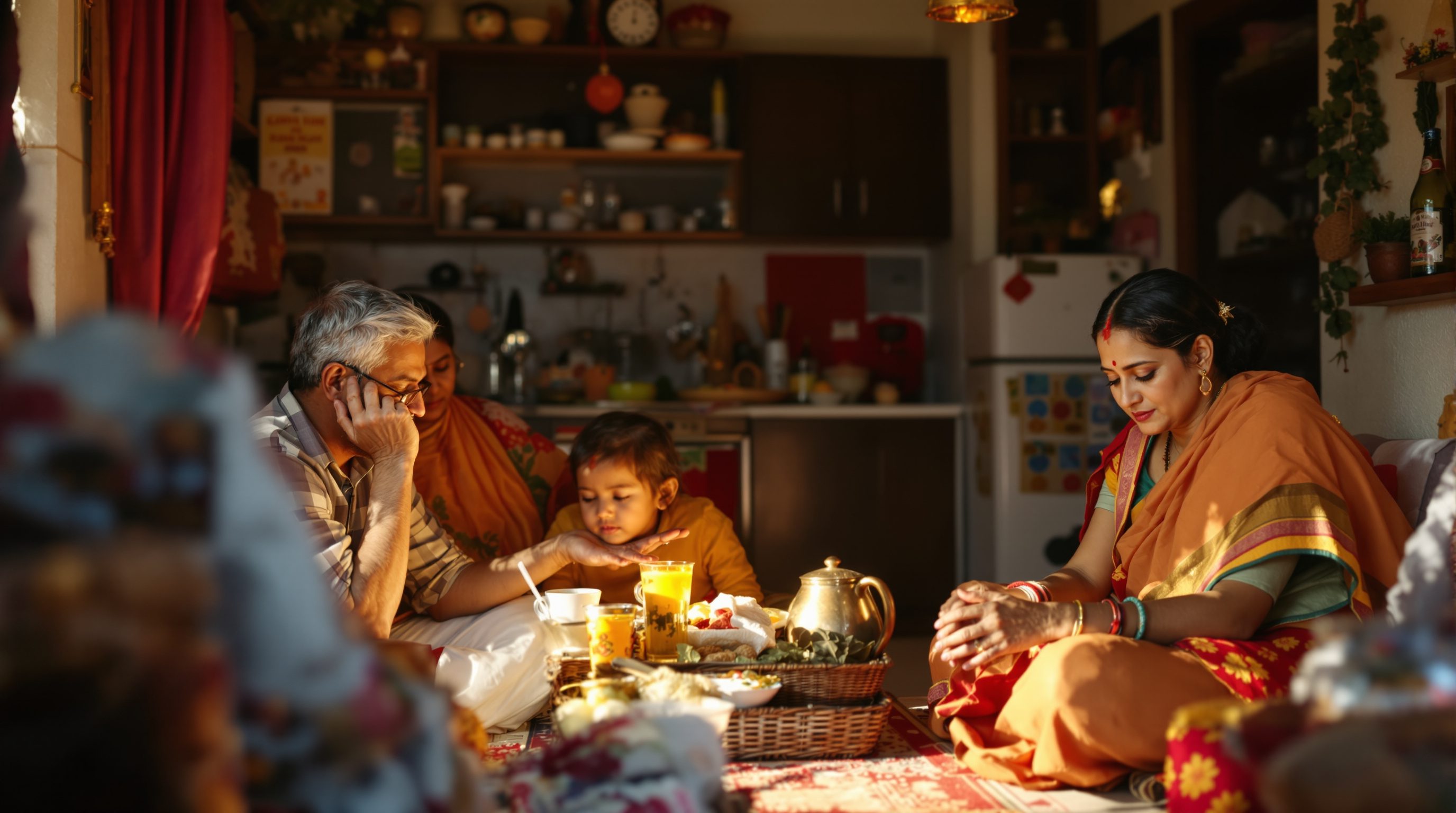
Pooja orientation, joint-family hierarchy, gendered kitchen logic, and zones
The hookA designer plans a beautiful open-plan home — living, dining, kitchen flowing into one bright space. The family moves in and something feels wrong they struggle to name: the mother feels exposed cooking in full view of guests, there's nowhere quiet for the grandmother's prayers, and the family has lost the ability to keep public space separate from private mess. No anthropometric rule was broken. The design ignored the cultural logic of how this household lives — and nobody told the designer the rules, because they were too obvious to mention.
The empathy that's hardest to see
Cultural empathy reads what space means — who belongs where, what must be separated, which arrangements carry significance. It's uniquely hard because the rules are invisible to insiders (assumed, not stated), plural and specific (India is not one culture; a Lingayat, a Tamil Brahmin, a Kerala Christian, a modern nuclear couple differ), and easy to override by accident. Cultural empathy means asking, never assuming.
Logic 1 — the pooja space
For many Hindu families the home has a space for worship whose placement and orientation carry significance (often northeast, facing east or north, separated from impure zones). Whether you hold these beliefs is irrelevant to your job: if the family does, the orientation is a constraint to honour, not a want to improve past. Honour it and make the space beautiful and integrated. Its dimensions come from the postures of worship and its eye-line from how the family prays — cultural and bodily empathy meet here.
Logic 2 — joint-family hierarchy
Many homes hold multiple generations, with a social structure to read: the eldest may warrant the most accessible or respected room (and, with ageing bodies, the ground floor near a bathroom); married couples need privacy within a shared household; the roster changes over years (a son marries, a daughter leaves, grandchildren arrive). The home is designed for a changing roster, not a fixed one.
Logic 3 — the kitchen's logic
For many families the kitchen is a working, somewhat private space, not a social showpiece. The cook (often a woman or hired cook) may not want to be on display; purity associations may keep it separate; and the heat, aromas, oil, and smoke of Indian cooking make full openness impractical. This is why the imported open-plan kitchen fails here. Gendered kitchen patterns are a description of how many homes currently work, not a prescription to reinforce uncritically: respect the lived logic while staying alert to designs that better serve the people who use the space most.
Logic 4 — public and private zones
Most Indian homes maintain a gradient from public (entrance, any visitor) to semi-public (living/dining, welcome guests) to semi-private (kitchen, family) to private (bedrooms, pooja). The thresholds between zones matter as much as the zones — they let the family control how far a guest comes in. The open-plan home failed by collapsing the gradient: it forced the most private working zone (the kitchen) into the most public one with no threshold. The fix isn't 'no open plan ever'; it's designing the gradient deliberately — a kitchen that opens or closes, a partial screen, a flexible threshold.
The synthesis: read, don't assume
The four logics are questions to investigate, not answers to assume. Does this family maintain a pooja space, and does its orientation matter? What's the household structure, now and later? Working-private or social-open kitchen? Where do they draw the public/private lines? The skill is telling a want you can improve past from a constraint you must honour — except here the constraints are cultural, unspoken, and deeply held.
Beware the modernity assumption in both directions — don't impose traditional separations on a couple who reject them, nor erase logics an educated urban family quietly still holds. Culture is contested within a household, not unanimous — the mother-in-law may want separations the daughter-in-law finds confining; don't design only for the loudest voice, and notice whose preferences usually win and whose get overlooked (often the women who use the space most). And your own values are present but not sovereign — you can offer options that gently expand what's possible without imposing your manifesto on people who didn't ask. The line between expanding someone's options and overriding their choices is the central ethical skill of culturally-grounded design.
1. Map a real household's four logics by asking, not assuming. Find one place a 'modern template' (open kitchen, flush threshold, no formal entrance) would clash with this family's actual logic. Note one internal disagreement — whose preference currently wins, and who uses that space most.
Check yourself
3 quick questions — pick an answer to see why.
Q1Why did the beautiful open-plan home feel 'wrong' to the family?
Q2How should a designer treat a family's pooja orientation?
Q3What is the public-to-private gradient, and how did the open plan fail it?
Key terms
- Cultural empathy
- The skill of reading what space means to a household — who belongs where and what must be separated — given that the rules are unspoken, plural, and easy to override by accident.
- Public-to-private gradient
- The arrangement of a home from public (entrance) through semi-public to private (bedrooms, pooja), where thresholds let the family control a guest's reach.
- The modernity assumption
- The error of assuming a family is either traditional or modern — imposing separations they reject, or erasing logics an educated urban family quietly still holds.
You've gathered feelings, routines, body, culture. But scattered notes don't design a home. How do you compress it into something you can hold in your head and design from?
The author
Amogh N P
Architect, interior designer, and creative polymath. Studio Matrx began in his notebooks — his vision of design made honest, useful, and open to everyone. Its Academy is written and taught in his memory, and free, forever.
More about Amogh →