
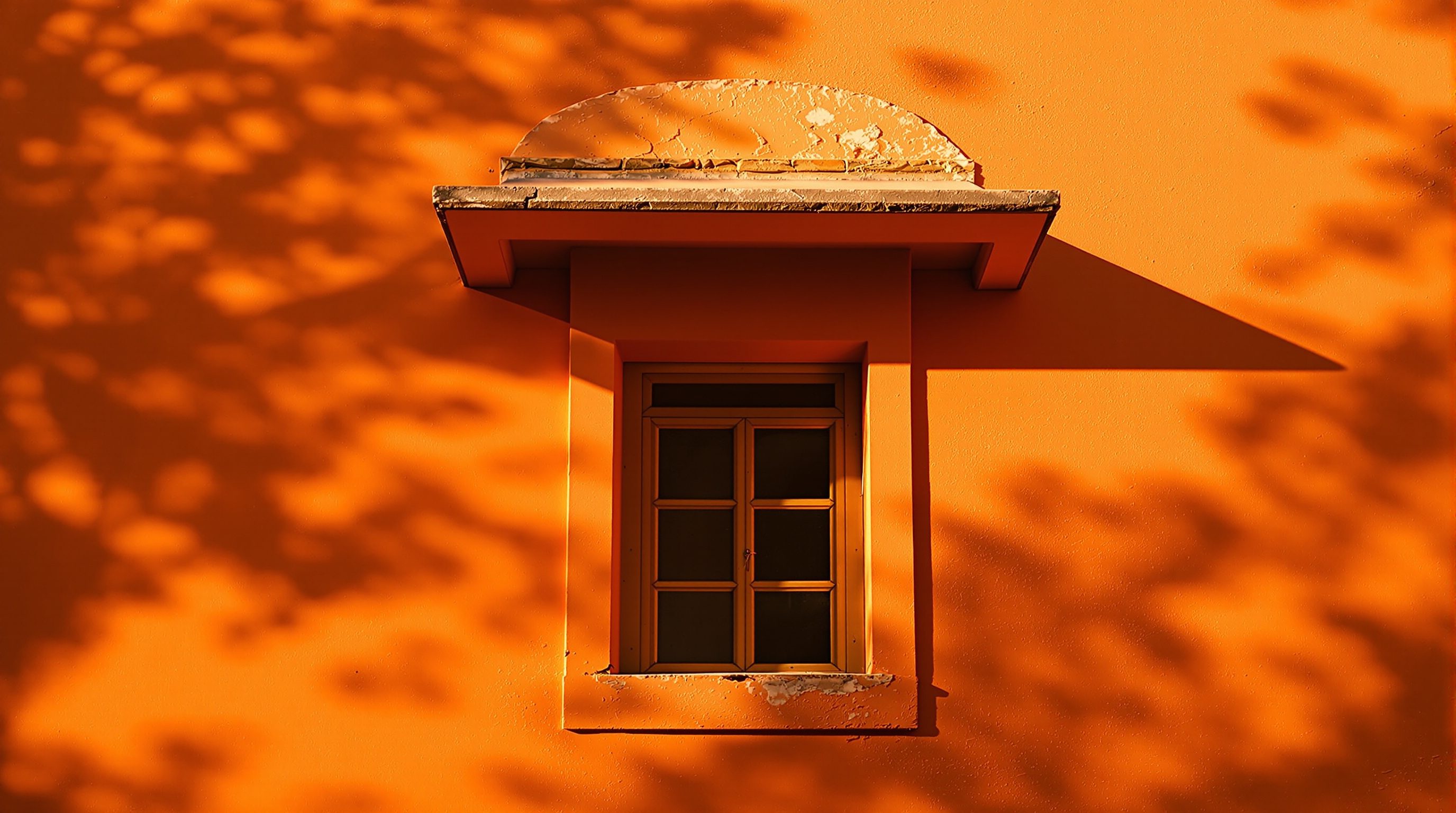
 Lesson 1.1
Lesson 1.1 · The Tools of Climate Analysis
The Sun Path Over India
Over a country from 8° to 37° North, the same sun keeps very different company — and every overhang answers to it.
Same sun, same moment — latitude changes everything
Noon, 21 June. In Kanyakumari the sun is nearly overhead and the shadow pools at your feet; in Leh it leans south and throws a long shadow across the ground. Same sun, same instant — only the latitude changed, and it changed everything.
Every overhang you will ever draw answers one question: how high, and from which direction, does the sun strike this wall? Get the geometry and shading stops being guesswork.
Before you shade a window, find the sun. Two angles, one formula — then draw.
Altitude and azimuth — the sun's two coordinates
Fix the sun in the sky with two angles, and only two.
Altitude (β) is its height above the horizon, from 0° at sunrise to 90° directly overhead. Altitude governs how deep a horizontal overhang must be: a high sun is easy to block with a shallow projection, a low sun rakes in underneath it — the hard case.
Azimuth (α) is its compass direction, conventionally measured from south. Azimuth tells you which façades get hit, and when through the day.
The practical consequence: south is the well-behaved façade in the northern hemisphere — high summer sun, easy to shade. East and west are the troublemakers, struck by low raking sun that no horizontal overhang can stop. One caution: north India's north wall does catch the summer morning and evening sun, so the temperate-climate rule "the north wall never sees sun" is a myth here.
High sun, shallow shade. Low sun, no shade saves you. Solve the west wall first.
The sun-path simulator — a reusable instrument
Picture the sun's daily track as an arc across a sky dome. Drag the latitude (8–37°N) and the date, and the arc shifts: it climbs steep and near-overhead at low latitudes, leans low to the south up north. A dot marks solar noon, the sun's daily high point and the reference moment for sizing horizontal shading, with a live noon-altitude readout.
This is not a one-lesson toy. The same simulator is reused across every shading lesson in Modules 2–6 — once you can read the arc, you can size a chajja, a fin, or a verandah eave anywhere in the country.
Worked example — the summer-overhead trap
Take a Mumbai window at 19°N. On 21 June the noon sun sits at roughly 85.5° — nearly straight overhead — so even a shallow overhang throws its shadow down the glass. On 21 December the same window faces a noon sun of about 47.5°: the low winter sun slips under the overhang and warms the room. One chajja, two seasonal jobs — block summer, admit winter.
For a south façade, size the horizontal shade to the summer noon altitude and then verify it releases the winter sun. East and west can't be solved this way — their low morning and evening sun calls for vertical fins, deep reveals, or simply less glazing. (The full chajja sizing comes in Lesson 4.4.)
A 38° seasonal swing in one window. Geometry, not guesswork.
Three altitudes on the same idea
Read the band that fits you — or all three.
A simple horizontal sunshade — a chajja — over a south-facing window blocks the harsh high summer sun while still letting the low winter sun in to warm the room. Get the overhang sized right before you spend on curtains, films or tints; the geometry does for free what they do at a recurring cost. And remember: it's your east and west windows, catching the low morning and evening sun, that are hardest to tame.
Size south-façade horizontal shades to the summer noon altitude, then verify the device releases the winter sun rather than killing useful passive gain. East and west façades cannot be solved horizontally — low raking sun defeats any overhang — so reach for vertical fins, deep reveals or reduced glazing, and solve west first. Make solar geometry an explicit step in orientation and façade studies; the chajja gets dimensioned formally in Lesson 4.4.
Declination for day-of-year n: δ = 23.45° · sin(360 · (284 + n) / 365). Noon altitude at latitude φ: β_noon = 90 − |φ − δ|. Work Mumbai (φ = 19°N): June, n = 172, δ = +23.45° → β = 90 − |19 − 23.45| = 85.5° (the sun is 4.45° north of the zenith, so it strikes the north wall). December, δ = −23.45° → β = 90 − |19 − (−23.45)| = 47.5°. A 38° seasonal swing the shading must straddle.
“South windows are always the hot ones — minimise them.”
Run the method yourself
Run the method once, on your own city, before the next lesson.
- 1Find your city's latitude φ.
- 2Compute β_noon = 90 − |φ − δ| with δ = +23.45° (June) and δ = −23.45° (December).
- 3Subtract the two to get the seasonal swing your shading must straddle.
- 4Read the swing: a large swing (north India) means a fixed overhang can both block summer and admit winter; a small swing (near the equator) means the sun is high in both seasons, so shade all year round.
- 5Check the simulator's noon-altitude readout against your hand calculation.
↳ Use the worksheet below to record your answers.
Take it with you
Shading becomes geometry
β_noon = 90 − |φ − δ| gives the noon sun height for any Indian latitude and date — shading becomes geometry, not guesswork.The sun governs heat and light — but Indian comfort is governed just as much by **moisture**. A 32 °C dry day in Jodhpur is a different animal from a 32 °C sticky day in Kolkata, and no thermometer can tell them apart. Next: the psychrometric chart, and how to plot a city's comfort cloud on it.
The author
Amogh N P
Architect, interior designer, and creative polymath. Studio Matrx began in his notebooks — his vision of design made honest, useful, and open to everyone. Its Academy is written and taught in his memory, and free, forever.
More about Amogh →