
 Lesson 3.2
Lesson 3.2 · Warm-Humid Strategies
Raised Floors and Deep Shade
The breeze runs faster upstairs and the ground is the enemy, so the humid house climbs onto stilts and hides under a deep shadow.
The breeze is faster upstairs, and the ground is crawling
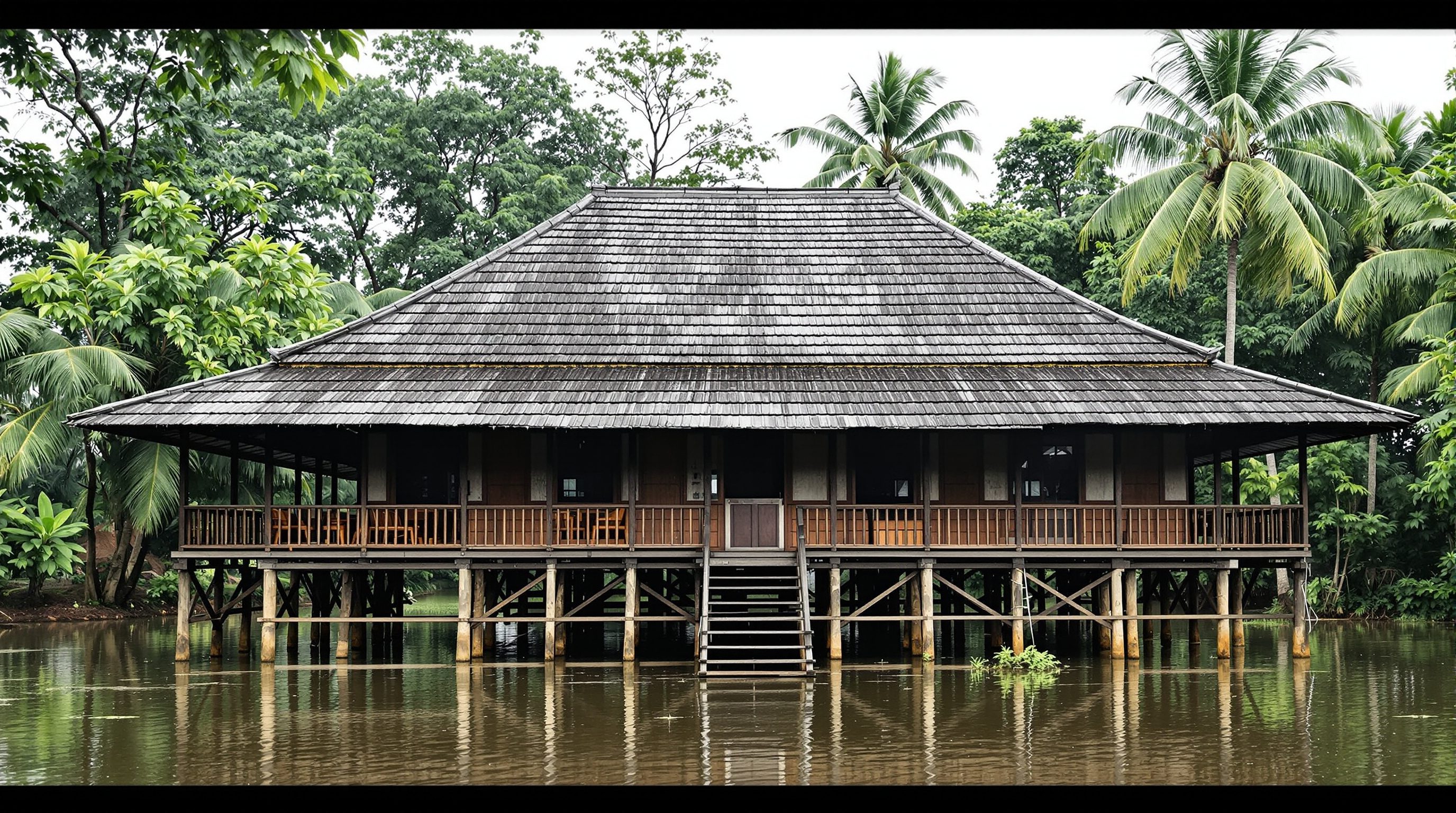
Look at the traditional houses of Assam, the Konkan, coastal Karnataka and the Northeast and you find them *lifted* — on timber stilts, a stone plinth, a raised platform — with a deep verandah running under a wide low roof. None of it is decoration. The humid ground stays damp and breeds mould, radiates its stored heat back up after dark, floods in the monsoon, and teems with insects. The air a metre or two higher moves faster and cleaner. So the house rises to meet the better breeze and escapes the wet earth — then shades itself completely. In a climate you cannot cool, the first rule is simple: never let the sun touch the wall.
Lift the house into the breeze; wrap it in shade. The dry house tuned its shading by season — the humid house shades everything, always.
The breeze is faster upstairs
Wind near the ground is slowed by friction with soil, grass, trees and buildings, and it speeds up steadily with height. This is the wind profile, and it is the whole case for raising the floor.
Near vegetated ground the air can be almost still while a usable breeze runs just a few metres up. Lift the living level — even a half-storey plinth — and you deliver a stronger, steadier flow to the openings, which is exactly the air movement that Lesson 3.1's cross-ventilation depends on. An inlet aimed at dead ground-level air barely ventilates; the same inlet raised into the faster layer comes alive.
Raising the floor buys more than breeze. It puts distance between the living space and the damp ground, cutting the rising moisture, mould and rot. It escapes the heat the hot ground re-radiates upward after dark. It clears monsoon floodwater and crawling pests, which pass harmlessly below. And it opens a ventilated underfloor where cool air can move beneath the rooms. The same logic scales straight up the section: a sixth-floor balcony catches a real breeze while the street below is stagnant — stilts and high-rise balconies answer the identical wind profile.
The air near the ground is slow and wet; a few metres up it is faster and cleaner. Raise the floor to meet it.
Shade everything, all the time
Hot-dry shading was a tunable thing — block the high summer sun, admit the low winter sun. Warm-humid India offers no such bargain. Here the heat and the sun are unwelcome almost every single day, so the move is to shade the entire envelope, permanently.
That is the reason for the enormous eaves and the wraparound verandah: a continuous room of pure shade that keeps the sun off every wall, intercepts the driving rain, and yet stays wide open to the breeze. Sun landing on a wall, or pouring through unshaded glass, deposits heat you then cannot remove — the air is too humid for passive cooling to claw it back. So shading is not comfort tuning; it is the front line of thermal defence in a climate with no cure.
The verandah does for the humid house exactly what the courtyard did for the dry one. It lets air in and keeps water out; it is a place to sit through the worst heat; it lets you leave the windows open right through a monsoon storm. The deep overhang and the deep verandah are the same idea at two scales — a permanent shadow wrapped around a house that must breathe.
In a climate you can't cool, keeping heat out is the only defence. So shade every wall, every day.
The wind-profile and shade-depth explorer
The lesson's instrument lets you raise the floor and deepen the overhang and watch both pay off at once. One side plots the wind profile — a curve of wind speed against height — so that as you lift the floor, the caught breeze visibly grows. The other side projects the overhang: deepen it and the shadow it throws climbs up the wall until the whole face is covered, while air still passes freely beneath the eave.
The two controls work together. A taller plinth reaches into faster air; a deeper eave shades more wall and sheds more driving rain. Push them and you watch the warm-humid house assemble itself — living level lifted into the breeze, the envelope sealed in shade, the openings still free to breathe.
This is a reusable instrument, not a one-lesson toy. The same wind profile underlies every ventilation decision on the humid coast, and the same overhang geometry returns whenever you size shading anywhere in tropical India.
Three altitudes on the same idea
Read the band that fits you — or all three.
A wide verandah or a deep balcony on your sunny and rain-facing sides beats almost any gadget you can buy: it keeps the sun off your walls, lets you leave the windows open through the monsoon, and gives you a cool shaded place to sit. A good plinth lifts the floor off the wet ground, keeping damp, flood and insects down while catching a better breeze. The two-line brief for a humid-coast house is the whole of this lesson — shade everywhere, and the floor up off the wet ground.
Treat full-envelope shading as a baseline, not an option. Low-latitude sun comes from nearly every direction, so run deep overhangs on all orientations and size verandahs to the local driving-rain angle, not just the noon sun. Raise the floor on a plinth or piers wherever you can — even 600 mm helps — and go to full stilts where flood risk or slope demands it. Keep the underfloor ventilated, not enclosed, or you simply rebuild the damp ground you raised away from. Light, ventilated roofs over the lot. And read the verandah as both a climate buffer and social space, integrated with the 3.1 air path rather than bolted on.
The breeze grows with height by the power-law profile v(z) = v_ref * (z / z_ref)^alpha, where the terrain exponent alpha is about 0.14 over open country, 0.22 suburban, and 0.33 in dense or forested ground. Worked, suburban, 3 m/s measured at z_ref = 10 m: at z = 1 m, v = 3 * (1/10)^0.22 = 1.8 m/s; at z = 4 m, v = 3 * (4/10)^0.22 = 2.4 m/s — a third more breeze bought by lifting the floor three metres.
Shade depth follows the overhang projection P = h / tan(beta), where h is the height of wall to shade and beta the solar altitude. Size P to the lowest *useful* sun angle (this is why tropical eaves run so deep), then check the same P against the driving-rain angle so the overhang sheds rain as well as sun.
“A big roof overhang is just for keeping the rain off — it doesn't really affect comfort.”
Run the method yourself
Lift the floor and deepen the eave in the explorer before crossing to the next lesson.
- 1In the wind-profile side, raise the floor off the ground and find the height at which the caught breeze jumps — that step is your case for raising.
- 2Compute v at 1 m versus 4 m with v(z) = vref · (z/zref)^0.22. How much breeze does the lift actually buy?
- 3Deepen the overhang until the wall is fully shaded and rain-free, and note that air still passes freely beneath the eave.
- 4Sketch one section: raised floor, a wraparound verandah shading the wall and shedding the rain, windows open behind it. That single drawing is the warm-humid house.
↳ Use the worksheet below to record your answers.
Take it with you
Climb the breeze, hide from the sun
In hot-dry India we wanted heavy mass to store and delay the heat — but on the humid coast that same mass becomes a slow-release radiator, keeping the bedroom warm all night when the air outside never falls. The humid house needs the opposite wall: a lightweight envelope that holds almost no heat and cools the instant the air does. Next: rebuilding the wall and the roof for the tropics — thin, light, reflective and ventilated.
The author
Amogh N P
Architect, interior designer, and creative polymath. Studio Matrx began in his notebooks — his vision of design made honest, useful, and open to everyone. Its Academy is written and taught in his memory, and free, forever.
More about Amogh →