
Development Control Parameters
FSI, coverage, setbacks, height, parking — and why they are all local.
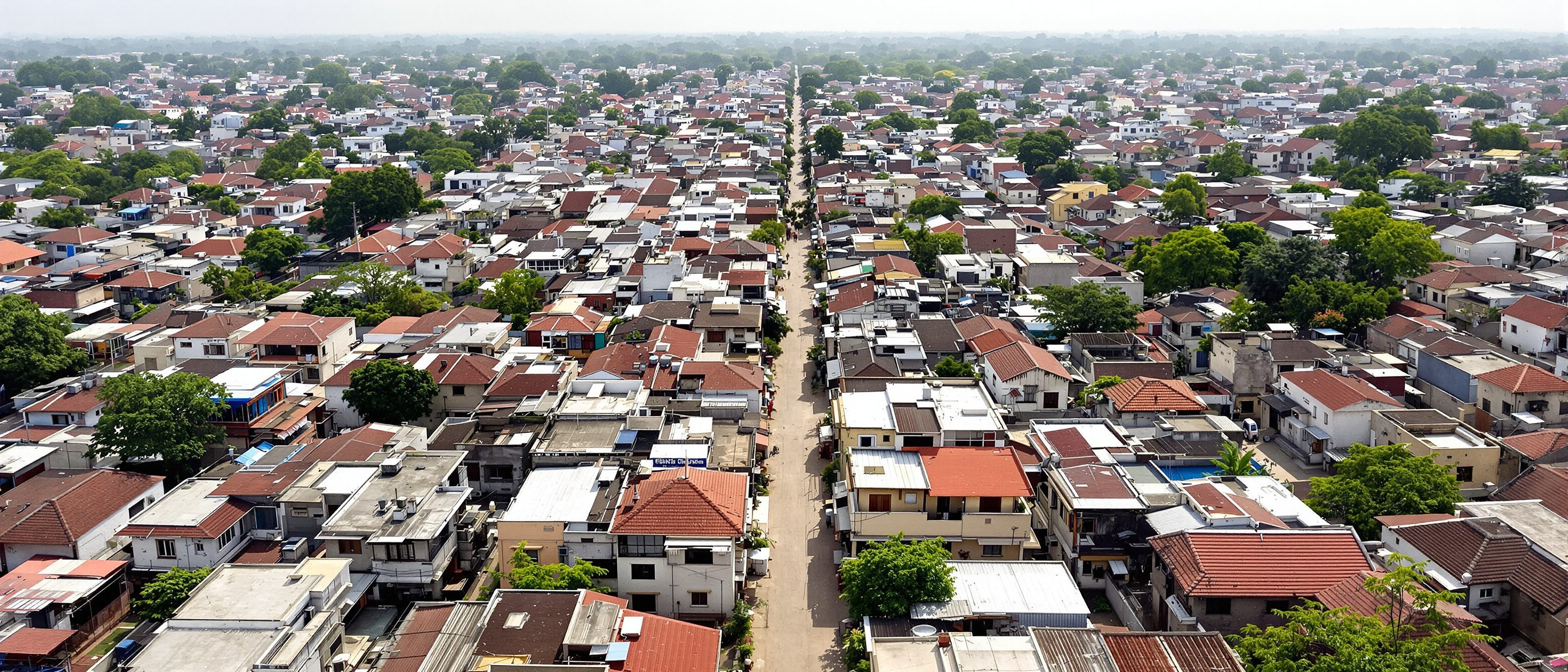
How much may you build on a plot? The answer is the intersection of five local rules: FSI caps the total floor area, ground coverage caps the footprint, setbacks shrink that footprint from every boundary, road width and airport limits cap the height, and parking and open space eat into the ground. Each of these is set by the local DCR and varies city to city — two cities can quote “FSI 2.0” and permit very different buildings. Learn the parameters, then size a buildable envelope with the explorer.
Learning objectives
By the end of this lesson, you will be able to — mapped to the course outcomes for Building Codes and Regulations:
Define FSI/FAR and ground coverage and explain what each controls.
Distinguish front/side/rear setbacks, the building line, and how height links to road width.
Estimate a buildable envelope from FSI, coverage and setback parameters.
Explain why the same FSI yields different floor areas in different cities.
The bulk parameters
The headline numbers that shape the envelope — and the reason equal FSI does not mean equal floor area.[1, 2]
Total area ÷ plot area
Floor Space Index = total built-up floor area ÷ plot area. FSI and FAR are used interchangeably in India. A representative residential base ranges roughly 1.0 to 2.5, but TOD and high-density zones go far higher. CRITICALLY, what COUNTS toward FSI (balconies, staircases, lift wells, services, parking) differs city to city — so equal FSI does not mean equal floor area.[1, 2]
Size the buildable envelope
Set the plot, setbacks, FSI and ground coverage and watch the footprint, total built-up area and implied floors update — and see which rule is the binding constraint.
Buildable envelope · move the sliders
15 × 20 m plot
300
m² plot
113
m² footprint
600
m² built-up (max)
6
floors implied
The footprint here is limited by setbacks. FSI caps the total built-up area at 600 m²; spread over a 113 m² footprint that needs about 6 floors — before the height limit and parking have their say.
Indicative only — every number here is set by your local DCR/bye-law and varies city to city.
Extra-FSI & amenity mechanisms
Beyond base FSI, cities sell and trade development rights, and demand parking and open space — all intensely local.[3]
Buy extra area
Beyond base FSI, cities sell additional development rights. Premium FSI lets an owner buy extra FSI from the authority for a premium (often a percentage of land/ready-reckoner value), usually only where road width permits.[3]
At a glance
| Aspect | One | The other |
|---|---|---|
| Measures | FSI: total floor area (all floors) | Ground coverage: footprint only |
| Controls | FSI: total density / bulk | Coverage: at-grade open space |
| Definition varies? | FSI: strongly (what counts in) | Coverage: less, but yes |
| Can be bought? | FSI: yes (premium / TDR) | Coverage: no |
| Caps the height? | FSI: no — only total area | Height: road width + AAI + fire |
Key terms
Total built-up floor area ÷ plot area — the headline density control.
Building footprint as a percentage of plot area — governs at-grade open space.
Mandatory open distance from a boundary or road; grows with height.
The forward limit of permitted construction toward the road.
Extra FSI bought from the authority for a premium, subject to road width.
Transferable Development Rights — a tradable certificate of extra build rights.
Equivalent Car Space — the standard unit of parking provision (~23 m²/car).
The 3-D volume left after FSI, coverage, setbacks and height limits are all applied.
Studio task
Take a real plot in your city (say 15 × 20 m). Look up the actual FSI, ground coverage, setbacks and parking from the local DCR, and compute the maximum built-up area, the footprint and the number of floors — using the explorer to check your arithmetic. State which parameter is the binding constraint, and how a wider abutting road would change the answer.
Self-assessment
1. Floor Space Index (FSI) is defined as —
2. Why can the same 'FSI 2.0' yield different floor areas in two cities?
3. Besides the DCR cap, permissible building height is most directly gated by —
Recap
References & further reading
- [1]BIS, NBC 2016, Part 3 — Development Control Rules and General Building Requirements.
- [2]Ministry of Housing and Urban Affairs, Model Building Bye-Laws, 2016 (FSI, setbacks, parking).
- [3]Maharashtra Unified DCPR 2020 / Mumbai DCPR 2034 (TDR, premium and fungible FSI — illustrative).
- [4]Relevant city Development Plan / DCR (jurisdiction-specific binding numbers).
- [5]Joseph De Chiara & Lee Koppelman, Time-Saver Standards for Site Planning (feasibility & parking methodology).
Further reading
- BIS — NBC 2016, Part 3 (Development Control).
- MoHUA — Model Building Bye-Laws 2016.
- Your city's DCR / DCPR (the actually-binding document).
Sources gathered and fact-checked June 2026. Published values vary by source, sample and method — treat as indicative and confirm against the cited standard before structural use.
The author
Amogh N P
Architect, interior designer, and creative polymath. Studio Matrx began in his notebooks — his vision of design made honest, useful, and open to everyone. Its Academy is written and taught in his memory, and free, forever.
More about Amogh →