
Accessibility, Structure & Energy
The 2021 Guidelines, the 1:12 ramp, seismic zones II–V, and the energy codes.
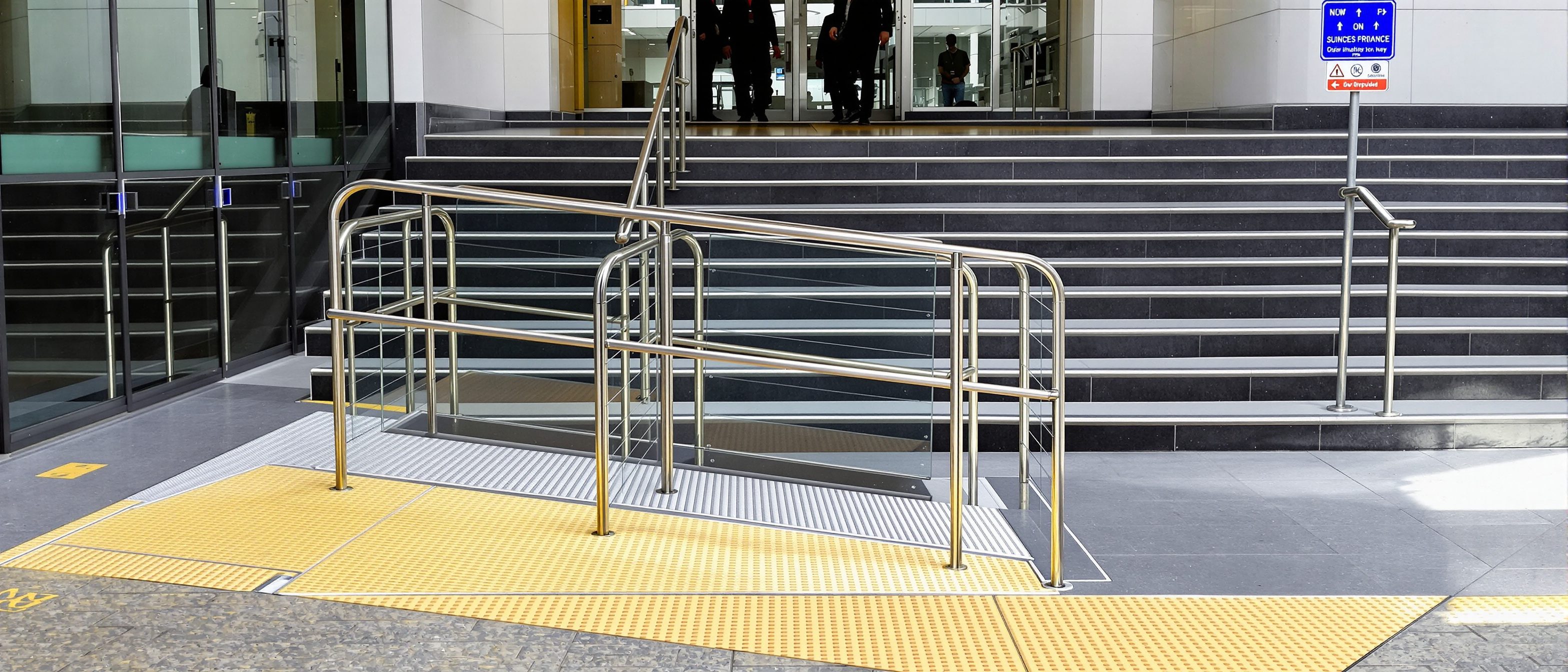
A building a wheelchair cannot enter is not finished — it is non-compliant. The Rights of Persons with Disabilities Act 2016 makes accessibility a legal duty, and the Harmonised Guidelines 2021 (which superseded the 2016 ones — a common error to teach the old version) give the standards: a 1:12 maximum ramp, a 1500 mm turning circle, accessible toilets and lifts. Add structural safety (NBC Part 6, IS 1893 seismic zones II–V), sanitation provisioning (Part 9), and the energy codes — ECBC 2017 for commercial, Eco-Niwas Samhita 2018 for homes.
Learning objectives
By the end of this lesson, you will be able to — mapped to the course outcomes for Building Codes and Regulations:
State the RPwD Act 2016 mandate and that the Harmonised Guidelines 2021 superseded the 2016 ones.
Apply the 1:12 ramp, 1500 mm turning circle and accessible-toilet/lift principles.
Identify IS 1893 seismic zones II–V and NBC Part 6/9 structural and sanitation provisions.
Distinguish ECBC 2017 (commercial) from Eco-Niwas Samhita 2018 (residential).
Universal accessibility
Accessibility is law, and the edition to cite is 2021. The chain — ramp, toilet, lift, route, signage — fails if any one link breaks.[1, 2]
Accessibility is law
The Rights of Persons with Disabilities Act 2016 makes accessibility a STATUTORY obligation, not a courtesy: public buildings and services must be made accessible, with rules prescribing timelines for retrofitting existing public buildings. For an architect, accessibility means complying with a binding legal standard enforced through approvals.[2]
Structure, sanitation & energy
Structural and seismic safety, fixtures-per-person, and the two energy codes — commercial and residential. India has no seismic Zone I.[3, 4, 5]
Structural safety
Part 6 covers structural design across materials — loads, foundations, timber, masonry, concrete and steel — and references the IS design codes. Design must account for dead, live, wind, seismic and other loads, and a structural-stability certificate by a qualified engineer is a standard sanction requirement.[3]
At a glance
| Aspect | One | The other |
|---|---|---|
| Building type | ECBC 2017: commercial / large load | Eco-Niwas Samhita: residential |
| Issued by | ECBC: Bureau of Energy Efficiency | ENS: Bureau of Energy Efficiency |
| Core metric | ECBC: envelope + systems efficiency | ENS: RETV (envelope transmittance) |
| Accessibility edition | Myth: Harmonised 2016 is current | Reality: Harmonised 2021 supersedes it |
| Seismic zones | Myth: India has Zone I | Reality: only Zones II–V |
Key terms
Statute making accessibility a legal duty for persons with disabilities.
Current Indian universal-accessibility standard (superseded the 2016 barrier-free guidelines).
Maximum accessible ramp gradient; landings and dual handrails required.
1500 mm clear space for a wheelchair to rotate — required in accessible toilets and lobbies.
Indian seismic design criteria; defines zones II, III, IV and V (no Zone I).
Plumbing-services code setting sanitation fixtures per occupant.
Commercial energy-conservation building code (BEE).
Residential energy-conservation code (BEE) — RETV envelope limit.
Studio task
Design the accessible entrance and a unisex accessible toilet for a small public building. Draw the ramp at no steeper than 1:12 with handrails and a landing, and lay out the toilet around a 1500 mm turning circle with side transfer and grab bars — citing the Harmonised Guidelines 2021, not a foreign figure. State your building's seismic zone and one consequence for its structure.
Self-assessment
1. The current authoritative accessibility standard for India is the —
2. The maximum gradient permitted for an accessibility ramp is —
3. Indian seismic zones under IS 1893 are —
Recap
References & further reading
- [1]CPWD / MoHUA, Harmonised Guidelines and Standards for Universal Accessibility in India, 2021.
- [2]The Rights of Persons with Disabilities Act, 2016 and Rules.
- [3]BIS, NBC 2016, Part 6 (Structural Design) and Part 9 (Plumbing Services).
- [4]BIS, IS 1893 (Part 1): 2016 — Criteria for Earthquake Resistant Design; IS 13920 (ductile detailing).
- [5]Bureau of Energy Efficiency, ECBC 2017 and Eco-Niwas Samhita 2018.
Further reading
- CPWD / MoHUA — Harmonised Guidelines for Universal Accessibility 2021 (free PDF).
- BIS — NBC 2016, Parts 6 & 9; IS 1893 (Part 1).
- Bureau of Energy Efficiency — ECBC 2017 & Eco-Niwas Samhita 2018.
Sources gathered and fact-checked June 2026. Published values vary by source, sample and method — treat as indicative and confirm against the cited standard before structural use.
The author
Amogh N P
Architect, interior designer, and creative polymath. Studio Matrx began in his notebooks — his vision of design made honest, useful, and open to everyone. Its Academy is written and taught in his memory, and free, forever.
More about Amogh →