
Designing for Accessibility
A continuous accessible route — for everyone, by right.
In India, accessibility is a right, not a favour — the RPwD Act 2016, the Harmonised Guidelines 2021 and NBC 2016 make a barrier-free environment mandatory, with the onus on the building owner. The aim is not a ramp bolted on at the end, but a continuous accessible route that works for everyone — and a design tested against the seven principles of universal design, the key dimensions, and a scaled model.
Learning objectives
By the end of this lesson, you will be able to — mapped to the course outcomes for Design of Structures I:
State the Indian accessibility framework — RPwD Act 2016, Harmonised Guidelines 2021, NBC 2016.
Apply the seven principles of universal design.
Detail the key barrier-free dimensions — ramps, doors, toilets, parking, lifts, tactile paving.
Test a continuous accessible route through a building with a checklist and a scaled model.
The framework and the principles
The RPwD Act 2016 makes accessibility a right; the Harmonised Guidelines 2021 (with NBC 2016) set the standard. Move from “barrier-free” to “universal design” — and run a design against all seven principles, not just the wheelchair.[1, 2, 3]
Accessibility by right
The Rights of Persons with Disabilities (RPwD) Act 2016 makes accessibility a legal right and puts the onus on the building owner. The technical standard is the Harmonised Guidelines and Standards for Universal Accessibility in India 2021 (CPWD/MoHUA), which updates the 2016 guidelines; NBC 2016 Part 3 aligns with it.[1, 2]
Useful to people with diverse abilities — the same solution for everyone, no segregation.
Accommodates a wide range of preferences and abilities (e.g. left- or right-handed).
Easy to understand regardless of experience, knowledge, language or focus.
Communicates effectively regardless of ambient conditions or the user's sensory ability.
Minimises hazards and the consequences of accidental or unintended actions.
Usable efficiently and comfortably with minimum fatigue.
Enough room to reach, manipulate and use, whatever the body size, posture or mobility.
The dimensions that matter
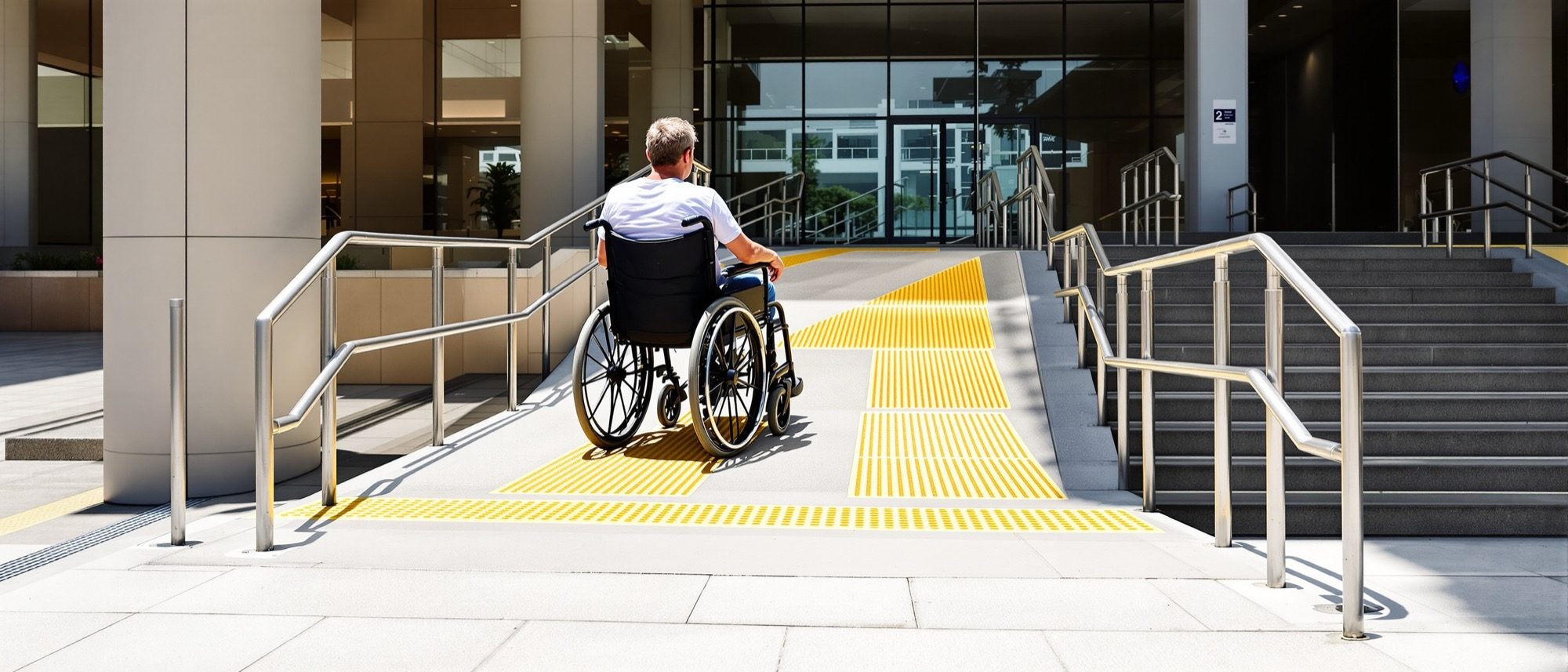
The accessible route is a chain — accessible parking, kerb ramp, 1:12 ramp, ≥ 900 mm doors, ≥ 1500 mm corridors, an accessible lift and an accessible toilet (≈ 2200 × 2000 mm), with tactile paving to warn and guide. One broken link breaks the chain.[1]
Slope, width, landings
A ramp is at most 1:12 (gentler is better; any floor steeper than 1:20 must be a ramp), at least 1200 mm wide, with handrails both sides at 760 and 900 mm and a level landing of at least 1500 mm every 9 m of run. Corridors and the accessible route are at least 1500 mm clear (1800 mm to pass).[1]
Barrier-free checklist
Tick the provisions your design includes and watch the compliance score. The point is the whole chain: a partial score means the route breaks somewhere.[1]
Barrier-free checklist · tick what your design provides
0/14 · 0%Not yet an accessible building
Accessibility is a continuous route — a single broken link breaks the chain. Targets follow the Harmonised Guidelines 2021 / NBC 2016.
At a glance
| Aspect | One | The other |
|---|---|---|
| Two framings | Barrier-free: remove obstacles (often retrofit) | Universal design: inclusive from the start, for all |
| Ramp vs stair | Ramp: 1:12, 1200 mm, for wheelchairs | Stair: compact, for many ambulant disabled — provide both |
| Gradient | 1:12 — steepest permitted short ramp | 1:20 — below this it is just a sloped floor |
| Tactile paving | Warning (domes): stop / hazard | Guiding (bars): follow this path |
| Accessible WC | ≈ 2200 × 2000 mm with manoeuvring space | Not just a wider cubicle |
Key terms
Designing so everyone can use a space to the greatest extent, without special adaptation (Mace).
The earlier framing — removing physical obstacles for disabled and elderly users.
A continuous unobstructed path linking accessible elements, ≥ 1500 mm wide.
Textured floor tiles read by foot or cane — warning (domes) and guiding (bars) types.
A short sloped cut through a kerb (≤ 1:10) linking footpath to road level.
The ~1500 mm clear space a wheelchair needs to rotate.
A fixed bar giving support, e.g. at a WC, 200–250 mm above the seat.
A person who can walk, often with aids, but cannot use a wheelchair.
The law making accessibility a right in India.
India's national technical standard for universal accessibility.
Studio task
Trace the accessible route through one of your building plans, from the accessible parking bay to the accessible toilet, and check every link against the dimensions above. Where the chain breaks, redesign it — then build a small scaled model of the entrance ramp and landing to test it in three dimensions.
Self-assessment
1. The maximum permitted ramp gradient for accessibility in India is —
2. The minimum clear width of an accessible door opening is —
3. Warning tactile paving (dome blocks) is placed to —
Recap
References & further reading
- [1]Harmonised Guidelines and Standards for Universal Accessibility in India 2021. CPWD / Ministry of Housing & Urban Affairs. https://ccpd.nic.in/harmonized-guidelines-for-standards-of-accessibility/
- [2]The Rights of Persons with Disabilities (RPwD) Act, 2016. Government of India. https://www.indiacode.nic.in/bitstream/123456789/15939/1/the_rights_of_persons_with_disabilities_act,_2016.pdf
- [3]The 7 Principles of Universal Design — Ronald Mace et al., NC State University (1997). https://universaldesign.ie/about-universal-design/the-7-principles
- [4]National Building Code of India 2016 (BIS) — Part 3, universal accessibility provisions.
Further reading
- Harmonised Guidelines and Standards for Universal Accessibility in India 2021 (CPWD/MoHUA).
- Julius Panero & Martin Zelnik, Human Dimension and Interior Space.
- Kent C. Bloomer & Charles W. Moore, Body, Memory, and Architecture.
Sources gathered and fact-checked June 2026. Published values vary by source, sample and method — treat as indicative and confirm against the cited standard before structural use.
The author
Amogh N P
Architect, interior designer, and creative polymath. Studio Matrx began in his notebooks — his vision of design made honest, useful, and open to everyone. Its Academy is written and taught in his memory, and free, forever.
More about Amogh →