
 Lesson 0.2
Lesson 0.2 · The Build Phase Meets AI
What AI in Construction Means
When people say 'AI' on a building site they rarely mean one thing - they mean a small family of data technologies (machine learning, computer vision, analytics and, lately, generative AI) doing a small family of jobs (predict, see, flag, forecast and optimise, summarise), sitting as an intelligence layer over the physical build and always feeding, never replacing, a human decision
'AI' on a building site is not a robot bricklayer or a brain that runs your job - it is a small family of data technologies doing a small family of jobs, and knowing exactly which is the whole difference between using it well and being sold to.
The word 'AI' has become a fog. A vendor says their platform 'uses AI' and you picture something autonomous and almost magical - a system that watches your project, understands it the way a seasoned superintendent does, and quietly keeps it on track. On a real site that picture is wrong, and the wrongness matters, because it is exactly the gap the hype lives in. To use AI well on a build you have to be able to say, plainly, what is actually inside the box: which technology is doing the work, what job it is doing, what it needs to do that job, and what it can never do at all.
This lesson does that narrowing. 'AI in construction' turns out to be a small family of data technologies - machine learning, computer vision, ordinary analytics, and, more recently, generative AI - put to a small family of jobs: predict, see, flag, forecast and optimise, summarise. None of them lays a brick. All of them take data the project produces and turn it into foresight or attention a human can use. And every one of them, without exception, produces an input to a human decision rather than the decision itself. Get this definition precise and the rest of the course - and every sales pitch you will ever hear - becomes readable.
AI in construction = machine learning + computer vision + analytics + generative AI, doing predict / see / flag / forecast / summarise. An info layer over the build - always an input to a human decision.
What 'AI' actually means here - four technologies, not one machine
Start by dissolving the fog. When 'AI' appears in a construction-tech pitch it is almost always one of four fairly ordinary technologies, or a combination of them, and naming which one is the first act of literacy. The workhorse is machine learning: software that is not hand-programmed with rules but is shown many past examples and learns the statistical patterns in them, so that given a new case it can estimate an output - which activities tend to slip, roughly where a cost is heading, whether a photo probably shows a hazard. It does not understand a project; it recognises patterns resembling ones it has seen. That single fact explains most of both its power and its limits.
The second is computer vision - machine learning applied to images and video, so a system can be trained to detect and locate things in a picture: a worker, a helmet, a crack, a section of wall that is built or not yet built. It is what lets a site's flood of photographs, which no human could ever watch, become countable information. The third is plain analytics: statistics, dashboards, forecasting and optimisation over a project's numbers - schedules, costs, quantities, productivity rates. Much of it is not glamorous and predates the current 'AI' label, but it is often the most reliable part of the toolkit. The fourth, newest and most over-hyped, is generative AI - large language models that produce fluent text (and increasingly images), useful for summarising reports, drafting correspondence, and querying a mountain of documents in plain language.
These four overlap and are often bundled, but they are genuinely different tools with different needs and failure modes. Machine learning and analytics live or die on the quality of past numerical data. Computer vision needs enough good, labelled imagery of your specific conditions. Generative AI is fluent but can be confidently, plausibly wrong - it writes a convincing sentence whether or not it is true. So the first question to ask of any 'AI' claim is not 'is it AI?' but 'which of these is it, and what does that one need to work here?' That question, asked calmly, deflates most of the mystique and points straight at whether a tool can actually help on your project.
Four boxes: machine learning (predict), computer vision (see), analytics (forecast), generative AI (summarise). 'AI' = one or more of these - never magic.
The family of jobs - predict, see, flag, forecast and optimise, summarise
Those technologies do a small, describable set of jobs on a project, and grouping them by job - rather than by product - is the clearest way to hold the field in your head. Predict: using patterns in past and current data to estimate the future - which activities are likely to slip and drag a delay behind them, where a cost is trending, which risks are rising - so a manager can act before a problem lands rather than after. See: using computer vision on photos, video and drone or camera feeds to understand what is physically there - how much has actually been built against the plan, whether the work matches the model, whether something on site looks unsafe or defective - turning imagery into structured fact.
Flag: watching, tirelessly, for the specific things a busy human misses and raising them early - a worker in a danger zone or without protective equipment, a developing situation, a quality problem, a document that contradicts another. Flagging is really just prediction or seeing pointed at exceptions, but it deserves its own name because it is where AI most directly touches safety, and therefore where the accountability rules bite hardest. Forecast and optimise: helping plan and sequence the work, allocate crews and equipment across competing demands, and estimate quantities and cost more quickly than by hand. Summarise and assist: increasingly, generative AI condenses the project's paperwork - daily reports, correspondence, specifications, contracts - and answers questions over it, taming a documentary flood that swallows managers' time.
Notice the shared shape. Every job takes data the project produces (or could produce) and returns foresight or attention - a number, an alert, a measurement, a summary. That is the honest, unglamorous heart of 'AI in construction': not intelligence in the human sense, but pattern-finding at a scale and tirelessness no person can match, aimed at the handful of questions that decide whether a build runs late, over budget or unsafe. When a pitch will not tell you plainly which of these jobs its tool does, treat that as a warning sign; a real tool does a nameable job on nameable data, and you should be able to state it in one sentence.
An intelligence layer over the physical build
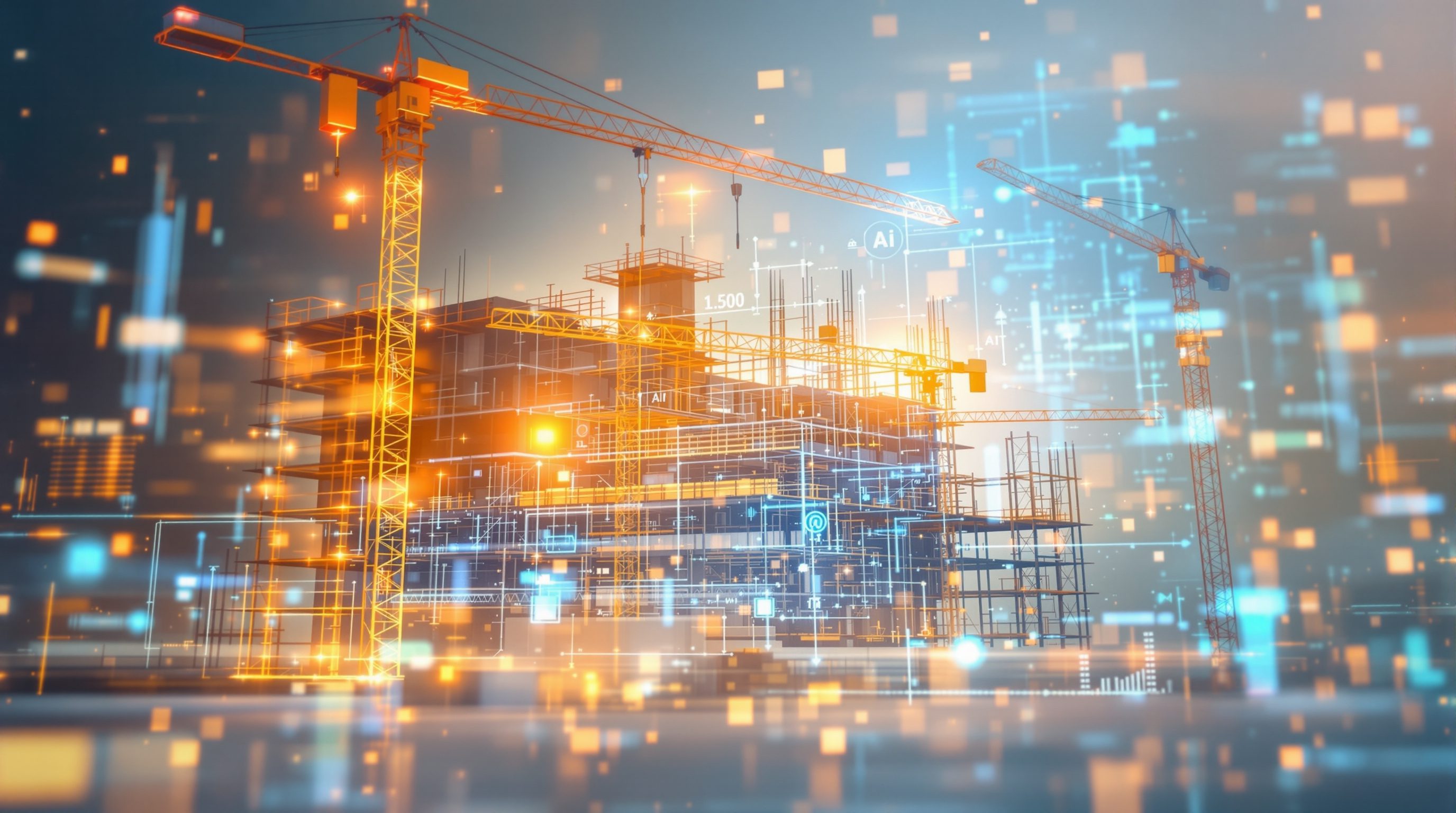
Hold all of that together and a single image emerges, and it is worth carrying through the whole course: AI in construction is an intelligence layer that sits over the physical work but never does it. The build itself - the mud, the steel, the concrete, the trades, the machines, the thousand daily decisions - happens exactly as it always has, done by people and equipment. What the AI layer adds is a stream of foresight and attention drawn from the data that work throws off: it predicts, it sees, it flags, it forecasts, it summarises. It helps the humans running the job see further, notice more, and decide better. It does not lay a brick, pour a slab, or tie a rebar, and it never will; that is not a temporary limitation waiting for better technology, it is what the layer is.
This framing does real work. It tells you where AI can and cannot reach: it reaches the *information* about the build - the plans, predictions, images, measurements, reports - not the physical act. It tells you what the layer needs to function: a supply of data flowing up from the real work, which is precisely what most sites do not reliably capture, which is why the data foundation (Module 2) is the precondition for everything above it. And it sets up the accountability boundary that the next section and the whole course insist on: because the layer only ever produces information, its every output is an *input* to a decision a human still has to make and own.
The image also guards against two opposite errors. Against the hype - 'AI will run your projects' - it answers that an information layer cannot run anything; running a project is deciding and acting in the physical world, which stays human. Against the dismissal - 'construction is too messy and physical for AI' - it answers that the messy physical work produces oceans of data, and finding patterns in data is exactly what this layer is good at, so the opportunity is real wherever the data is real. The competent stance lives in between: treat AI as a genuinely useful intelligence layer over a build you and your team still run, feed it good data, read what it tells you critically, and keep every act in the physical world - and every decision that commits one - firmly in human hands.
AI floats ABOVE the build as an info layer: data goes up, foresight comes down, but the bricks, slab and people are all still human. The layer never touches the physical work.
Always an input to a human decision - and what that rules out
The last piece of the definition is the firmest, and it is a boundary rather than a capability: in construction, an AI output is always an input to a human decision, never the decision itself. A model predicts a delay - a person decides what to change. Computer vision flags a possible hazard - a person goes and verifies it and acts. Analytics estimates a cost - a person owns that number in front of a client and a contract. This is not a polite disclaimer bolted on at the end; it is structural, and it follows directly from what AI actually is. The technology finds patterns in data and produces information; it does not carry duty, judgement or liability, and on a construction site those are exactly what a decision requires.
Why so absolute here, when in some domains we happily let AI decide? Because construction is life-safety-critical, structurally consequential, and legally and contractually binding. A wrong call is not a bad recommendation you can undo; it can be a collapse, an injury, a death, a breach, a ruinous cost. So the site manager stays accountable for safety, the engineer for the structure, the quantity surveyor and the contract for the money, and the professionals and the law for whether the works are safe and correct - and no confident output from a model transfers any of that. A particular trap is automation bias: the human tendency to over-trust a fluent, precise-looking machine and stop checking. On a site where being wrong can be fatal, uncritical trust is itself a hazard, which is why 'input, not decision' has to be a discipline you actively keep, not a phrase you nod at.
This boundary also clears away what 'AI in construction' does *not* mean, sharpening the definition by its edges. It does not mean autonomous project management, a system you hand the job to. It does not mean the design phase - generative and analytical AI in the studio is a different course; this one is about getting a design built. It does not mean self-driving robots replacing the workforce, least of all in India, where the workforce is vast, largely manual and largely informal. And it does not mean a guarantee: any tool, figure or prediction named in this course is illustrative and fast-moving, and every binding result - safety, structural, contractual, cost - still defers to the qualified professionals, the responsible site management, and the governing law and codes (the National Building Code of India, the applicable IS standards, and construction-safety and labour law). AI, properly defined, is a powerful assistant. It is not, and will not be, the person who is answerable for the build.
Which technology, not just 'AI'
Reading any construction-tech claim
'AI' is machine learning, computer vision, analytics or generative AI - or a bundle. Name which one, because each has a different precondition and failure mode. Modules 0.3, 8.2.
Which job it does
Predict / see / flag / forecast and optimise / summarise
A real tool does a nameable job on nameable data; you should state it in one sentence. If a pitch will not, treat that as a warning. Modules 3-7.
An input, never the decision
The accountability boundary
Every AI output is an input a human weighs and owns; the technology finds patterns but carries no duty or liability. Safety, structural, contractual and cost calls stay human. Modules 6.4, 9.4.
Illustrative, fast-moving tools
Naming platforms and figures
Named products and numbers change fast; the enduring skill is the technologies, the jobs and the data discipline, not the brand. Binding results defer to professionals, site management and the law (NBC India, IS). Module 10.4.
Workshop - decode three 'AI' claims into technology + job + data
The literacy this lesson teaches is a habit of decoding. In this workshop you will take three real 'AI in construction' claims and translate each into plain terms - which technology, which job, what data it needs, and what it can never decide - so the marketing fog turns into something you can judge.
Just three claims you can find online and a notebook. No software - this workshop builds the habit of decoding 'AI' into technology, job and data before trusting it; binding decisions always stay with the accountable people and the law.
Goal: turn vague 'AI' claims into a clear technology-plus-job reading Inputs: three construction-tech claims (vendor pages, ads, articles) + this lesson + a notebook Time: ~40 minutes
- 1Collect three claims: find three places where a product, article or ad says a construction tool 'uses AI' - copy the exact sentence for each.
- 2Name the technology: for each, decide which it most likely is - machine learning, computer vision, analytics, or generative AI - and say how you can tell (does it work on past numbers, on images, on documents?).
- 3Name the job: classify each as predict, see, flag, forecast and optimise, or summarise, and write the one-sentence 'it does X on Y data' version of the claim.
- 4Check the precondition: for each, note what data it would need to work on a real site, and whether a typical project actually captures that - flag any where the honest answer is 'no data'.
- 5Draw the boundary: for each, state the human decision the output feeds into and who stays accountable for it (safety, cost, structure) - confirm none of the three could responsibly be handed the decision itself.
You’ll walk away with
A one-page table: three real 'AI' claims, each decoded into technology, job, one-sentence description, data precondition, and the human decision and owner it feeds - framed as your reasoning, not a verdict on the products.
Three altitudes on the same idea
Read the band that fits you — or all three.
For the architect or project manager, the practical payoff of this lesson is a habit: whenever you meet 'AI' on a project, immediately name which technology it is and which job it does. Is this machine learning predicting from your past data, computer vision measuring your site imagery, plain analytics forecasting your numbers, or a language model summarising your documents? Each has a different precondition and a different way of being wrong, and naming it tells you at once whether the tool can help here and what it needs to do so. Treat AI as an intelligence layer over a build you still run - it predicts, sees, flags, forecasts and summarises, and every one of those is an input you weigh, not a decision you delegate. Read its outputs critically, watch yourself for automation bias, and keep every binding call - safety, structural, contractual, cost - with the accountable professionals, site management and the governing law and codes (NBC India, IS, construction-safety law). Fluency in what AI actually is turns most of the sales fog into something you can evaluate.
For the contractor or site team, this lesson is about knowing what the tool on your site actually is, so you neither dismiss it nor over-trust it. The 'AI' in a progress app is usually computer vision comparing photos to a plan; in a safety alert it is computer vision or machine learning flagging a pattern; in a delay warning it is machine learning over the schedule; in a document assistant it is a language model. Each helps a stretched team genuinely - measuring what is really built, catching a defect early, warning that a delivery or trade will bite - but each only works if the site actually captures usable data, and each produces an early warning, not a verdict. A flag is a prompt to walk over and check with your own eyes and your own duty of care; when the tool misses something, the responsibility never moved off you. Know which technology you are relying on, know what it needs, and keep binding safety, quality and technical calls with the responsible people and the law.
For a student, being able to define 'AI in construction' precisely - not as a buzzword but as a few named technologies doing a few named jobs - is exactly the literacy that sets you apart in interviews and on site. Learn the four technologies (machine learning, computer vision, analytics, generative AI) and the family of jobs (predict, see, flag, forecast and optimise, summarise), and practise stating, for any tool you meet, which technology it uses and which job it does. Hold the core image: AI is an intelligence layer over the physical build - it turns the data a project produces into foresight and attention, and it never lays a brick. And hold the boundary: every output is an input to a human decision, because the technology finds patterns but cannot carry duty or liability, and construction is life-safety-critical. Understand the definition, the preconditions (good data) and the accountability boundary, and you understand the spine of the entire field.
“'AI' in construction means an intelligent system - something close to a digital superintendent or a robot that understands and runs the job. If a platform says it 'uses AI', it must have some general intelligence about your project, so I can more or less trust what it tells me and let it take the wheel on scheduling, cost or safety.”
Do it yourself
No tools needed - reason it through.
- 1Name the four technologies that 'AI' usually refers to on a site, and one thing each one needs to work.
- 2Group AI's jobs into predict, see, flag, forecast and optimise, and summarise, with a construction example of each.
- 3Explain the phrase 'an intelligence layer over the physical build' - what does the layer touch, and what does it never touch?
- 4Why is every AI output described as an input to a human decision rather than the decision itself?
- 5Given a tool that says it 'uses AI to improve safety', what three questions would you ask to decode it?
The one line to carry out
Peer-reviewed journals & authoritative standards
- 01Artificial intelligence — Wikipedia - Artificial intelligence, 2026.
- 02Machine learning — Wikipedia - Machine learning, 2026.
- 03Computer vision — Wikipedia - Computer vision, 2026.
- 04Generative artificial intelligence — Wikipedia - Generative artificial intelligence, 2026.
- 05Predictive analytics — Wikipedia - Predictive analytics, 2026.
Now that we can say precisely what AI in construction is, we can map where it actually turns up. Next: the construction-AI landscape - the application areas across a project, the players pushing and using it, and where it is heading.
The author
Amogh N P
Architect, interior designer, and creative polymath. Studio Matrx began in his notebooks — his vision of design made honest, useful, and open to everyone. Its Academy is written and taught in his memory, and free, forever.
More about Amogh →