
Ideas, trends & design stories.
Tips on interior design, AI in home styling, and inspiration for Indian homes.
 02
02Five Levels of Digital Twin Maturity: From Digital Model to Autonomous Built Environment
Digital Twin maturity is transforming architecture from static BIM models into intelligent, connected and adaptive buildings. Explore the five levels of Digital Twin maturity—from digital representation and real-time monitoring to predictive intelligence, autonomous optimisation and federated built environments.
 03
03What Exactly Is a Digital Twin of a Building?
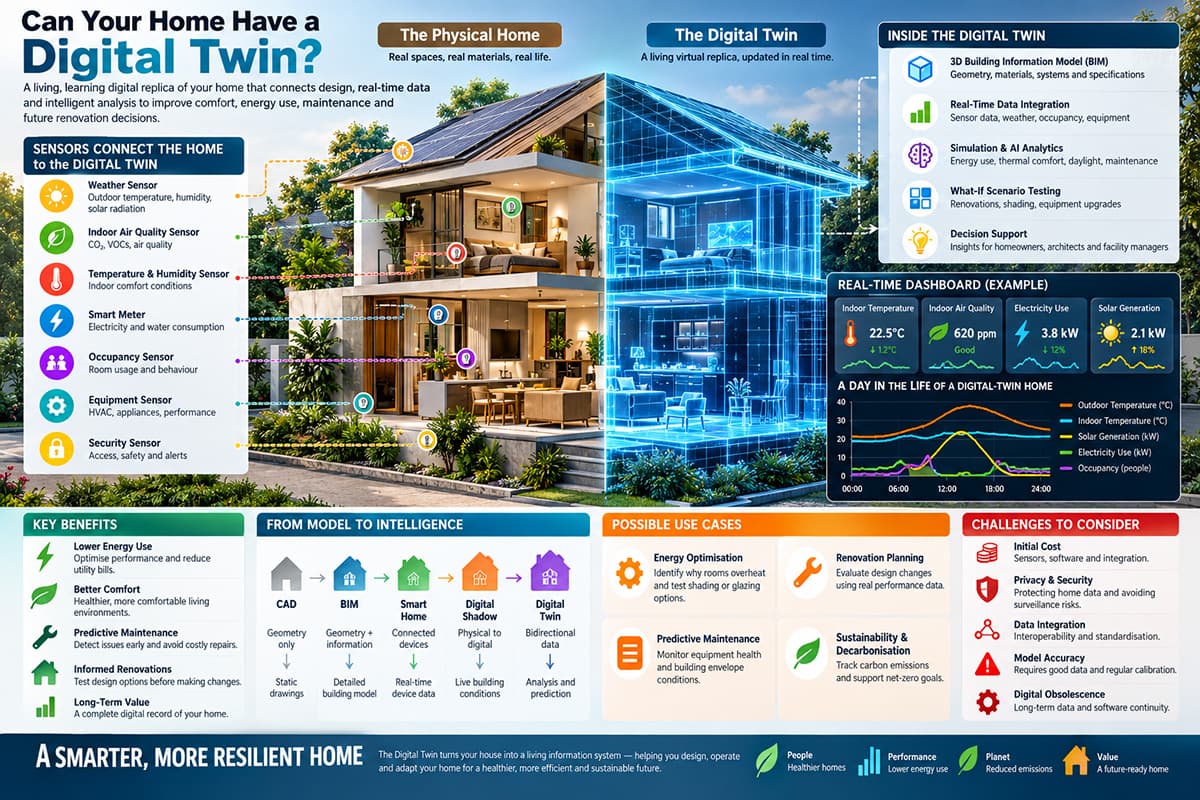
A building digital twin transforms architecture from static representation into a living, data-connected system. By integrating BIM, IoT sensors, real-time data, simulation and AI, digital twins enable architects to understand actual building performance, predict future behaviour, optimise operations and learn from buildings throughout their lifecycle.
 04
04BIM-to-Digital-Twin: The Complete Workflow
Explore the complete BIM-to-Digital-Twin workflow—from architectural design and information-rich BIM to IoT integration, real-time building data, AI analytics and predictive operations. Discover how Digital Twins transform static building models into connected, intelligent environments that continuously monitor, learn and optimise building performance.
 05
05Using Algorithms to Optimise Apartment Layouts
Explore how algorithms, genetic optimisation, reinforcement learning and generative AI are transforming apartment layout design. Discover how computational architecture can optimise space efficiency, daylight, circulation, privacy and adaptability while keeping architects at the centre of design decisions.
 06
06Evolutionary Algorithms in Architecture: Designing Through Variation, Selection and Performance
Explore how evolutionary algorithms are transforming architecture through genetic algorithms, computational optimisation, performance simulation and multi-objective design. Discover how architects can evolve thousands of alternatives, identify Pareto-optimal solutions and combine computational intelligence with human design judgement.
 07
07Algorithmic Façade Design: From Surface Composition to Performance-Driven Building Skins
Explore how algorithmic façade design transforms building envelopes through parametric modelling, generative algorithms, environmental simulation and multi-objective optimisation—allowing architects to create responsive, performance-driven façades balancing daylight, energy, comfort, carbon, constructability and architectural expression.
 08
08Human-in-the-Loop Architecture: Why Designers Must Remain in Control
Human-in-the-Loop Architecture offers a powerful alternative to autonomous AI design. By combining generative intelligence, simulation and optimisation with human creativity, contextual understanding, ethical judgement and professional accountability, architects can harness AI while remaining firmly in control of the decisions that shape our built environment.
 09
09Can AI Understand Architectural Context?
Can AI truly understand architectural context? Explore how artificial intelligence interprets climate, urban fabric, culture, history, vernacular architecture and human experience—and why the future of design may lie in architect-led, AI-augmented contextual intelligence.
 10
10AI-Powered Design Optimisation: Daylight, Energy, Cost and Comfort Together
AI-powered design optimisation is transforming architecture by evaluating daylight, energy, cost and occupant comfort simultaneously. By combining parametric design, building-performance simulation, machine learning and multi-objective optimisation, architects can rapidly explore thousands of alternatives and identify high-performance, climate-responsive design solutions.