
18 · The Chicago School & the Birth of the SkyscraperNo. 07 in era
Woolworth Building
The Cathedral of Commerce — a record-breaking steel tower dressed in Gothic terracotta, the moment the American skyscraper stopped being merely tall and reached for cultural grandeur. From 1913 to 1930 it was the tallest building in the world.
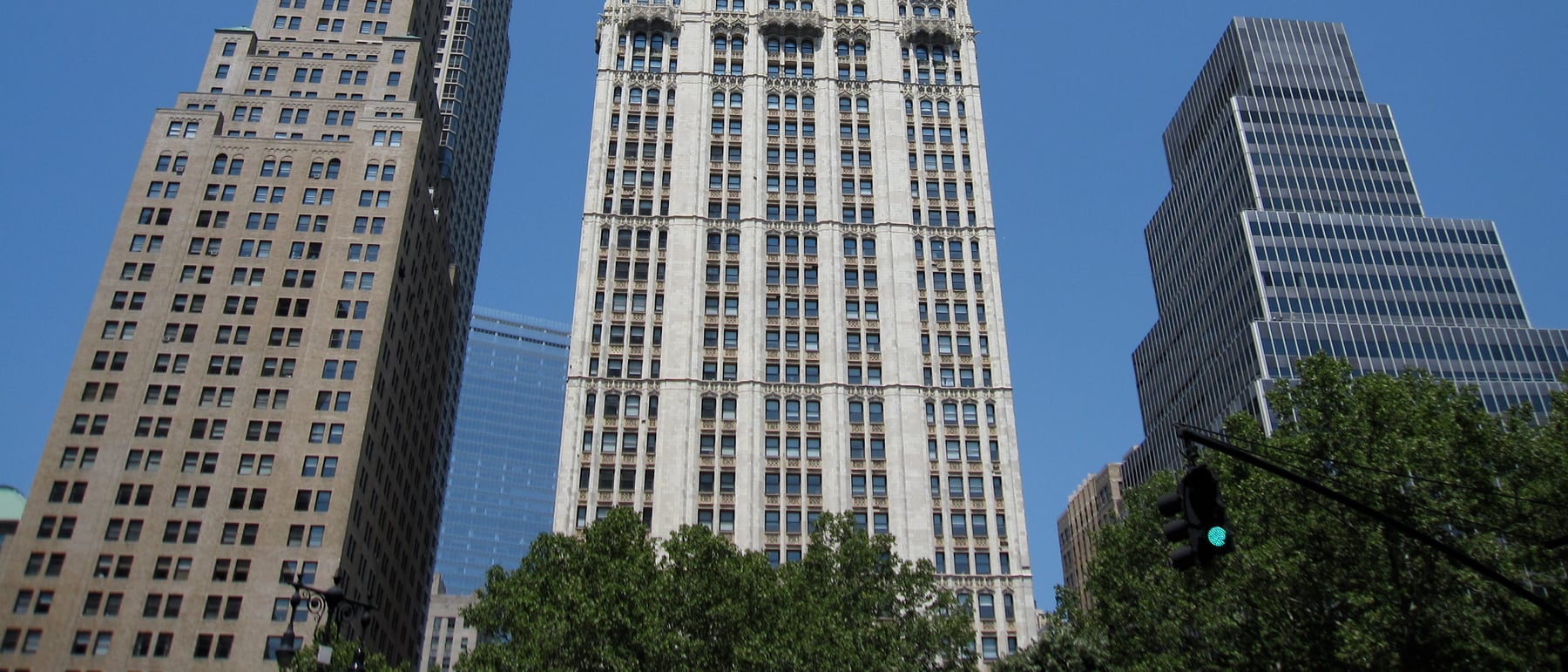
1. The tallest building in the world
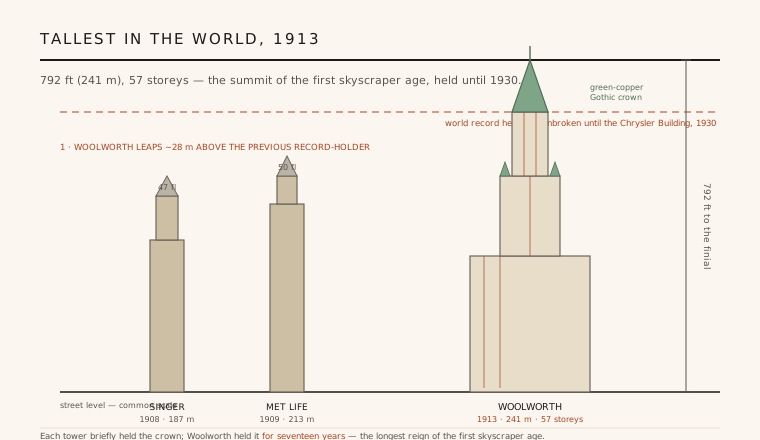
When it opened on Broadway opposite City Hall Park in 1913, the Woolworth Building rose 792 feet (241 m) over 57 storeys and seized the title of tallest building in the world — a crown it would hold for seventeen years, until the Chrysler Building overtook it in 1930. It leapt roughly 28 metres past the previous record-holder, the Metropolitan Life Tower, and stood as the undisputed summit of the first skyscraper age.
It was built by the retail magnate Frank W. Woolworth and famously paid for in cash — about US$13.5 million — as a deliberate advertisement for his five-and-dime empire. Height here was not an accident of the site or a by-product of land values; it was the point. The building was commissioned to be seen from across the harbour and to fix an image, and in doing so it turned raw altitude into a piece of corporate branding.
2. The steel frame and the reach for height
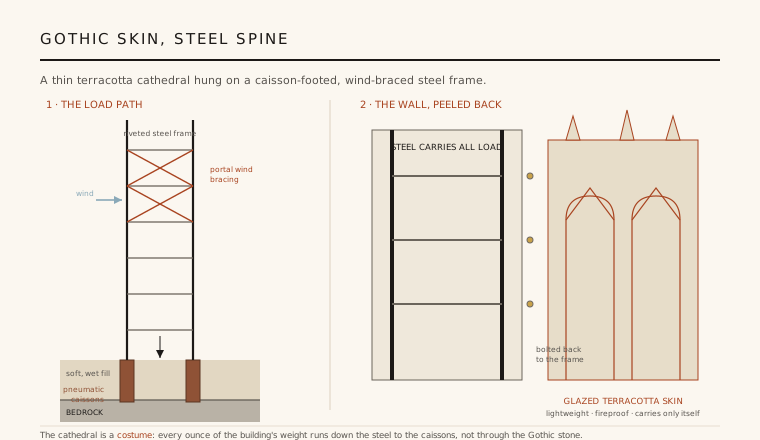
A tower this slender is only possible because of the steel skeleton frame — the Chicago-born idea that a riveted cage of columns and beams, not the outer walls, carries the load. Gunvald Aus engineered a frame that let the building climb far beyond what masonry could bear, with the exterior reduced to a curtain that carries only its own weight.
Getting there demanded two harder feats. The soft, wet ground of Lower Manhattan could not support the load, so the builders sank deep pneumatic caisson foundations — pressurised working chambers driven down through the fill to bedrock, roughly 30 metres below the street, so the whole mass lands on solid rock. And because a tower so tall and narrow is vulnerable to wind, the frame was stiffened with portal wind-bracing — deep riveted knee-braces and portal connections between columns and girders that turn the cage into a rigid, sway-resistant structure. Height, at this scale, is as much a foundation-and-wind problem as a strength problem.
3. A cathedral of terracotta over a cage of steel
Cass Gilbert clad this thoroughly modern frame in the dress of a medieval cathedral. The steel was faced in cream, lightweight, fireproof glazed terracotta modelled into Gothic tracery, flying-buttress-like crockets, pinnacles and gargoyles, and crowned by a soaring green-copper Gothic spire. Gilbert chose Gothic deliberately: its upward-striving vertical lines were the perfect visual grammar for a very tall building, drawing the eye ceaselessly skyward. At the 1913 opening a clergyman called it the "Cathedral of Commerce," and the name stuck.
The honest point — and the one that matters most to architecture — is that this Gothic is a thin decorative skin, not structure. The terracotta carries nothing but itself; it is bolted back to the steel frame as a facing, chosen partly because it was light and fire-resistant and partly because it could be moulded cheaply into endless ornament. The cathedral is, structurally, a costume. Ornament here has become advertising and cultural aspiration — a modern commercial machine wrapped in the borrowed authority of the Middle Ages.
4. The lobby and the caricatures
The cathedral analogy continues indoors. The lobby is a lavish, cruciform, vaulted hall lined in veined marble and roofed with glittering glass mosaic in a Byzantine-Gothic manner — a secular narthex meant to awe the visitor exactly as a great church nave would. Light, colour and rich material are marshalled to make commerce feel sacred.
Yet Gilbert leavened the solemnity with wit. Tucked into the vaulting are carved corbel caricatures of the building's makers: Frank Woolworth counting his nickels and dimes, the renting agent closing a deal, and Gilbert himself cradling a model of the tower. It is a rare, self-aware joke built into a monument — a reminder that this cathedral was raised not to a god but to a five-and-dime fortune, and knew it.
5. The skyscraper as secular cathedral
The Woolworth Building fixed an image that the twentieth century never let go of: the tall commercial tower as a secular cathedral, an object of civic pride and corporate identity rather than mere floor area. By marrying record-breaking engineering to unashamed cultural ambition, it argued that the skyscraper could be monumental architecture — not just efficient real estate — and it set the template the Chrysler and Empire State buildings would follow within two decades.
It also crystallised a tension the discipline is still arguing about. Beneath the tracery, this is a rational steel cage; the Gothic is applied. Modernists would later condemn exactly this split between honest structure and borrowed ornament, and strip the skin away. But the Woolworth Building's frank theatricality — dressing new technology in cultural memory to make people care about it — is a strategy that never truly died, and that postmodernism would one day openly celebrate.
Every corporate supertall that spends its budget on a sculpted, brand-defining silhouette — from Gehry's crumpled tower on Spruce Street a few blocks away to the crowns of Petronas and Shanghai — is still playing Woolworth's game: turn structural height into cultural image and let the building advertise its owner to the skyline.
References & further reading
- 01Fenske, G. (2008). The Skyscraper and the City: The Woolworth Building and the Making of Modern New York. University of Chicago Press, Chicago.
- 02Landmarks Preservation Commission, City of New York (1983). Woolworth Building Designation Report (LP-1275). New York City Landmarks Preservation Commission.
- 03National Park Service (1966). Woolworth Building — National Historic Landmark Nomination. U.S. Department of the Interior, National Register of Historic Places.
- 04Gibbs, K. T. (1984). Business Architectural Imagery in America, 1870–1930. UMI Research Press, Ann Arbor.
- 05Cohen, B. H. (ed.) (1982). The Woolworth Building: Cass Gilbert's Cathedral of Commerce. Skyline / Rizzoli, New York.
Last verified 2026-07-08. Ancient and vernacular works often have no single architect or firm date; dates are given as widely accepted approximations and the builder-culture is named where no individual designer is known.