
25 · Late Modern, Postmodern & the Road to NowNo. 11 in era
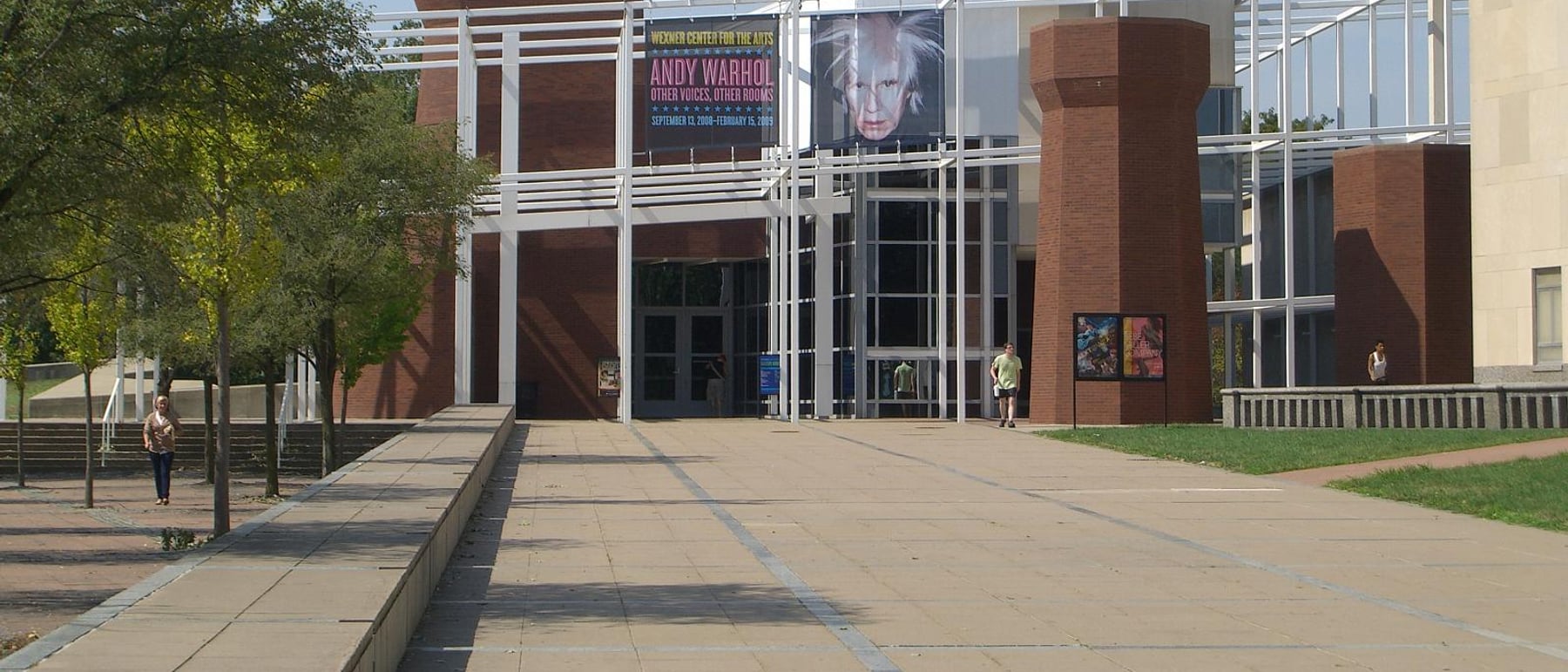
Wexner Center
A building generated not from a programme but from a collision — Peter Eisenman jams the Ohio State campus grid into the tilted Columbus city grid and lets the wreckage stand. The result, opened in 1989, is the first major American monument of Deconstructivism: architecture as theory, brilliant, disorienting, and famously hard to hang a painting in.
1. A form born from a clash of grids
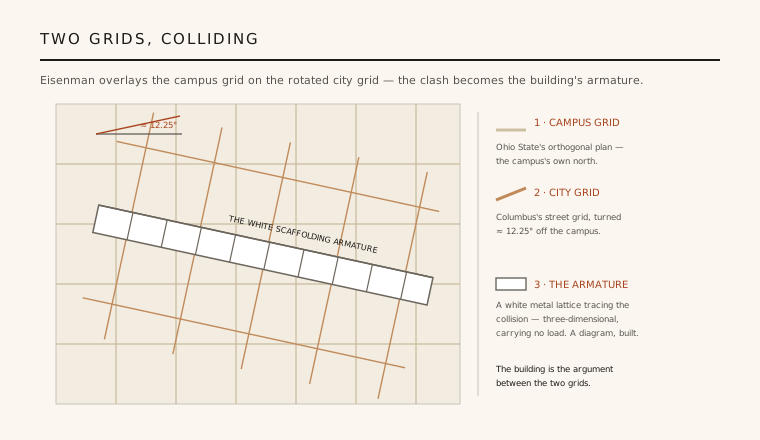
Most buildings begin with a programme — rooms, sizes, a plan. The Wexner Center begins with an argument. Ohio State's campus is laid out on its own orthogonal grid; the city of Columbus is laid out on a slightly different one, rotated about 12.25° off the campus. Eisenman took both grids, superimposed them across the site, and refused to reconcile them. The building is the frozen record of their collision.
That collision is made literally visible as a white metal scaffolding — a three-dimensional, gridded armature that marches through and across the building like an abstract diagram made solid. It looks structural but carries almost nothing; it is the two grids arguing in space. Circulation, walls and openings all take their cues from this doubled geometry, so the visitor moves through a plan that is deliberately never quite resolved.
2. Architecture as text — Eisenman's theory
Eisenman came to the Wexner Center less as a builder than as a theorist. Drawing on post-structuralist thought — Jacques Derrida's deconstruction above all — he argued that architecture could be read like a text: something to be taken apart, its assumptions exposed, its stable centre removed. He called this "decentring". The building is meant to resist the comfortable readings — front and back, up and down, figure and ground — that we normally impose without noticing.
This is why the Wexner reads as a diagram rather than a composition. Its logic is generative and rule-based: apply the two grids, trace their interference, and let the by-products — the scaffold, the misalignments, the leftover slots of space — become the architecture. The building does not try to look beautiful in the classical sense; it tries to make its own process of thinking visible, which is exactly what made it a manifesto.
3. Provocations: fragmentary towers and a column that hangs
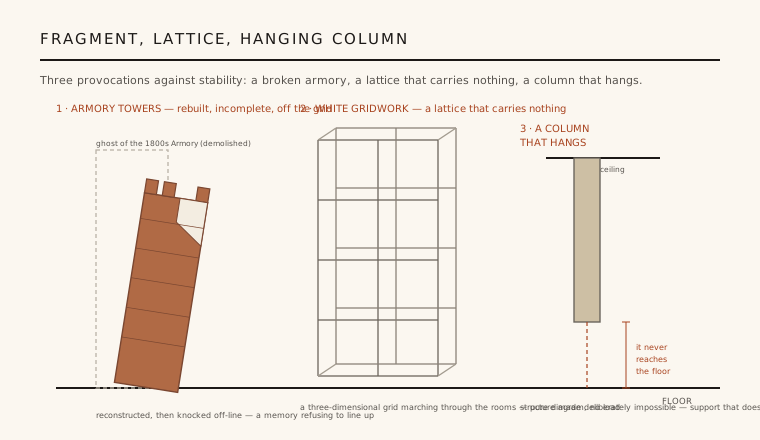
On the site once stood a 19th-century Armory, a red-brick castle-like building long demolished. Eisenman reconstructs it — but only in fragments, incomplete and knowingly off-line, its brick towers pushed off the grid so they read as memory rather than restoration. They are quotations of a lost building, deliberately unfinished and unaligned, a history that refuses to sit straight.
The most notorious provocations are structural jokes with a serious point. Columns descend from the ceiling and stop short of the floor, appearing to hang rather than support; grids run into one another and never resolve; stairs and corridors disorient. Each move attacks the idea that architecture must express stability and function. Eisenman wants you to feel the ground shift — support that does not support, order that will not cohere.
4. Deconstructivism, and a place in the canon
In 1988 the Museum of Modern Art mounted Deconstructivist Architecture, curated by Philip Johnson and Mark Wigley, gathering Eisenman alongside Frank Gehry, Zaha Hadid, Rem Koolhaas, Daniel Libeskind, Bernard Tschumi and Coop Himmelb(l)au. The show named a sensibility — fractured geometry, instability, the diagonal against the orthogonal — that the Wexner Center, then rising in Columbus, embodied almost perfectly. When it opened in 1989 it was widely read as the movement's first major American public building.
Its importance is disciplinary rather than merely stylistic. The Wexner demonstrated that a building could be driven by an explicit theoretical programme — legible, arguable, teachable — and still get built at civic scale. For a generation of architects and students it proved that the diagram, the grid-clash and the refusal of resolution were not just paper ideas but could become inhabitable space.
5. Theory over function — and the reckoning
The honesty the building demands of others it also owes about itself: as a place to show art, the Wexner Center was notoriously difficult. The white armature cut through the galleries, the grids produced awkward angled walls and slots, skylights admitted damaging daylight, and curators struggled to find clean, orthogonal surfaces on which to hang paintings. Theory, here, plainly won out over function — the galleries fought the art rather than serving it.
The reckoning came with a major 2005 renovation that reworked the environmental systems and gallery conditions to make the spaces genuinely usable for exhibitions. That the building needed remediation is part of its lesson, not a footnote to it: the Wexner Center is at once a landmark of architectural thought and a cautionary tale about what happens when the idea is asked to carry more than the building can.
Every parametric and diagram-driven building since — from Zaha Hadid's fractured geometries to today's script-generated forms — descends from the Wexner's wager that a rule, rigorously followed, can generate architecture; and its gallery troubles still warn each of them that a compelling diagram is not yet a usable room.
References & further reading
- 01Johnson, P. & Wigley, M. (1988). Deconstructivist Architecture. The Museum of Modern Art, New York (exhibition catalogue).
- 02Eisenman, P. (1989). Wexner Center for the Visual Arts, The Ohio State University. Assemblage 10, 68–89. https://doi.org/10.2307/3171142
- 03Bédard, J.-F. (ed.) (1994). Cities of Artificial Excavation: The Work of Peter Eisenman, 1978–1988. Rizzoli / Canadian Centre for Architecture, New York.
- 04Frampton, K. (2007). Modern Architecture: A Critical History (4th ed.). Thames & Hudson, London.
- 05Wexner Center for the Arts (2024). About the Building: History and Architecture. The Ohio State University (institutional record). https://wexarts.org/about/building
Last verified 2026-07-11. Ancient and vernacular works often have no single architect or firm date; dates are given as widely accepted approximations and the builder-culture is named where no individual designer is known.