
10 · East & Southeast AsiaNo. 15 in era
Wat Arun
On the Thonburi bank of the Chao Phraya rises a corn-cob mountain of broken porcelain — a Khmer temple-tower reimagined at Rattanakosin Bangkok scale and clad, not carved, in thousands of shards of recycled Chinese crockery that catch the first and last light. This is the Temple of Dawn.
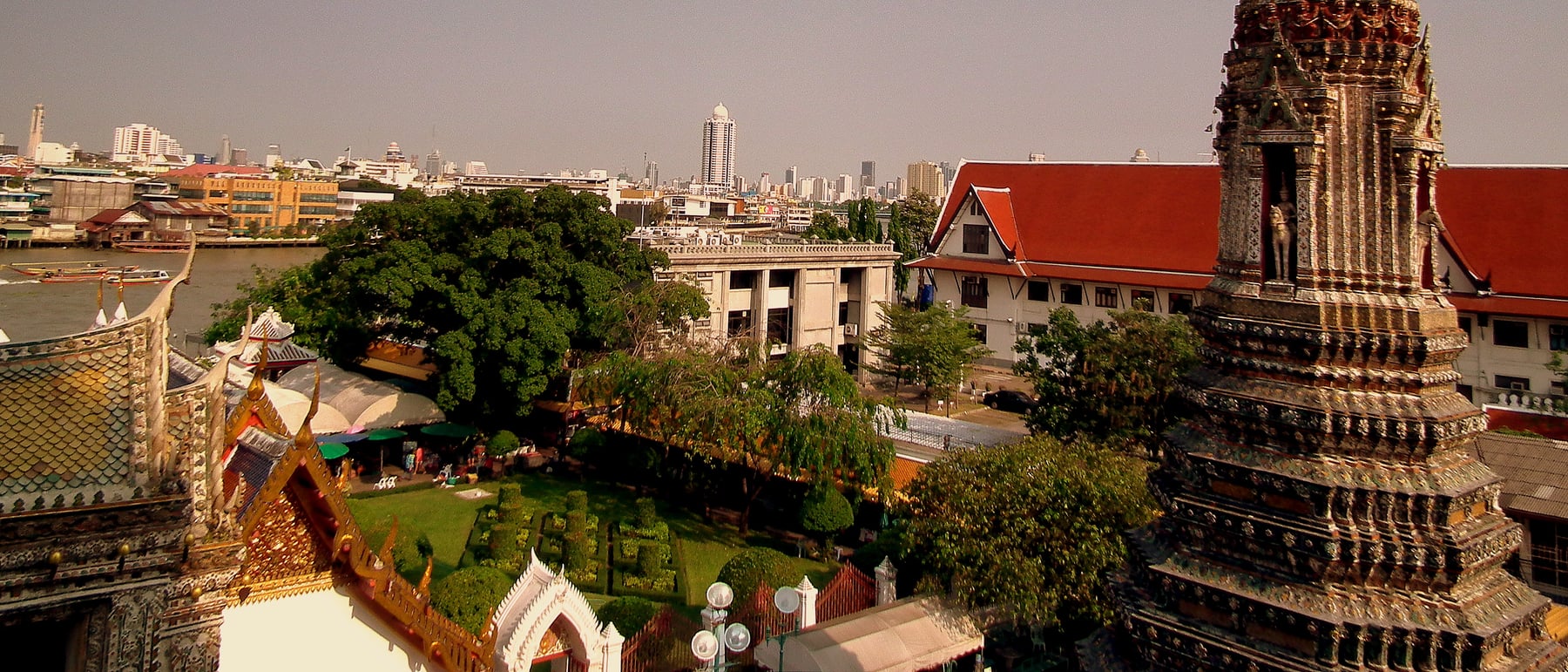
1. A temple-mountain reset at Bangkok scale
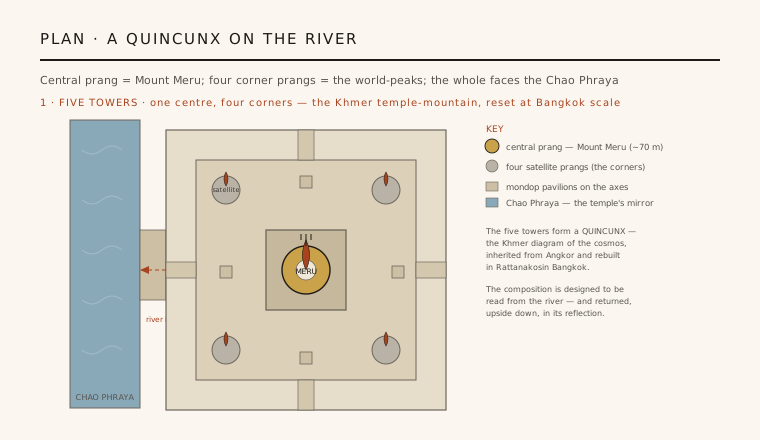
Wat Arun's landmark is its great central prang — a tall, tapering, corn-cob-shaped tower that descends directly from the Khmer prasat or temple-mountain, the same form crowning Angkor. Like its Khmer ancestor the prang is a model of Mount Meru, the cosmic mountain at the axis of the Buddhist-Hindu universe. It does not stand alone: four smaller satellite prangs are set at the corners of its terraced platform, so that the five towers together form a quincunx — one centre, four corners — the ancient diagram of the world and its ringing peaks.
What makes Wat Arun matter to the discipline is the transposition. A cosmological plan invented in stone across the medieval Khmer empire is here inherited by early-19th-century Siam and rebuilt in brick, stucco and ceramic on the riverbank of a new capital. The site is old — an Ayutthaya-era temple stood here — but the colossal prang is a Rattanakosin ambition, begun under Rama II and raised to its full height under Rama III around 1851. It is the moment a borrowed cosmic form becomes an emphatically Thai monument.
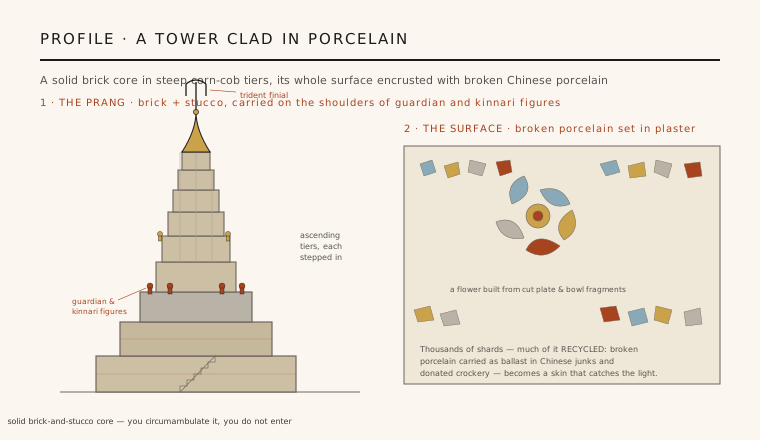
2. A solid mountain you circle, not a room you enter
The prang is not a building in the ordinary sense — it has no interior hall. Like a stupa, it is a solid core of brick faced in stucco, a mass to be walked around rather than walked into. The devotional act it stages is circumambulation: you move around and, by its steep flights of stairs, partway up the base, reading the mountain from outside. Structurally this is the logic of the Khmer prasat stripped of its narrow corbelled cell — Wat Arun keeps the silhouette and the symbolism but makes the tower essentially sculptural.
That silhouette is built from steep ascending tiers and encircling terraces that step inward as they rise, giving the redented, corn-cob profile its characteristic ribbed climb. At successive levels, tiers of small figures — yaksha demon guardians, monkey warriors and kinnari bird-maidens — appear to shoulder the tower, so the mountain seems literally carried by the beings of the cosmos. The whole is crowned by a gilded trident finial, the vajra associated with Shiva and Indra, planting the tower's summit firmly in the heavens.
3. The signature surface: a skin of broken porcelain
Wat Arun's most original contribution is not its shape but its surface. Where a Khmer tower would be carved sandstone and an Ayutthaya one gilded and lacquered, the prang is clad in a mosaic of countless fragments of broken Chinese porcelain and glazed ceramic — plates, bowls and tiles cut, shaped and pressed into the wet plaster to build up flowers, rosettes, patterns and figures across nearly every surface. Estimates run into the millions of pieces. It is a distinctively Thai decorative technique carried to monumental scale: ornament assembled from shards rather than cut into stone.
The material story is as striking as the effect. Much of the porcelain was recycled — broken crockery that had arrived in Bangkok as ballast in Chinese trading junks, together with damaged and donated household china given by the city's population. Thousands of reused fragments thus become a shimmering, faceted skin that scatters daylight, so that the tower glitters at dawn and dusk — the reason it is called the Temple of Dawn. Recycling waste ceramic into a coherent architectural surface is a genuinely inventive act of cladding.
4. Architecture built with the river
Wat Arun is composed for water as much as for land. It stands on the Thonburi (west) bank of the Chao Phraya, and its whole massing — the vertical thrust of the central prang, the balanced corner towers, the glinting ceramic skin — is designed to be read from the river and from the opposite shore, then doubled in the moving reflection below. The building's front is effectively the waterline; its river landing and axial stairs orient the composition toward the current.
This is an urban design instinct as much as a religious one. Bangkok was a city of canals and river traffic, and Wat Arun functions as a landmark on the water, a fixed vertical marker in a horizontal watery landscape, catching the low sun at the two ends of the day. The lesson — that a monument's real façade may be the view across a body of water, and that light and reflection are structural materials — is one contemporary riverfront architecture still relies on.
5. What Wat Arun demonstrates
Wat Arun is a lesson in translation across cultures and materials. It takes a form born in the stone temple-mountains of the Khmer, keeps its cosmic diagram — Meru at the centre, four peaks at the corners — and rematerialises it in the brick, stucco and recycled ceramic of early Bangkok. In doing so it shows that architectural meaning can survive a complete change of material and workshop tradition, and even be intensified by it: the porcelain skin makes the mountain luminous.
Precise figures remain slippery — sources give the central prang's height anywhere from roughly 67 to 82 metres, and the long build straddles the reigns of Rama II and Rama III, with completion usually placed around 1851. That imprecision is worth stating plainly. But the architectural argument is unambiguous: a borrowed cosmic tower, made solid and sculptural, dressed in a mosaic of reused shards, and set to perform for the river and the light — one of the most inventive surface-and-setting ideas in Southeast Asian architecture.
Every contemporary building that turns discarded material into a deliberate architectural skin — from recycled-tile façades to Gaudí's trencadís and today's mosaic of salvaged ceramics — is working Wat Arun's move: make ornament, and light, out of what others threw away.
References & further reading
- 01UNESCO World Heritage Centre (2017). Phra Prang of Wat Arun Ratchawararam: The Masterpiece of Krung Rattanakosin (Tentative List). UNESCO World Heritage Centre (institutional record). https://whc.unesco.org/en/tentativelists/6821/
- 02Ringis, R. (1990). Thai Temples and Temple Murals. Oxford University Press, Singapore.
- 03O'Neil, M. (2008). Bangkok: A Cultural History. Oxford University Press, New York.
- 04Sthapitanonda, N. & Mertens, B. (2012). Architecture of Thailand: A Guide to Traditional and Contemporary Forms. Editions Didier Millet, Singapore.
- 05Warren, W. & Tettoni, L. I. (2002). Arts and Crafts of Thailand. Thames & Hudson, London.
Last verified 2026-07-06. Ancient and vernacular works often have no single architect or firm date; dates are given as widely accepted approximations and the builder-culture is named where no individual designer is known.