
25 · Late Modern, Postmodern & the Road to NowNo. 13 in era
Vitra Fire Station
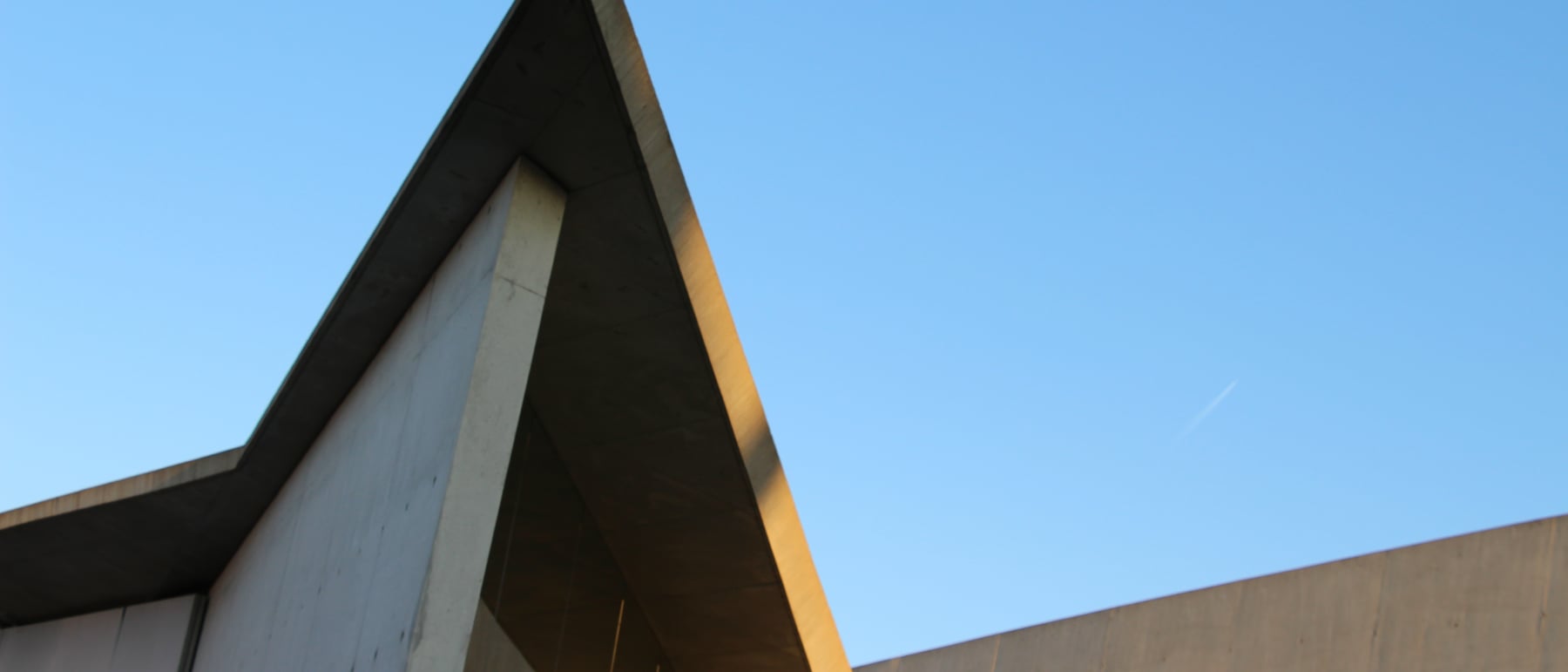
For a decade Zaha Hadid was the most famous architect who had never built anything — a "paper architect" whose explosive drawings seemed to defy construction itself. Then a factory fire on a furniture campus in Germany gave her a chance, and she answered it with frozen motion in raw concrete: leaning walls, colliding planes and a canopy sharpened to a knife-edge prow.
1. The paper architect who could not build
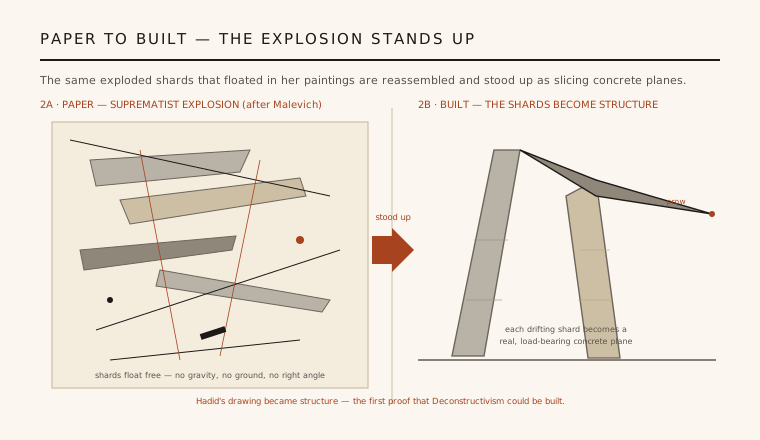
By the late 1980s Zaha Hadid was celebrated and unbuilt in equal measure. Her competition-winning drawings — most famously for The Peak in Hong Kong (1983) — were painted in the fractured, weightless language of Russian Suprematism, splinters and shards flying across the sheet in the manner of Kazimir Malevich. Critics loved them and clients feared them; the consensus was that such explosive geometry simply could not be constructed. She became, in the profession's phrase, a paper architect.
The commission that broke the deadlock was almost incidental. After a fire swept through the Vitra furniture campus at Weil am Rhein in 1981, the company built its own private fire brigade and asked Hadid — then designing a boundary wall and shed for the site — to house it. A small, utilitarian building for a handful of engines became the unlikely vehicle for the first full translation of her painted world into standing structure.
2. Frozen motion in concrete
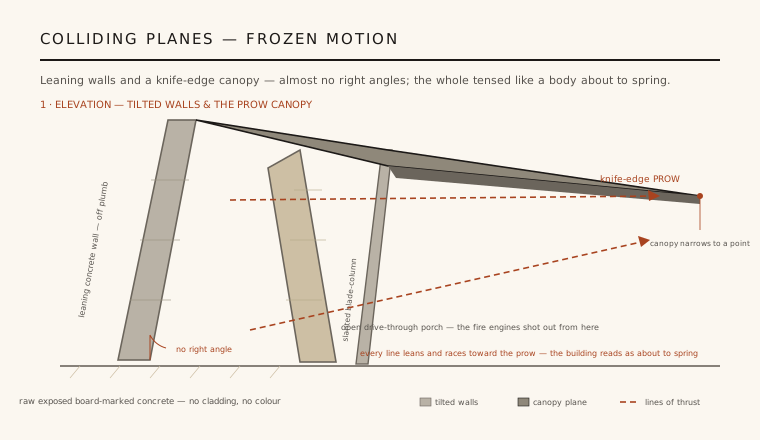
The building is conceived not as rooms but as a collision of planes. Walls tilt off the vertical and slice past one another; the long roof canopy is thrust forward over an open drive-through porch and tapers to a sharp point, a knife-edge prow hovering above the entrance. There is scarcely a right angle in the composition — every line leans, converges or shears, so that the whole mass appears caught mid-movement, tensed like a sprinter in the blocks.
That tension is not arbitrary. A fire station is a machine for alertness, a place whose entire purpose is the instant from stillness to action, and Hadid made the geometry perform exactly that idea. The dynamism a critic would once have called unbuildable here becomes the building's programme: architecture as arrested acceleration, the moment before the engines burst out onto the campus.
3. From the sheet to the slab
What makes the Fire Station historically decisive is that the drawing did not merely inspire the building — it became it. The floating shards of Hadid's paintings were, in effect, stood upright and cast as solid concrete planes. The exploded, layered aesthetic that had existed only on paper was reassembled at full scale, proving that the Suprematist explosion could be poured, reinforced and made to carry load.
The medium was uncompromising: raw, board-marked, cast in-situ reinforced concrete, left exposed inside and out with no cladding, no colour and almost no detail to soften the edges. The material had to be worked to unusually fine tolerances so that walls could meet at acute angles and the canopy could thin to a genuine blade. The result reads as a single monolithic gesture rather than an assembly of parts — the drawing turned to stone.
4. Deconstructivism, actually constructed
The Fire Station arrived at a charged moment. In 1988 Philip Johnson and Mark Wigley's exhibition Deconstructivist Architecture at New York's Museum of Modern Art had grouped Hadid with Frank Gehry, Rem Koolhaas, Daniel Libeskind, Peter Eisenman, Coop Himmelblau and Bernard Tschumi under a banner of instability, fracture and skewed geometry — but much of that work still lived in drawings and models. Completed in 1993, the Vitra building gave the tendency one of its first fully realised, permanent works.
It mattered to the discipline precisely because it was small and real. Where the movement's rhetoric of collapse and disorientation risked remaining a graphic style, Hadid demonstrated that the leaning, colliding, angle-defying manner could be engineered and inhabited. The station became a touchstone: evidence that the fractured line was not a fantasy but a buildable spatial idea.
5. Afterlife and legacy
The building's working life was brief. The angular, dramatic interiors proved impractical for a fire crew, and when Vitra reorganised its emergency arrangements the brigade was relocated. Rather than demolish it, the company kept the structure as an event venue and a gallery for its collection of chairs — so the fire station that launched a career now exhibits the furniture of the campus it once guarded.
For Hadid the consequences were immense. The Vitra Fire Station converted her from a visionary on paper into a builder, opening the path to the Rosenthal Center in Cincinnati, the MAXXI in Rome and the London Aquatics Centre, and in 2004 she became the first woman to win the Pritzker Prize. A modest concrete shed for a few fire engines remains the pivot on which one of the most influential careers in modern architecture turned.
Every fluid, gravity-defying building of the parametric era — from Hadid's own MAXXI to the swooping forms now generated in software worldwide — traces back to this small concrete shed where the unbuildable drawing first stood up.
References & further reading
- 01Hadid, Zaha & Vitra (1994). Zaha Hadid: The Vitra Fire Station. Ernst & Sohn, Berlin.
- 02Johnson, Philip & Wigley, Mark (1988). Deconstructivist Architecture. The Museum of Modern Art, New York.
- 03Jodidio, Philip (2013). Hadid: Complete Works 1979–Today. Taschen, Cologne.
- 04Giovannini, Joseph (2021). Architecture Unbound: A Century of the Disruptive Avant-Garde. Rizzoli, New York.
- 05The Pritzker Architecture Prize (2004). Zaha Hadid: 2004 Laureate — Biography and Jury Citation. The Hyatt Foundation. https://www.pritzkerprize.com/laureates/2004
Last verified 2026-07-11. Ancient and vernacular works often have no single architect or firm date; dates are given as widely accepted approximations and the builder-culture is named where no individual designer is known.