
26 · Vernacular, Gardens & Engineering WondersNo. 11 in era
Villa d'Este Gardens
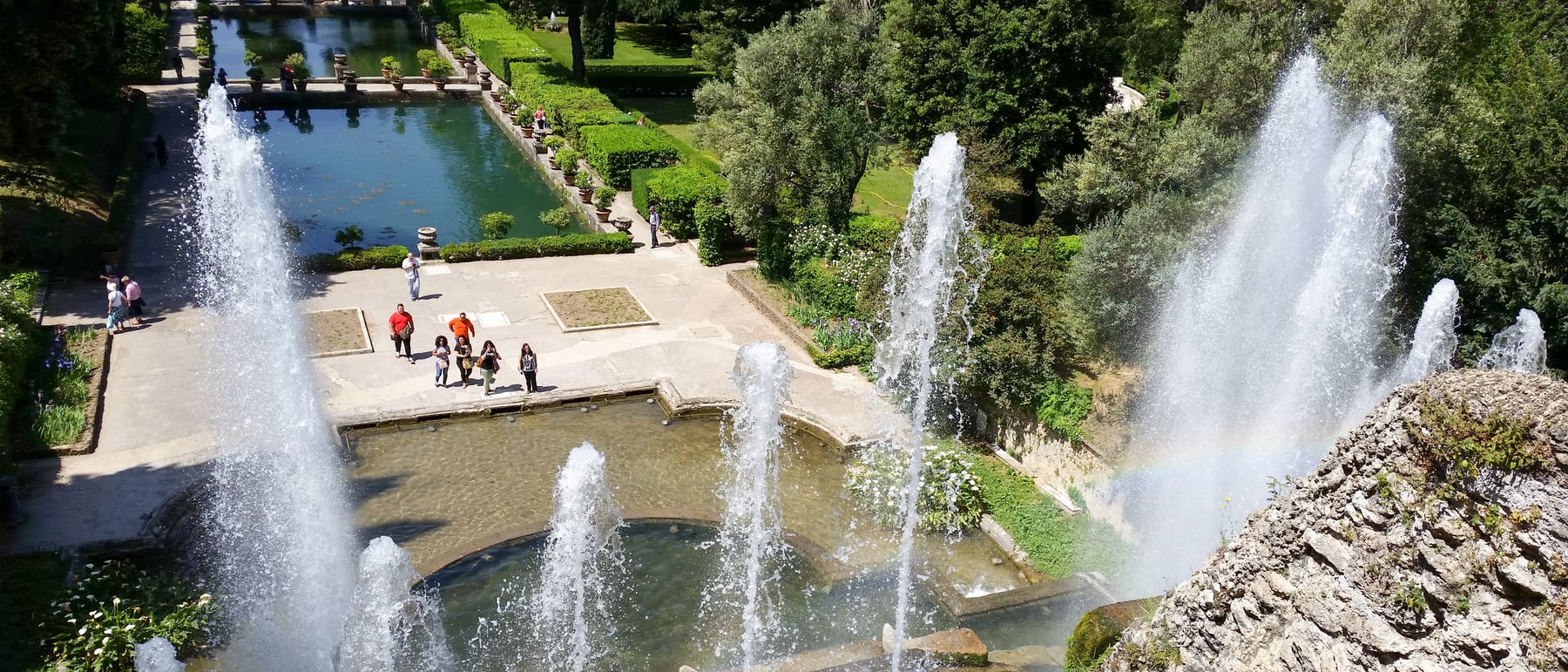
Tivoli, from the 1560s. On a steep hillside above Rome, Cardinal Ippolito II d'Este and his architect-antiquary Pirro Ligorio built a garden of hundreds of fountains, cascades and jets — a water-organ that plays music, artificial birdsong, roaring dragons, a miniature Rome in stone. And not a single pump. The whole spectacle is driven by one thing: the fall of a diverted river down the slope, under gravity alone.
1. A garden built as a machine
The Villa d'Este is remembered as one of the most beautiful gardens in Europe, but it is better understood as a hydraulic machine dressed as a garden. Around 1560 Cardinal Ippolito II d'Este, having failed to win the papacy, turned a steep, awkward slope below the town of Tivoli into a stage for hundreds of fountains, cascades and water-jets — and set his designer, the antiquary Pirro Ligorio, the problem of making all that water move without any means of pumping it. The answer shaped everything: the garden is laid out as a series of descending terraces, so that water released at the top can do its work purely by falling.
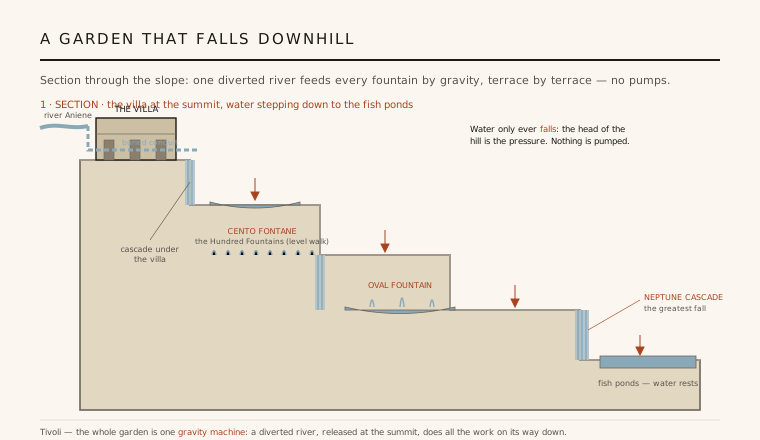
This is the garden's central architectural idea. Ligorio read the site not as a picture to be composed but as a head of pressure to be exploited: the height of the hill is the energy, and every basin, spout and cascade is placed where gravity will reach it. Plan and section are therefore inseparable here — you cannot understand the layout of paths and set-pieces without understanding the invisible fall of water threaded beneath and through them. It is landscape design conceived, unusually for its age, as engineering.
2. The water supply — a diverted river
Hundreds of fountains need an enormous and constant flow, far more than any spring or cistern could give. The solution was audacious: divert the river Aniene itself. Water was drawn from the river and carried to the garden through underground conduits — including a tunnel driven beneath the town of Tivoli — arriving high on the slope with the full head of the hill behind it. From this buried supply the whole system was fed, so that the working parts of the garden were, quite literally, plumbed into a river.
What makes the achievement architectural rather than merely mechanical is its totality and its silence. There are no visible engines, no waterwheels lifting supply, no bellows: the machinery is the terrain itself, hidden in masonry channels and lead pipes under the terraces. The visitor sees only effortless abundance — sheets, arcs and threads of water everywhere — while the labour of moving it has been designed entirely out of sight. That concealment of means behind an appearance of magic is the deliberate art of the place.
3. The water-organ — sound from falling water
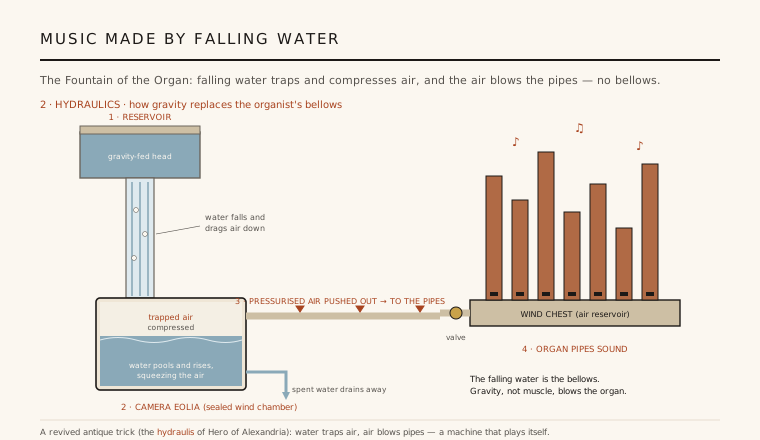
The garden's most astonishing device is the Fountain of the Organ, which does not merely spout water but plays music. Its secret is a piece of revived ancient pneumatics, a camera eolia or wind chamber: water falling down a shaft drags air with it into a sealed chamber, where the water pools and rises and compresses the trapped air. That pressurised air is forced out through a pipe into a wind chest, and a rotating barrel valve admits it to a rank of organ pipes, sounding them. The falling water has simply replaced an organist's bellows.
This is the same principle as the hydraulis described by Hero of Alexandria in antiquity, rebuilt at monumental scale as a garden ornament. Alongside it the garden once held hydraulic automata and artificial birdsong — mechanical birds that sang until an owl appeared and silenced them, another Heronian trick — all powered by the same downhill flow. The point was not gadgetry for its own sake but wonder: architecture that seems to breathe, sing and move on its own, blurring the line between building, instrument and living thing.
4. Theatre, allegory and the set-pieces
The fountains are not scattered but composed as a narrative, read as one descends. The Hundred Fountains (Cento Fontane) run a long level walk lined with an unbroken rank of jets and spouts, a horizontal ribbon of water linking the garden's great cross-axes. The Oval Fountain (Fontana dell'Ovato) gathers a broad basin beneath a crescent of cascades; the Fountain of Neptune stages the garden's most violent fall of water; and the Rometta, a miniature Rome in stone and water, once let the cardinal survey a model of the city he never ruled.
Underlying this is a dense allegorical programme by Ligorio the antiquary, drawing on the myths of Hercules and the local landscape of rivers and hills, so that the walk through the garden reads as a moral and mythological journey. The garden is conceived as theatre: a designed sequence of surprise, framed view and climax, with water as the medium of drama. It set the template for the great water-gardens that followed, from the Villa Lante to, ultimately, the fountains of Versailles.
5. Why it matters
The Villa d'Este demonstrated, more completely than any garden before it, that landscape could be engineered — that the shaping of ground, water and planting was a technical discipline as demanding as building in stone. Its fusion of hydraulic engineering, antiquarian scholarship and stagecraft made the Italian Renaissance water-garden a recognised art form and exported it across Europe; the ambition of Tivoli stands directly behind the vast, pump-assisted spectacles of the seventeenth century. Yet Tivoli itself remained purer: everything it does, it does by falling water alone.
That constraint is also its lasting lesson. Because it refused pumps, the garden had to be designed around its energy source from the first line, terrace, conduit and fountain all resolved together into a single working system. It is an early and eloquent case of what we would now call environmental or passive design — a machine that runs, four and a half centuries on, on nothing but gravity and a diverted river. UNESCO listed it in 2001 as a masterpiece that shaped the European garden.
Every passive, gravity-fed and pumpless water system praised today as sustainable design — rainwater cascades, gravity-drained green roofs, buildings engineered to run on their own head of water — is working the same idea the Villa d'Este proved in the 1560s: let the fall of the land, not a machine, do the work.
References & further reading
- 01Coffin, D. R. (1960). The Villa d'Este at Tivoli. Princeton University Press, Princeton.
- 02Coffin, D. R. (1979). The Villa in the Life of Renaissance Rome. Princeton University Press, Princeton.
- 03Lazzaro, C. (1990). The Italian Renaissance Garden. Yale University Press, New Haven.
- 04Barisi, I., Fagiolo, M. & Madonna, M. L. (2003). Villa d'Este. De Luca Editori d'Arte, Rome.
- 05UNESCO World Heritage Centre (2001). Villa d'Este, Tivoli. World Heritage List, ref. 1025. https://whc.unesco.org/en/list/1025
Last verified 2026-07-11. Ancient and vernacular works often have no single architect or firm date; dates are given as widely accepted approximations and the builder-culture is named where no individual designer is known.