
24 · Brasília & the Modern CityNo. 06 in era
UNAM Central Library
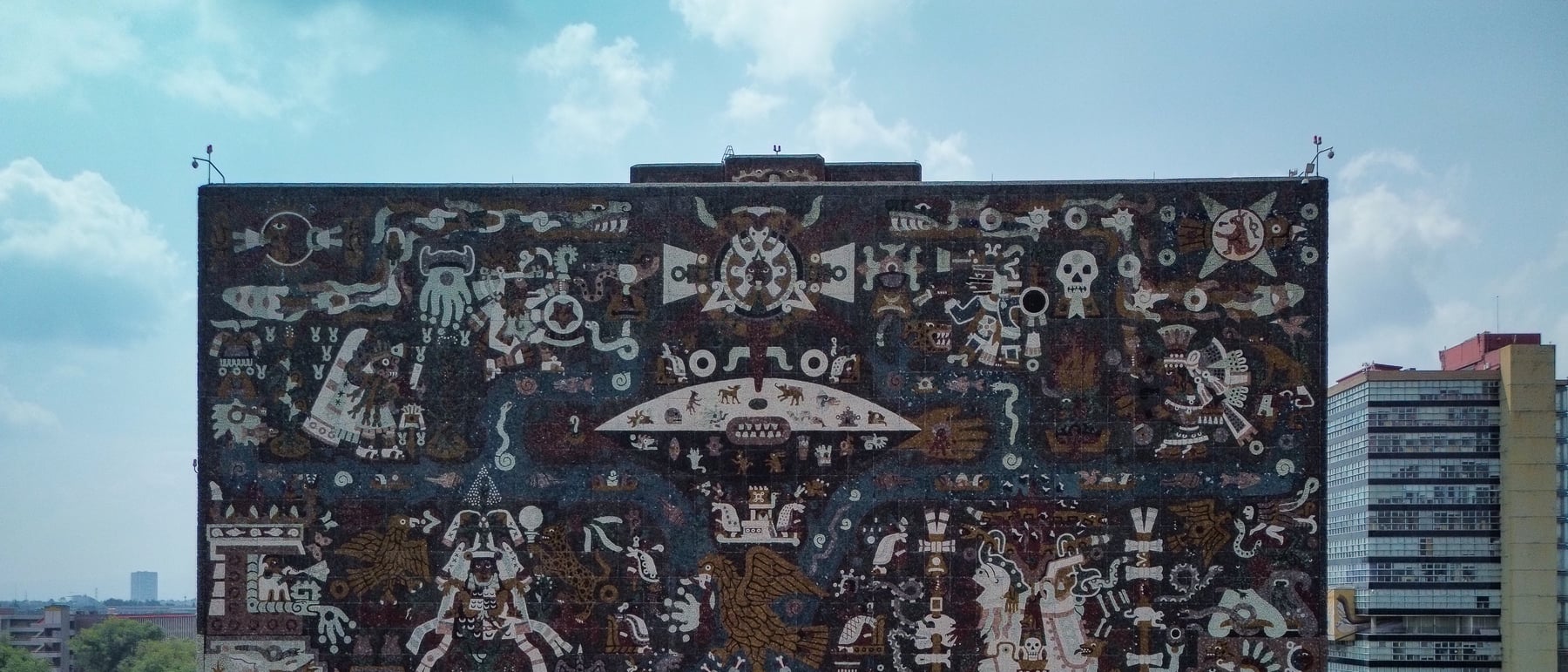
A ten-storey book-stack with almost no windows — and every one of its four blind walls turned into a single ~4,000 m² picture made not of paint but of natural coloured stone, gathered rock by rock from across Mexico. Juan O'Gorman's Central Library is a modern tower that became a mural of the whole nation's history, and the moment a functionalist recanted the placeless International Style.
1. A book-stack turned into a picture
The Central Library's form follows a very ordinary functional fact: a research library needs a tall, dense, climate-stable place to keep its books. O'Gorman gave it a ten-storey book-stack tower set on a low, horizontal, glazed reading-room base — a clear modern parti of a tall closed volume over a transparent public one. The genius is what he did with the stack. Because stored books must be shielded from sun and heat, the tower had almost no need for windows, so its four tall faces became blind walls — four vast, uninterrupted vertical canvases.
Those blank walls are the whole point. Rather than treat windowlessness as a problem to disguise, O'Gorman seized it as an opportunity, wrapping all four facades in one continuous mosaic mural of roughly 4,000 m². The building thus reads at two scales at once: from far across the campus it is a colossal painted billboard of Mexican history; up close it is a precisely detailed field of coloured stone. Structure, program and image are made to coincide — the functional need to keep light out is exactly what supplies the surface for the art.
2. Integración plástica — art built into the campus
The library belongs to a larger, deliberately theorised project: integración plástica, the planned integration of the plastic arts — above all muralism — into architecture itself. Ciudad Universitaria, the new campus for the Universidad Nacional Autónoma de México laid out from 1948, was designed by a team of dozens of architects as a showcase of this idea, and it drew in Mexico's great muralists. Diego Rivera worked the stone-relief of the Estadio Olímpico; David Alfaro Siqueiros built projecting three-dimensional murals onto the Rectory tower; O'Gorman clad the library.
This was not decoration applied after the fact but a doctrine that art and building should be conceived together as one civic statement. In a young post-revolutionary nation, the campus became a manifesto: modern architecture could carry a legible, popular, national narrative rather than remain mute abstraction. The Central Library is the doctrine's most complete demonstration, because here the mural is not a panel hung on a wall — it is the wall, wrapping the entire volume so that the building has no un-narrated face.
3. Stone, not paint — a picture that cannot fade
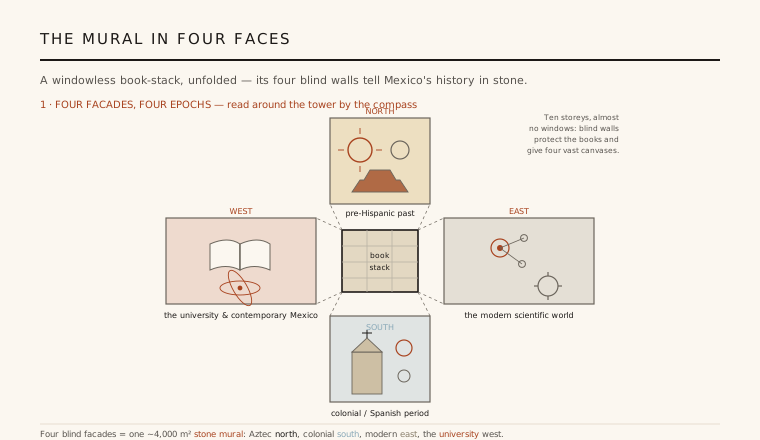
O'Gorman's decisive move was technical as much as artistic. Instead of painting the mural — which the harsh Mexican sun would eventually bleach — he built it from thousands of small tiles of natural coloured rock, each stone used in its own native colour. Reds, ochres, greens, blue-greys, blacks, whites and browns were quarried from many Mexican states, sorted by hue, cut into small pieces and set into precast concrete slabs hung on the blind stack walls. The colour is the mineral itself; there is no pigment, no glaze and no paint anywhere in the picture.
The consequence is permanence. A conventional fresco or oil mural at that scale, fully exposed to weather, would degrade within a generation; a mosaic of stone will hold its colour essentially forever. In doing this O'Gorman reached past European modernism to Mexico's own deep tradition of worked stone and mosaic, and made the material carry the meaning: a history of Mexico literally built out of the earth of Mexico. It is one of the largest permanent murals ever made, and one of very few executed in raw rock at architectural scale.
4. Four facades, four epochs of Mexico
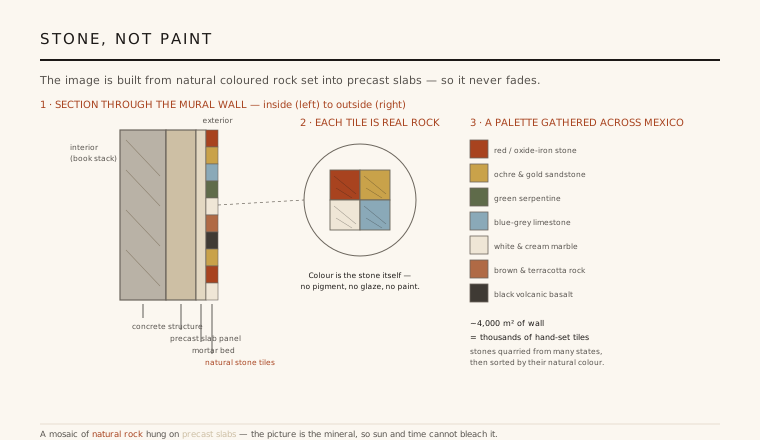
The mural is an iconographic program, a reading of Mexican history that turns around the tower by the compass. The north facade depicts the pre-Hispanic past, centred on the Aztec cosmos with its dualities of sun and moon, life and death. The south facade takes up the colonial, Spanish period, its Christian and imperial imagery marking the Conquest and the fusion of two worlds. Together the two long faces stage the foundational encounter that made modern Mexico.
The remaining faces bring the story to the present. The east facade addresses the modern scientific world — atoms, molecules and the machinery of the twentieth century — while the west facade, above the entrance, turns to the university itself and contemporary Mexico, its emblem and open book. Read as a whole, the four walls are a nationalist, mestizo telling of history in which the university stands as the inheritor and interpreter of all that came before. Whatever one makes of its politics, it is architecture asked to speak, at civic scale, to everyone who crosses the campus.
5. A functionalist recants the International Style
The library is astonishing partly because of who made it. In the early 1930s Juan O'Gorman had been Mexico's most doctrinaire functionalist, building severe glass-and-concrete houses — including the celebrated studio-houses for Diego Rivera and Frida Kahlo — straight out of Le Corbusier's rulebook. The Central Library is his very public reversal: ornamented, symbolic, rooted in place and history, and unmistakably Mexican. He came to see the placeless, universal International Style as a kind of cultural amnesia, and set out to build its opposite.
That makes the building a hinge in modern architecture's story. It anticipates by decades the later critique that modernism had grown rootless, anonymous and hostile to meaning, and it proposes an alternative — an architecture that is technically modern (concrete frame, rational plan, industrial precasting) yet nationally rooted, legible and permanent. The dates 1948–1956 span design through the mural's completion; sources vary slightly on the exact year each facade was finished. What is not in doubt is the result: one of the twentieth century's boldest attempts to give modern architecture a place, a memory and a face.
Every building since that has argued modern architecture must belong somewhere — Barragán's coloured Mexican walls, Luis Fernández-Galiano's regionalism, or any facade today that turns its skin into legible cultural narrative rather than neutral glass — is answering the question O'Gorman posed on this tower: can a modern building carry the memory of a whole people?
References & further reading
- 01Carranza, L. E. & Lara, F. L. (2014). Modern Architecture in Latin America: Art, Technology, and Utopia. University of Texas Press, Austin.
- 02Fraser, V. (2000). Building the New World: Studies in the Modern Architecture of Latin America 1930–1960. Verso, London.
- 03Burian, E. R. (ed.) (1997). Modernity and the Architecture of Mexico. University of Texas Press, Austin.
- 04UNESCO World Heritage Centre (2007). Central University City Campus of the Universidad Nacional Autónoma de México (UNAM). UNESCO World Heritage List, ref. 1250. https://whc.unesco.org/en/list/1250
- 05Curtis, W. J. R. (1996). Modern Architecture Since 1900 (3rd ed.). Phaidon, London.
Last verified 2026-07-10. Ancient and vernacular works often have no single architect or firm date; dates are given as widely accepted approximations and the builder-culture is named where no individual designer is known.