
24 · Brasília & the Modern CityNo. 07 in era
Torres de Satélite
Five hollow prisms of coloured concrete standing in the middle of a suburban interchange, meant to be read not by a walker but by a driver: raised in 1957–58 as the monumental gateway to Ciudad Satélite, Mexico City's new car-suburb, the Torres de Satélite were conceived by the architect Luis Barragán and the sculptor Mathias Goeritz as pure urban sculpture for the age of the automobile. Triangular, tapering, of different heights and painted in flat colour, they overlap and shift as you speed past — architecture with no function but presence, and one of the first works of monumental abstract sculpture set loose in public space.
1. Five prisms and nothing inside
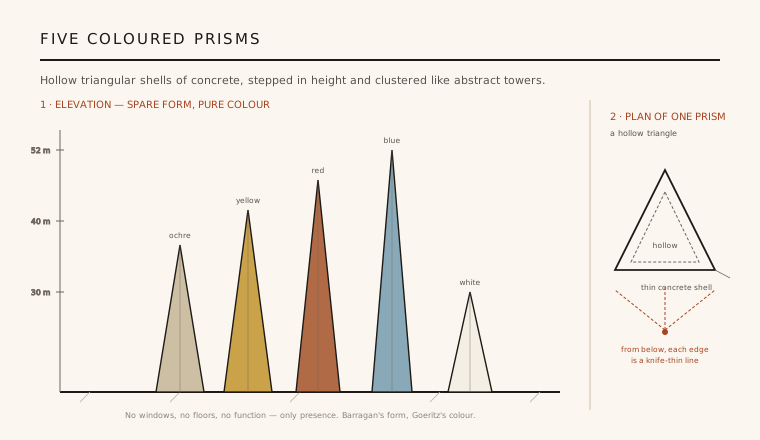
The Torres de Satélite are five triangular towers of reinforced concrete, standing close together on the median of the highway that leads north out of Mexico City. Each is a thin, hollow shell — a prism whose cross-section is a narrow triangle, open at top and bottom, with no floors, no windows and no way in. They taper slightly as they rise and stop at different heights, roughly 30, 37, 42, 45 and 52 metres, so that the group reads as a jostling cluster of unequal spires rather than a tidy row.
This is the first thing to grasp about the work: it is a building only in construction, not in purpose. There is no programme to house, no space to occupy, nothing to serve. What might have been a skyscraper's frame is here reduced to its silhouette — a set of coloured planes and knife-sharp edges held up for their own sake. Barragán and Goeritz built the outline of a city of towers and left the interior out, making pure identity and presence the entire content of the piece.
2. A landmark built for velocity
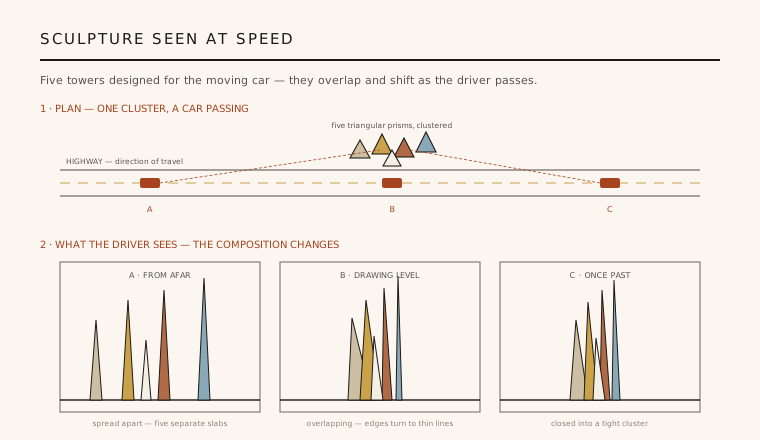
The towers were commissioned as the gateway to Ciudad Satélite, a large new car-suburb master-planned by Mario Pani on the northern edge of the capital. Their whole logic is bound to the highway they stand beside. Goeritz's key insight — radical for a sculpture — was that the audience would almost never be on foot: people would meet the work through a windscreen, at speed, in a few seconds of a passing glance. So the towers were shaped to perform in motion rather than to reward the standing viewer.
As a car approaches, draws level and passes, the five prisms slide across one another. From far off they spread apart into separate coloured slabs; as the driver comes abreast they overlap, their triangular edges turning to thin bright lines; once past, they close into a single tight cluster. The composition is therefore never fixed — it is authored by the movement of the traffic. This makes the Torres one of the earliest deliberate attempts to design a landmark for the experience of the automobile, a marker calibrated to the geometry and tempo of the road.
3. Colour as the second architect
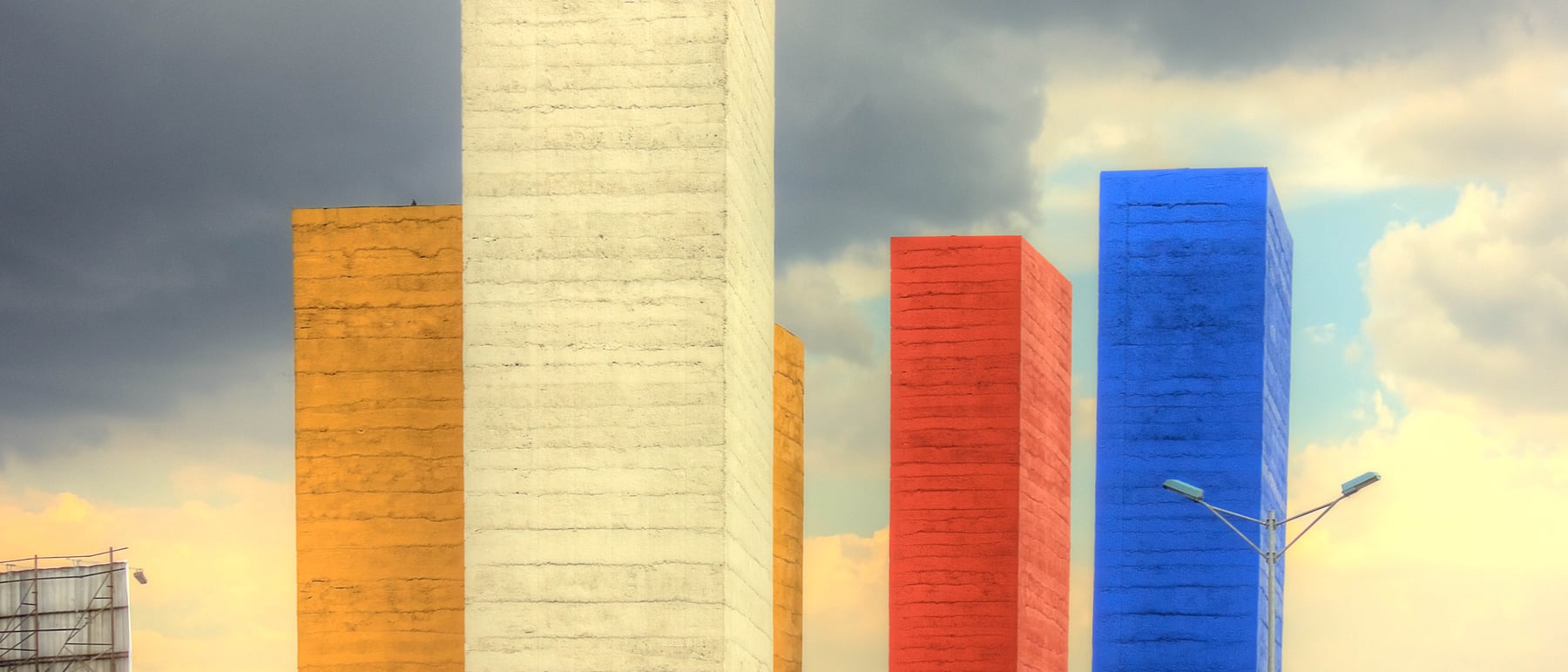
As first built the towers were largely white and ochre, but their identity is inseparable from colour. Goeritz, working with the painter Jesús "Chucho" Reyes Ferreira, later repainted them in vivid flat hues — yellow, white, ochre-orange, red and blue — so that each prism became a distinct chromatic event and the group a bar of pure colour on the horizon. The palette was revised more than once over the decades, and the towers seen today do not carry their original 1958 coats; the colour is a living, restated part of the work rather than a fixed finish.
Colour here does the job that ornament, windows or cladding do on a conventional building: it distinguishes the five near-identical forms, sets up rhythm across the cluster, and makes the towers legible against the enormous Mexican sky. The division of labour is telling — Barragán supplied the austere geometry, the tapering triangular masses and their siting, while Goeritz and Reyes supplied the emotional charge of the paint. Form and colour are authored by different hands, and the tension between them is part of what gives the monument its force.
4. Emotional architecture
The Torres are the clearest built statement of Goeritz's manifesto of *arquitectura emocional — "emotional architecture." First set out in 1953 for his experimental museum El Eco, the idea held that architecture and sculpture had a duty to move the spirit*, to produce awe and elevation, and not merely to solve functional problems. Against the cool rationalism of much International-Style modernism, Goeritz argued for buildings and monuments that work on the emotions the way great religious or archaic art does.
The satellite towers put that theory in concrete. Their scale, their upward thrust and their abstraction were meant to give a young, faceless suburb a jolt of the sublime — a secular equivalent of the campanili and spires that once oriented a town. The work also declares Goeritz's belief that the boundary between architecture and sculpture should dissolve: this is a monument that is neither quite a building nor quite a statue, but a piece of inhabited abstraction planted at the scale of the city.
5. Why it matters to the discipline
The Torres de Satélite occupy an important place in the history of public abstract art. Monumental, non-figurative sculpture placed in ordinary civic space — not in a gallery, not as a memorial to a person, but as pure form giving identity to a place — was almost unknown in the mid-1950s. The Torres anticipated by a decade the great public abstractions of the 1960s and after, and they did so at genuinely architectural scale, blurring the line between land art, sculpture and the built landmark.
They also crystallised a distinctly Mexican modernism: rooted in Barragán's language of plain massive walls, strong colour and emotional restraint, yet outward-looking and abstract. The collaboration made both men's reputations and became a symbol of Mexico City itself. As a demonstration that a work with no use whatsoever could still do essential urban work — orienting, identifying, elevating — the Torres remain a touchstone for anyone thinking about how architecture and art give meaning to the shapeless spaces of the modern car-city.
Every contemporary landmark tuned to the moving eye rather than the standing one — the sculpted highway gateways, the abstract coloured pylons that brand a district, Anish Kapoor's civic monoliths — descends from the Torres de Satélite, which first proved that pure form with no function could still anchor a whole city.
References & further reading
- 01Eggener, K. (2001). Luis Barragán's Gardens of El Pedregal. Princeton Architectural Press, New York.
- 02Zanco, F. (ed.) (2001). Luis Barragán: The Quiet Revolution. Skira / Barragan Foundation, Milan.
- 03Rodríguez Prampolini, I. (1997). Mathias Goeritz: El eco de la arquitectura emocional. Museo del Palacio de Bellas Artes, Mexico City.
- 04Kassner, L. (2007). Mathias Goeritz: Una biografía 1915–1990. CONACULTA / INBA, Mexico City.
- 05Del Cueto Ruiz-Funes, J. I. (2018). Mario Pani and the Making of Modern Mexico City. The Journal of Architecture 23(4), pp. 543–566.
Last verified 2026-07-10. Ancient and vernacular works often have no single architect or firm date; dates are given as widely accepted approximations and the builder-culture is named where no individual designer is known.