
3 · The Classical World (Greece)No. 06 in era
Tholos of Delphi
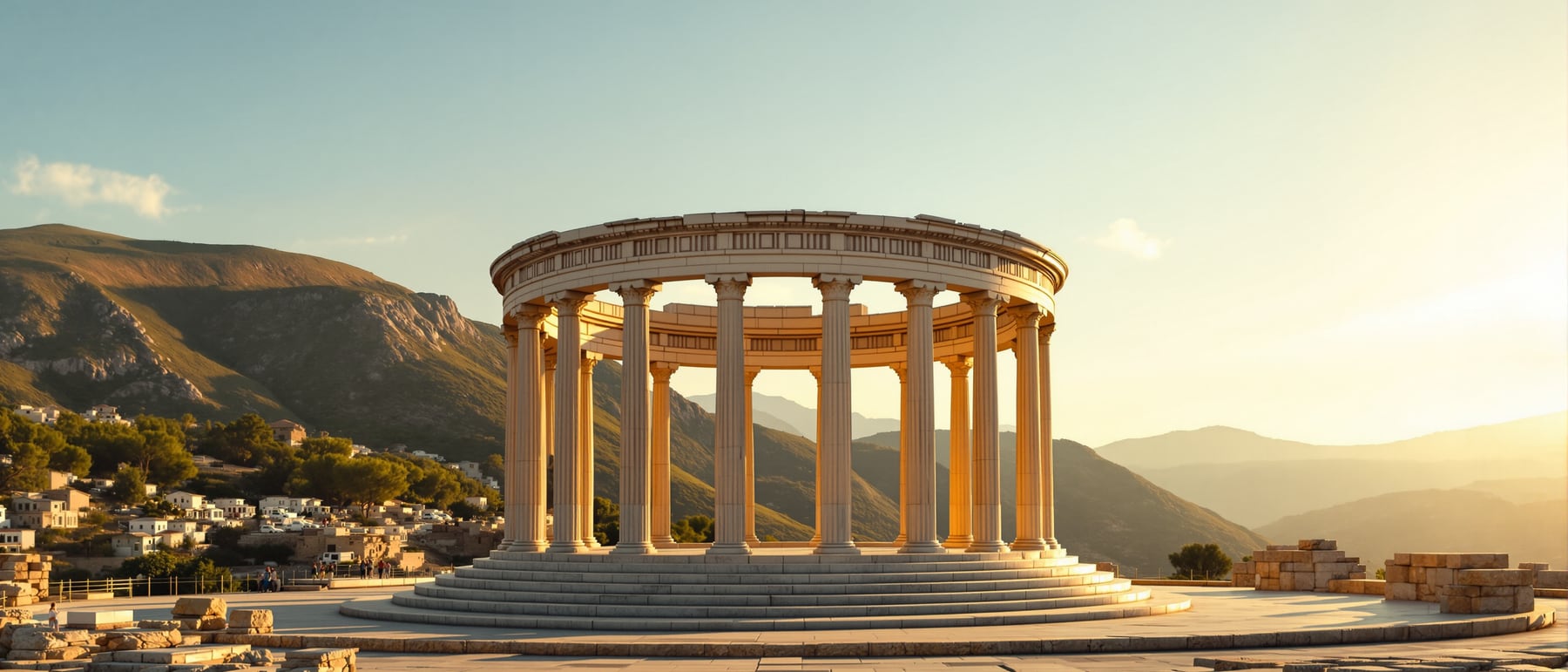
Below the great sanctuary at Delphi stands the most graceful puzzle in Greek architecture — a round marble temple in a world that built only boxes. Twenty Doric columns ring a circular wall lined with Corinthian; the geometry is flawless, the craftsmanship exquisite, and after two thousand years no one can say for certain which god it served or what it was for.
1. The exception: a circle in a world of boxes
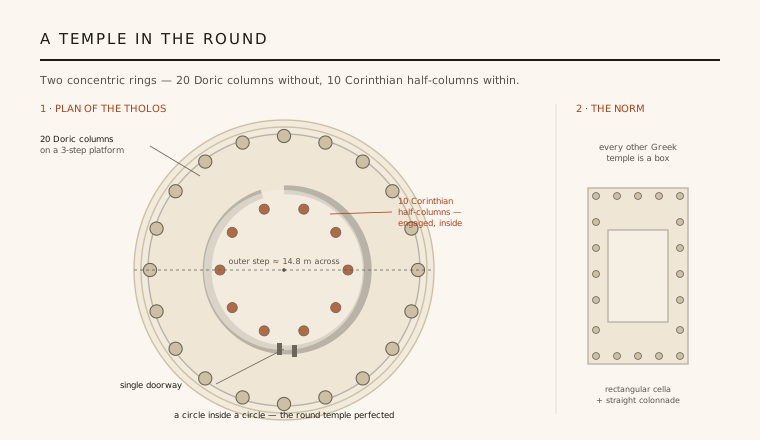
Almost every Greek temple is a rectangle — a long walled room, the cella, wrapped in a straight colonnade. The Tholos of Delphi is one of the rare and deliberate exceptions: a round temple, built about 380 BCE on the terrace of the Sanctuary of Athena Pronaia, the lower precinct a visitor met before climbing to Apollo's oracle. The Greeks called such a building a tholos, and only a handful were ever raised — at Delphi, at Epidaurus, at Olympia, in the Athenian Agora. Each was treated as something special, and the Delphic tholos is the most refined of them all.
Its plan is two circles, one inside the other. A ring of twenty Doric columns stands on a stepped circular platform roughly fourteen and three-quarter metres across, and inside that colonnade rises a circular cella wall enclosing a single round room reached through one doorway. A conical marble roof once capped the whole like the lid of a drum. The effect — a perfectly centred, all-round object with no front and no back — is unlike anything in the rectangular canon, and it is the reason the building has haunted architects ever since.
2. Designing in the round
Building a circle out of the Doric order is far harder than it looks. Doric was invented for straight runs — level architraves, a frieze whose triglyphs and metopes march in a fixed rhythm, cornice blocks that meet at true right angles. Bend that system onto a curve and every course must be re-cut: each architrave block subtly wedge-shaped, each frieze unit set on a radius, the stylobate and steps ground to arcs so that twenty columns lean imperceptibly inward toward a single centre. The Tholos is a tour de force of stereotomy — of carving stone to an exact geometry — and its surviving blocks show refinements worked to fractions of a millimetre.
The materials heightened the effect: the visible order was cut in fine white marble and set off against darker local limestone below, with sculptured metopes carved in relief around the Doric frieze. Antiquity remembered the achievement by name. The Roman writer Vitruvius records that the architect, Theodoros of Phocaea, thought the building important enough to write a treatise about the tholos at Delphi — one of the earliest known cases of a designer publishing an account of his own work, and a sign that even to the Greeks this round temple was a self-conscious feat of design.
3. Two orders, inside and out
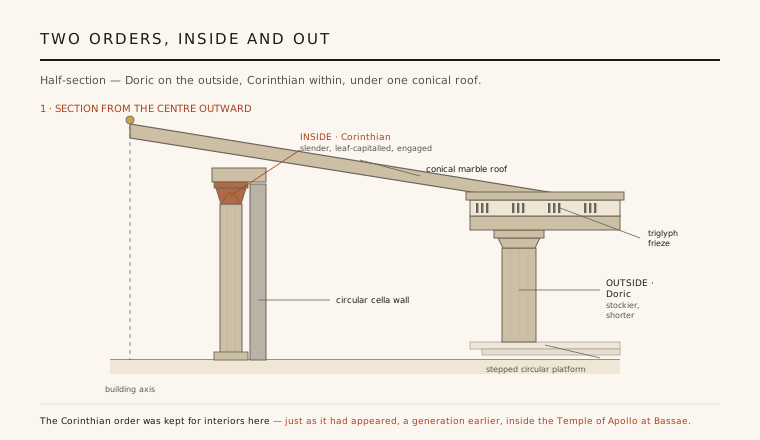
The Tholos does something quietly radical with the Greek orders. Outside, on public view, it wears sober masculine Doric. But the inner face of the round cella wall was lined with ten engaged Corinthian half-columns — the slender, leaf-crowned order kept here for the shaded interior, taller and more delicate than the Doric ring outdoors. It is one of the earliest appearances of Corinthian in Greek building, and it follows a telling precedent: a generation before, the sculptor-architect Iktinos had set a single Corinthian column inside the Temple of Apollo at Bassae.
That pattern — Corinthian used indoors — matters to the whole later history of architecture. For centuries the richest, most ornamental order was reserved for interiors and special effects, a hidden luxury glimpsed past a plainer outer face. The Tholos stages the contrast with unusual clarity: step through the one door and the austere grey Doric of the exterior gives way to a ring of intricate leafy capitals, a shift in register from the civic to the intimate that the plan makes almost theatrical.
4. A mystery of purpose
For all its precision, the Tholos guards a genuine secret: no one knows what it was for. It stands in Athena's sanctuary, so a link to her is likely, yet the building carries no securely identified dedication, and scholars have proposed everything from a shrine of Athena Pronaia to a heroön, a treasury, a cult building for a chthonic or underworld power, or a monument tied to Delphi's tangle of local myths. The round plan itself — closed, centred, hard to fill with the usual furniture of a temple — resists explanation. Round buildings elsewhere in the Greek world served as tombs, council chambers and hero-shrines, which only widens the field of guesses.
It is worth being honest about this uncertainty rather than papering over it: the Tholos is one of the enduring mysteries of Delphi, a masterpiece whose meaning was lost when its cult died. What survives is the architecture itself, and perhaps that is the point. Stripped of a legible function, the building is experienced almost purely as form — as geometry, proportion and craft — which may explain why it has spoken so powerfully to later ages that cared, above all, about exactly those things.
5. Ruin, re-erection and the afterlife of the round
The Tholos fell like the rest of Delphi and lay as scattered drums and cornice blocks until the French School at Athens excavated the sanctuary. In 1938, working from the site's own fragments, archaeologists re-erected three of the Doric columns with a stretch of their entablature — a careful anastylosis that restored just enough of the ring to let a visitor read the curve of the vanished circle. Those three columns, rising against the ravine of Marmaria, have become one of the most photographed images of Greece, standing for a building that is otherwise almost entirely lost.
The idea outlived the ruin. The Greek tholos handed the round temple to Rome, which built it again as the Temples of Vesta and of Hercules Victor and, at monumental scale, as the domed rotunda of the Pantheon. A millennium and a half later Bramante distilled the type into the perfect little Tempietto in Rome (1502), and the eighteenth century scattered its descendants across Europe as garden rotundas and follies. Every centred, columned round pavilion built to mark a special place traces its lineage, in part, back to the mysterious round temple that Theodoros raised at Delphi.
Whenever a modern architect breaks the grid with a pure circular room to signal that a space is set apart — a memorial rotunda, a museum's spiralling drum, a chapel that turns its back on the street — it repeats the Tholos's oldest lesson: that a circle, alone among plans, reads instantly as sacred, centred and complete.
References & further reading
- 01Charbonneaux, J., & Gottlob, K. (1925). La Tholos. Fouilles de Delphes, Tome II: Topographie et Architecture. École française d'Athènes / E. de Boccard, Paris.
- 02Seiler, F. (1986). Die griechische Tholos: Untersuchungen zur Entwicklung, Typologie und Funktion. Philipp von Zabern, Mainz.
- 03Lawrence, A. W., & Tomlinson, R. A. (1996). Greek Architecture (5th ed.). Pelican History of Art. Yale University Press, New Haven.
- 04Vitruvius (trans. Morgan, M. H.) (1914). The Ten Books on Architecture, VII, preface, 12. Harvard University Press, Cambridge, MA.
- 05UNESCO World Heritage Centre (1987). Archaeological Site of Delphi (inscription record). UNESCO World Heritage List, ref. 393. https://whc.unesco.org/en/list/393/
Last verified 2026-07-06. Ancient and vernacular works often have no single architect or firm date; dates are given as widely accepted approximations and the builder-culture is named where no individual designer is known.