
3 · The Classical World (Greece)No. 04 in era
Theatre of Epidaurus
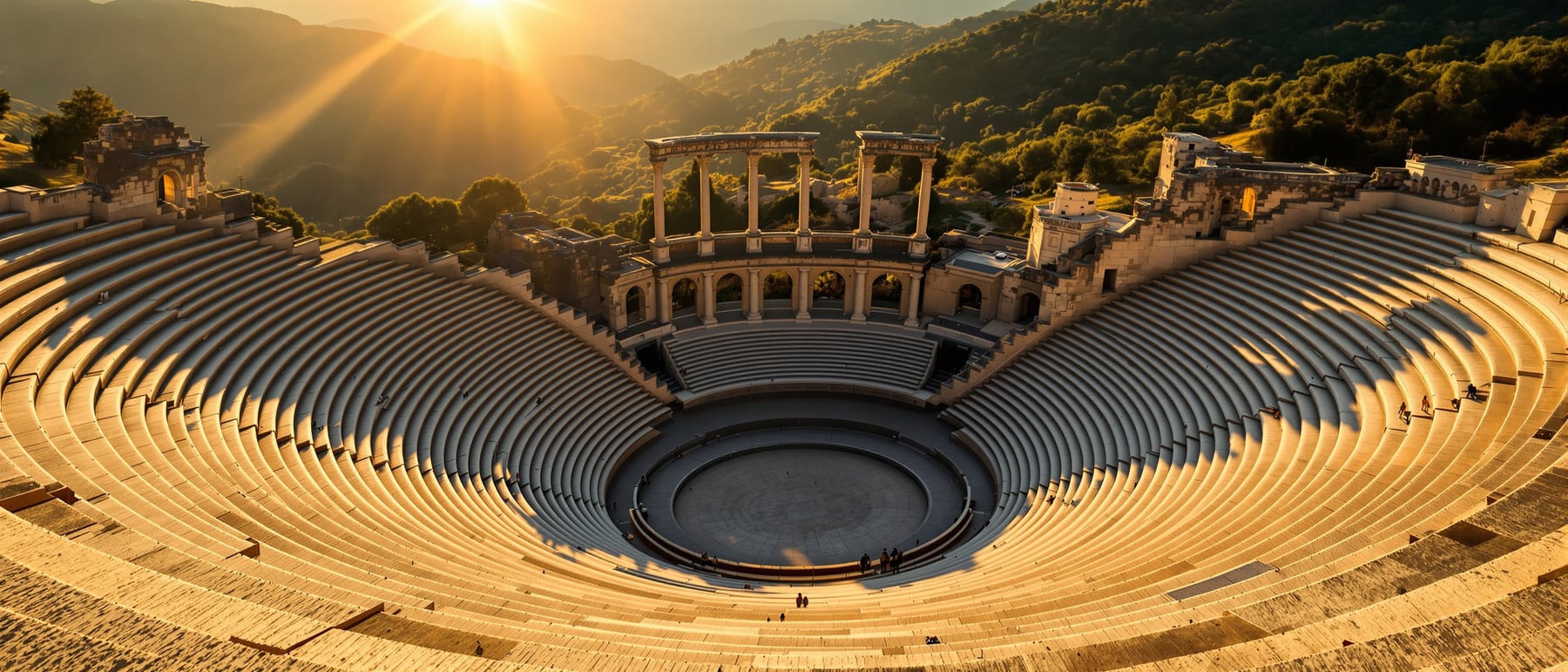
On a slope above the sanctuary of Asklepios, Greek builders stopped fighting the land and started using it — carving a fan of stone seats straight into a hillside to make the perfected Greek theatre: a machine for the human voice.
1. The hillside is the grandstand
Most theatres are buildings you enter; the Theatre of Epidaurus is a landform you occupy. Rather than raise a freestanding structure, its designers found a natural hollow in the flank of Mount Kynortion and cut the seating directly into the slope. The Greek word for the seating bank, the cavea (Greek theatron, 'the seeing place'), is literally earthwork faced in stone — the hill does the structural work that Roman engineers would later have to build up from level ground with vaults and arcades.
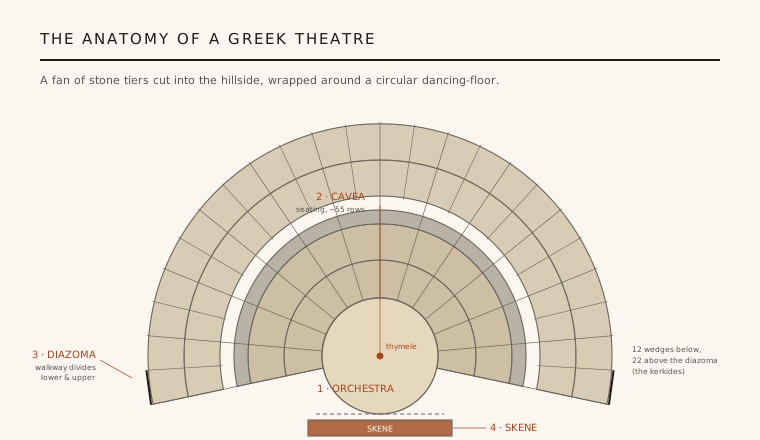
The plan has three parts, and Epidaurus states each with unusual clarity. The fan-shaped cavea of about 55 rows wraps rather more than a semicircle around a circular orchestra, the flat floor where the chorus performed; beyond the orchestra stood the skene, the stage building that served as backdrop and dressing room. Retaining walls (the analemmata) hold the ends of the seating bank against the hill. It is the cleanest surviving diagram of what a Greek theatre is.
2. The circle at the centre
At the heart of the design is the orchestra — a true, complete circle about 20 metres across, marked at its centre by the base of the thymele, a small altar. Epidaurus preserves this full circle better than any other Greek theatre, and that matters: the orchestra, not the raised stage of later tradition, was the original focus of Greek drama. Here the chorus sang and danced, moving in and out through the two side-passages, the parodoi, that funnel between the seating and the skene.
The geometry radiates outward from that circle. Every seat is a segment of a ring centred on the orchestra, so every spectator faces the same point and shares roughly the same sightline to the performers. The design is centripetal — a crowd of up to fourteen thousand people, gathered on a hillside, all aimed at one circle of packed earth and stone. Architecture here is not a container for the event; it is the instrument that concentrates it.
3. Why a whisper carries to the back row
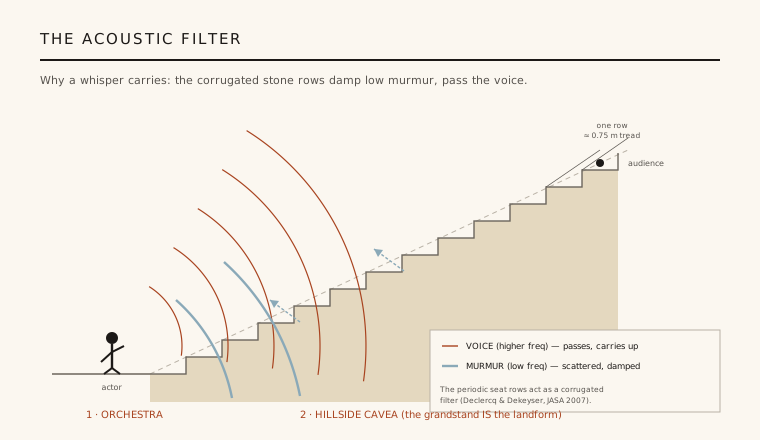
Epidaurus is famous for acoustics so good that a coin dropped in the orchestra, or an actor's ordinary voice, is said to reach the topmost of the 55 rows. For centuries this was credited to prevailing winds, to masks that acted as megaphones, or simply to Greek genius. The real explanation turned out to be the seats themselves. In a 2007 study in the Journal of the Acoustical Society of America, Nico Declercq and Cindy Dekeyser of Georgia Tech showed that the regular, periodic corrugation of the stone rows behaves like an acoustic filter.
The rows form a diffraction grating for sound. They back-scatter and suppress the low-frequency components — the wind, the rustle and murmur of a large audience, the general background noise below roughly 500 Hz — while letting the higher frequencies that carry the intelligibility of speech pass on up the bank. The theatre effectively cleans the signal, damping the noise floor so the voice stands out. Whether or not the builders understood the physics, the geometry of a perfected Greek seating bank produced the effect — and Epidaurus is where it works best.
4. Near-perfect geometry
Epidaurus is prized not only for what survives but for how exactly it was set out. The seating divides into a lower bank of 34 rows and an upper bank of 21, split by a horizontal walkway, the diazoma, that lets spectators circulate without climbing over one another. Radiating stairways cut the seating into wedges — the kerkides — twelve in the lower cavea and twenty-two in the upper, a doubling that keeps every wedge a comfortable, human-scaled width even as the rows grow longer toward the top.
That measured relationship between the two divisions is part of why the theatre reads as resolved rather than merely large. The whole bowl is symmetrical about a single axis running from the top of the cavea through the centre of the orchestra to the skene, and the curves are struck with a consistency that later theatres rarely matched. It is the built equivalent of a proof — the Greek theatre reduced to its essential geometry and executed without slack.
5. The best-preserved theatre — and an honest footnote
The Theatre of Epidaurus is the finest-preserved theatre of the Greek world, which is why it has become the standard image of the type. Its condition also keeps it alive: it still hosts performances of ancient drama each summer as part of the Athens Epidaurus Festival, so the building continues to do the exact job it was designed for some 2,350 years ago — a rare continuity in the history of architecture.
The scholarship is careful about its origins. The traveller Pausanias, writing in the 2nd century CE, credited the theatre to Polykleitos the Younger, and modern historians repeat the attribution while noting it comes some six centuries after the fact. The lower cavea is dated to roughly 340–330 BCE; the upper bank of seats was added later, in the Hellenistic period, lifting capacity to its ~14,000 peak. The attribution and the phasing are traditional and approximate — but the building's mastery is not in doubt.
Every modern concert hall and amphitheatre tuned by acousticians — from Frank Gehry's Walt Disney Concert Hall to open-air venues shaped for speech intelligibility — is chasing what Epidaurus stumbled into: a room whose very geometry filters noise and delivers the voice.
References & further reading
- 01Declercq, N. F., Dekeyser, C. S. A. (2007). Acoustic diffraction effects at the Hellenistic amphitheater of Epidaurus: Seat rows responsible for the marvelous acoustics. Journal of the Acoustical Society of America 121(4), 2011–2022. https://doi.org/10.1121/1.2709842
- 02Lawrence, A. W. (rev. Tomlinson, R. A.) (1996). Greek Architecture (5th ed., Yale/Pelican History of Art). Yale University Press, New Haven.
- 03Gogos, S. (2006). Das Theater von Epidauros. Phoibos Verlag, Vienna.
- 04Pausanias (trans. W. H. S. Jones) (c. 175 CE). Description of Greece, Book II (Corinth), 2.27.5. Loeb Classical Library, Harvard University Press (1918 ed.).
- 05UNESCO World Heritage Centre (1988). Sanctuary of Asklepios at Epidaurus (institutional record). UNESCO WHS List no. 491. https://whc.unesco.org/en/list/491
Last verified 2026-07-06. Ancient and vernacular works often have no single architect or firm date; dates are given as widely accepted approximations and the builder-culture is named where no individual designer is known.