
5 · Ancient & Classical IndiaNo. 07 in era · ▸ India
Shore Temple, Mahabalipuram
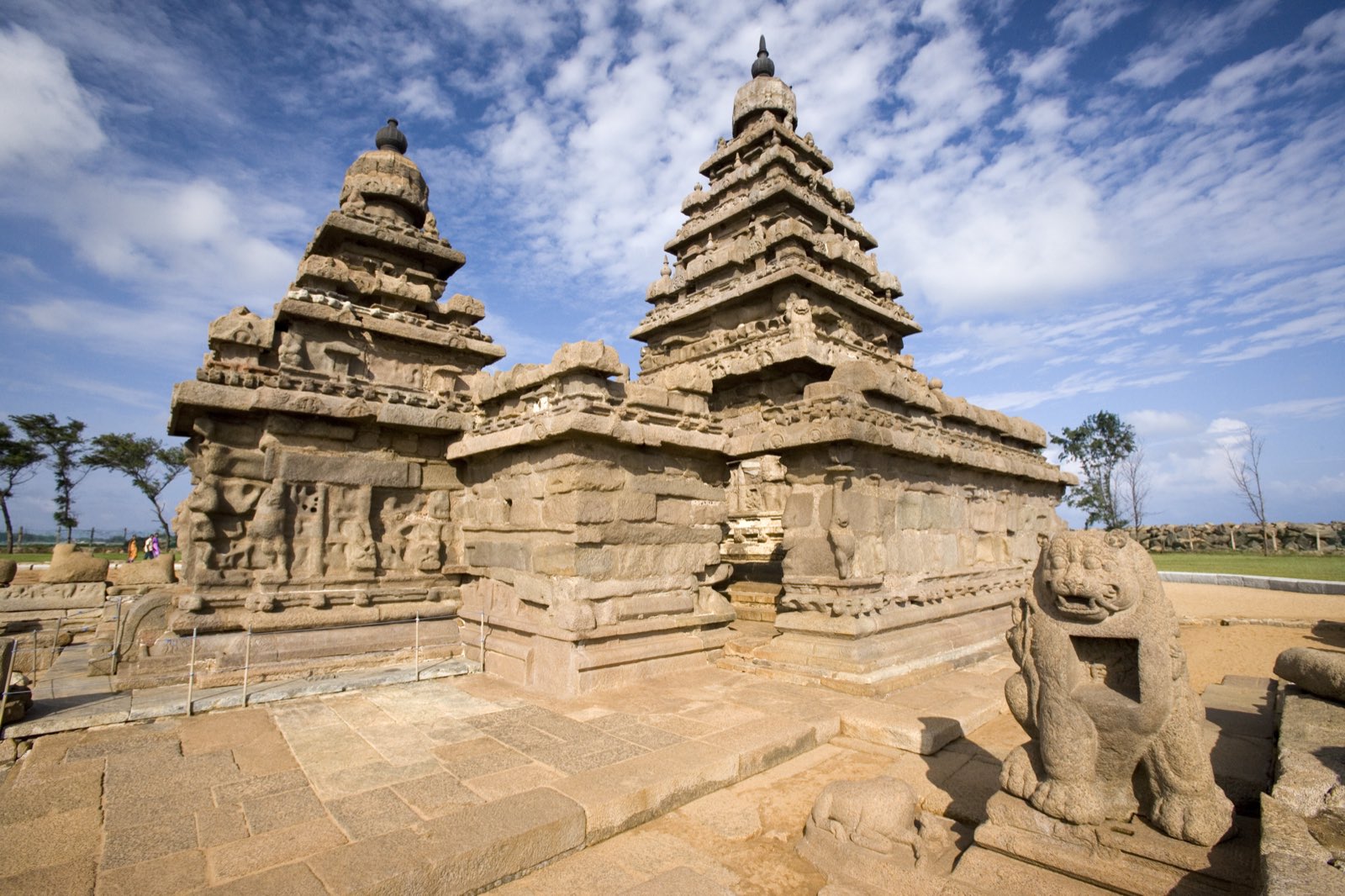
On a spit of granite above the Bay of Bengal, the Pallavas stopped carving temples out of the rock and began building them up from it — and in that one move, at the edge of the sea, laid the foundation stone of the entire Dravidian tradition to come.
1. The move from carving to building
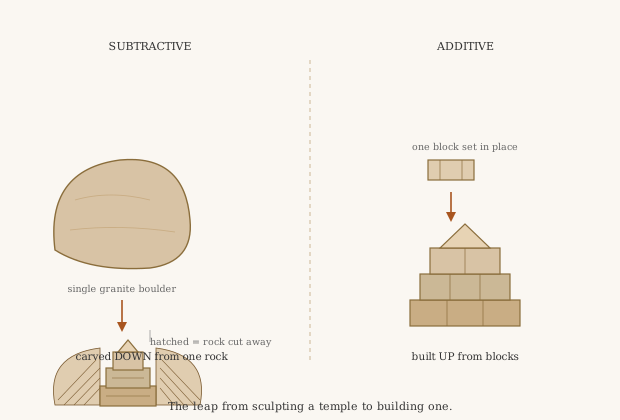
Everything the Pallavas had built at Mamallapuram before this was subtractive. In the seventh century their masons had cut pillared mandapas into the living hillside and, most spectacularly, had carved whole temples — the Pancha Rathas — as monoliths, freeing each shrine from a single granite boulder as a sculptor frees a figure. It was breathtaking, but it was a dead end: you cannot carve a tower taller than the rock you start with, and you can only build where the boulders happen to lie.
The Shore Temple is the answer to that limit. Here the same dynasty, under Narasimhavarman II (Rajasimha) around 700–728 CE, quarried granite into dressed blocks and stacked them — an additive, structural temple assembled course by course rather than released from a cliff. It is one of the earliest structural stone temples in South India, and the hinge on which the whole tradition turns: from the rock-cut experiments below it flows a line that runs straight to the towering Dravidian temples of the Cholas.
2. Two Shivas and a sleeping Vishnu
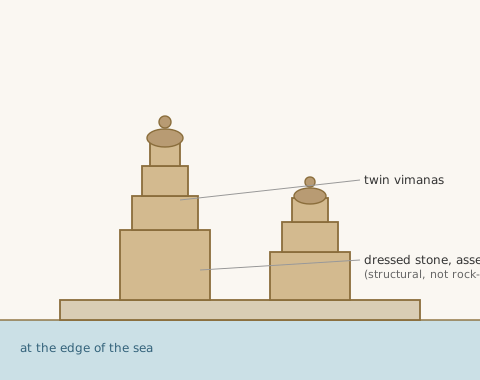
The complex is unusual in housing three shrines of two faiths in a single interlocked group. The tall principal vimana shelters a Shiva sanctum facing east, out to the sunrise over the sea; a second, smaller Shiva shrine faces west, inland. Wedged between them, and older in conception, is a Vishnu shrine holding a reclining image of the god — Anantashayana, Vishnu asleep on the cosmic ocean — carved from an outcrop of the living bedrock rather than built up in blocks.
That embedded Vishnu is a fossil of the older method surviving inside the new one: a monolithic relief around which the Pallavas then constructed their masonry temples. The result is a rare and deliberately ecumenical monument — Shaiva and Vaishnava under one enclosure — its low walls topped by rows of seated Nandi bulls that once ringed the sanctuaries and still march along the boundary today.
3. Built up in dressed granite
Structural granite construction is far harder than it sounds. Granite is brutally tough to quarry and dress, and it does not span: like all pre-modern stone temples the Shore Temple is trabeated — post-and-lintel throughout, with corbelled courses closing the tower — because stone is strong in compression and weak in tension, so nothing here is arched or vaulted. Every load runs vertically, block bearing on block, held by weight and precise fit rather than mortar.
The achievement is therefore one of organisation as much as design: quarrying, transporting, dressing and coursing granite blocks into a slender, stepped tower that had to stand true without a supporting cliff behind it. Where the monolithic rathas were a sculptor's feat, the Shore Temple is a builder's feat — the discipline of modular masonry that every later Dravidian temple would inherit and scale up.
4. The Dravidian vimana takes shape
Above the sanctum, the Shore Temple codifies the vocabulary that defines the southern, or Dravidian, temple tower. The vimana rises as a stepped pyramid of receding storeys — talas — each ringed by a parapet of miniature shrine-forms (the kuta and shala motifs) that make every tier read as a diminishing palace stacked on the one below. It is a mountain built of architecture: a hierarchy of small buildings climbing toward the sky.
The ascent is capped by an octagonal domed finial, the shikhara, crowned in turn by a stupi or pot-finial. This is the exact grammar — tiered talas, shrine-parapets, octagonal capstone — that the Cholas would inflate three centuries later into the colossal vimana of the Brihadishvara temple at Thanjavur. The Shore Temple is small, but it is the seed: the compact, legible first statement of a form South India would build for a thousand years.
5. The sea that made it and unmakes it
Almost no other great temple was sited like this. Standing directly on the shore of the Bay of Bengal, the Shore Temple was meant to be seen from the water — a landmark for Pallava maritime trade and, by legend, one of a group of temples of which the rest are said to lie beneath the waves. But the same sea is its slow undoing: centuries of salt-laden wind and spray have abraded the granite, softening and rounding what were once crisp reliefs and sharp mouldings into weathered, sea-smoothed forms.
That erosion is part of how we must read it honestly — precise dates and the exact sequence of its three shrines remain debated, and the surface that survives is a ghost of the original carving. Yet its place is secure. As the keystone of the Group of Monuments at Mahabalipuram (UNESCO, 1984), it stands where the Pallavas turned from carving mountains into stacking them — the built ancestor of every Dravidian tower that followed.
Any building that wins its power by facing the ocean and accepting the sea's slow editing of its surface — from weathered coastal chapels to Tadao Ando's exposed-concrete works on the water — is heir to the Shore Temple's wager: to place architecture where the elements will both frame it and wear it.
References & further reading
- 01Brown, Percy (1942). Indian Architecture (Buddhist and Hindu Periods). D. B. Taraporevala Sons & Co., Bombay.
- 02Michell, George (1988). The Hindu Temple: An Introduction to Its Meaning and Forms. University of Chicago Press.
- 03Srinivasan, K. R. (1964). Cave-Temples of the Pallavas. Archaeological Survey of India, New Delhi.
- 04Huntington, Susan L. (1985). The Art of Ancient India: Buddhist, Hindu, Jain. Weatherhill, New York.
- 05UNESCO World Heritage Centre (1984). Group of Monuments at Mahabalipuram. UNESCO (World Heritage List, ref. 249). https://whc.unesco.org/en/list/249
Last verified 2026-07-06. Ancient and vernacular works often have no single architect or firm date; dates are given as widely accepted approximations and the builder-culture is named where no individual designer is known.