
26 · Vernacular, Gardens & Engineering WondersNo. 25 in era · ▸ India
Sanchi / Ashokan pillars
In the third century BCE, the Mauryan emperor Ashoka set up polished stone columns across his empire — each a single shaft of sandstone, quarried, dressed and dragged hundreds of kilometres, then raised without a base and burnished until it shone like glass. Crowned with sculpted lions and inscribed with the emperor's edicts on moral law, the Ashokan stambha is the finest surviving work of Mauryan imperial art — and its Sarnath capital is today the State Emblem of India.
1. The monolith — one block, raised without a base
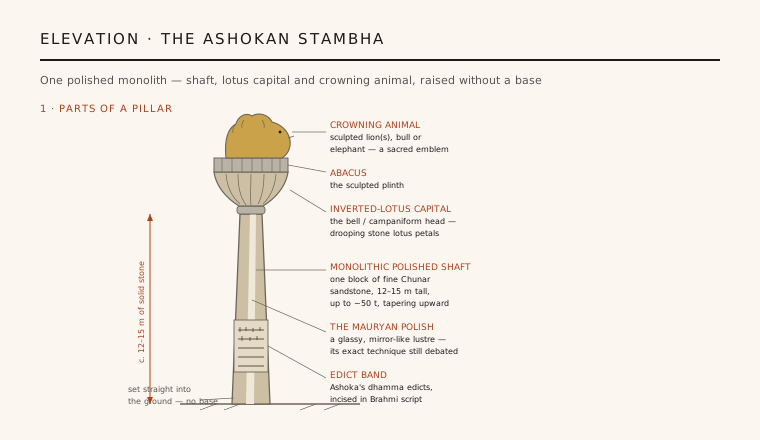
An Ashokan pillar, or stambha, is not built but made from a single stone. Each shaft was cut whole from the fine sandstone quarries at Chunar, near Varanasi, dressed to a gentle upward taper, and then hauled — sometimes hundreds of kilometres — to the site where it would stand. The finished columns rise 12 to 15 metres and weigh up to some fifty tonnes, yet they are set straight into the ground with no base or pedestal, so that the shaft seems to grow directly out of the earth. Quarrying, transporting and erecting so long and heavy a monolith was a feat of organisation at the very edge of the age's capacity.
The form is severe and confident: a plain, unfluted cylinder, narrowing as it rises, with none of the drums, joints or masonry courses of a conventional column. That singleness is the whole point. Where Greek and Persian builders assembled their columns from stacked stone, the Mauryan workshops insisted on the unbroken monolith — a demonstration of imperial reach as much as of engineering, since only a centralised state could command the quarrying, labour and roads such a project required.
2. The Mauryan polish — a mirror in stone
The most astonishing feature of the pillars is their surface. The sandstone is ground and burnished to a glassy, mirror-like lustre, so smooth and reflective that early observers mistook the shafts for metal or cast bronze. This finish — the celebrated 'Mauryan polish' — is the same luminous sheen found inside Ashoka's rock-cut Barabar caves, and it is one of the genuine unsolved problems of ancient technology: exactly how the Mauryan craftsmen achieved so hard and even a gloss on such intractable stone is still debated, with explanations ranging from patient abrasive rubbing to a fine siliceous surface layer.
The polish is not decoration but ideology made visible. A perfectly smooth, gleaming column reads as something beyond ordinary masonry — durable, faultless, almost supernatural — a fitting vehicle for an emperor's word. Tellingly, the finish appears suddenly under Ashoka and then largely vanishes from Indian stonework after the Mauryan collapse, which is one reason it has long been suspected of drawing on imported, possibly Persian, technical knowledge that did not outlive the dynasty.
3. The capital — lotus, abacus and lion
Every complete pillar was crowned by a separately carved capital, and its design is remarkably consistent. Above the shaft sits an inverted-lotus or bell-shaped (campaniform) member, its stone petals drooping downward like an opened flower turned upside down. On this rests a circular or square abacus, and on the abacus stands one or more sculpted animals — a lion, a bull, an elephant or a horse — each an emblem charged with royal and Buddhist meaning. The animals are modelled with a naturalism and muscular energy unmatched in earlier Indian art.
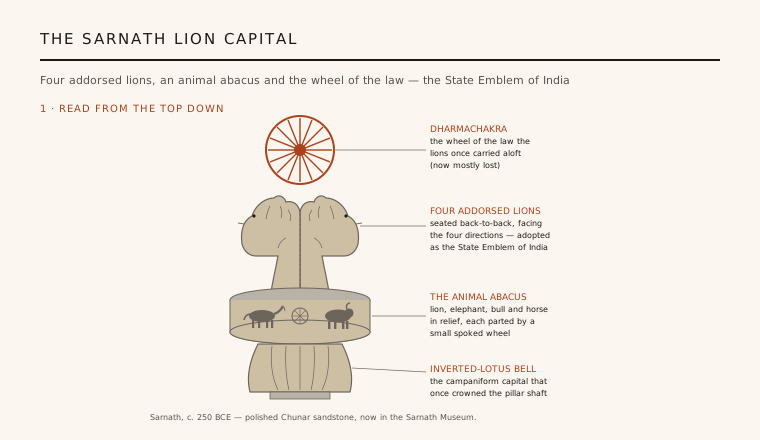
The supreme example is the Sarnath capital: four addorsed lions seated back-to-back, facing the four directions, standing on an abacus carved with a lion, an elephant, a bull and a horse, each separated by a small spoked wheel, above a lotus bell. The four lions once supported a great Dharmachakra, the wheel of the law, most of which is now lost. This capital, discovered at the site of the Buddha's first sermon, was adopted in 1950 as the State Emblem of the Republic of India — the pillar's most enduring afterlife.
4. The edicts — an empire writes on stone
Many of the shafts carry, incised into the polished stone near their foot, the edicts of Ashoka — public proclamations in the Brahmi script announcing the emperor's policy of dhamma, a broad moral and civic law of non-violence, tolerance, care for animals and respect between faiths. According to his own words, Ashoka turned to this path in remorse after the bloody conquest of Kalinga, and his conversion to Buddhism reshaped the message the pillars were built to broadcast. The columns are, in effect, a state addressing its people directly, in permanent stone, at sacred and well-travelled sites across the realm.
Their importance reaches beyond architecture. These inscriptions are among the earliest deciphered writing in India, and when the orientalist James Prinsep read the Brahmi script in the 1830s he unlocked the language of an entire lost imperial age. That a ruler chose to publish law and conscience on gleaming monoliths, rather than merely record royal victories, gives the Ashokan pillar a distinctly ethical character — architecture as public conscience as much as public art.
5. Between two worlds — and what survives
The pillars stand at a cultural crossroads. Their polished monolithic shafts, bell-shaped capitals and heraldic animals show clear kinship with Achaemenid Persian court art, whose columns Mauryan envoys and craftsmen would have known — yet the freestanding column with no building around it, the indigenous lotus and the Buddhist wheel are unmistakably Indian. The result is a genuine fusion, an imperial idiom that borrows a foreign vocabulary to say something wholly of the subcontinent. It should be said honestly that how much was learned from Persia and how much invented locally is still argued by scholars.
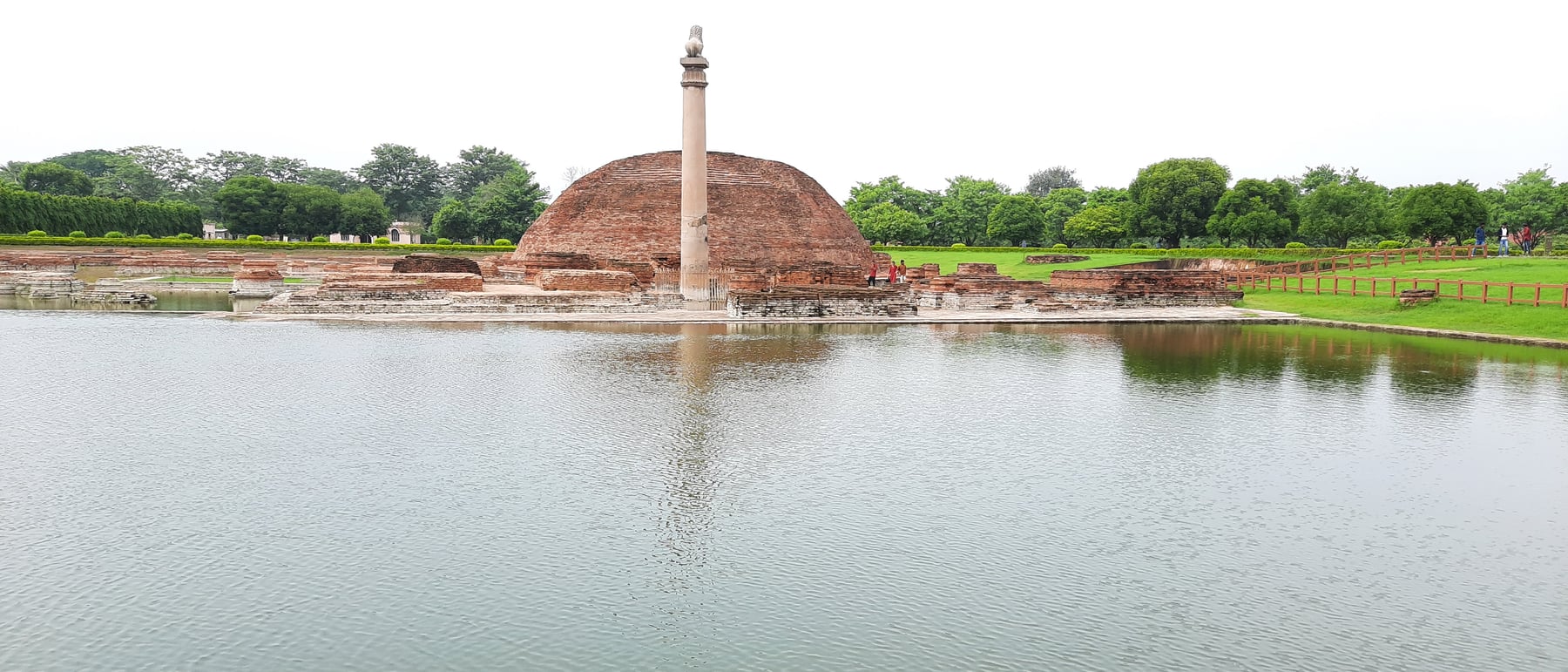
Of perhaps two dozen or more pillars once raised, only a handful survive whole; many shafts are broken, and most capitals are lost or moved to museums. The column at Vaishali, topped by a single lion and standing complete and in situ, gives the truest sense of the original — a solitary, gleaming shaft against the plain. Fragile in their afterlife but monumental in conception, the Ashokan pillars remain the founding monument of imperial art in India, the moment its architecture first spoke in polished, permanent stone.
The idea of a single, freestanding, immaculately finished shaft that carries a public message survives in the modern commemorative column and obelisk — and, more subtly, in India's own choice to place the Sarnath lions on its currency, passports and state seal, so that a 3rd-century-BCE capital still speaks for the nation every day.
References & further reading
- 01Irwin, J. (1973). 'Asokan' Pillars: A Reassessment of the Evidence. The Burlington Magazine 115(848), pp. 706–720.
- 02Hultzsch, E. (1925). Inscriptions of Asoka (Corpus Inscriptionum Indicarum, Vol. I). Clarendon Press, Oxford.
- 03Huntington, S. L. (1985). The Art of Ancient India: Buddhist, Hindu, Jain. Weatherhill, New York.
- 04Falk, H. (2006). Asokan Sites and Artefacts: A Source-Book with Bibliography. Verlag Philipp von Zabern, Mainz.
- 05Coomaraswamy, A. K. (1927). History of Indian and Indonesian Art. Edward Goldston, London.
Last verified 2026-07-11. Ancient and vernacular works often have no single architect or firm date; dates are given as widely accepted approximations and the builder-culture is named where no individual designer is known.