
26 · Vernacular, Gardens & Engineering WondersNo. 17 in era
Roman road & aqueduct network
Rome did not merely conquer territory — it engineered it into a single working machine. Two great networks, the roads and the aqueducts, gave the empire mobility and water at continental scale, and became the skeleton on which a civilization was built.
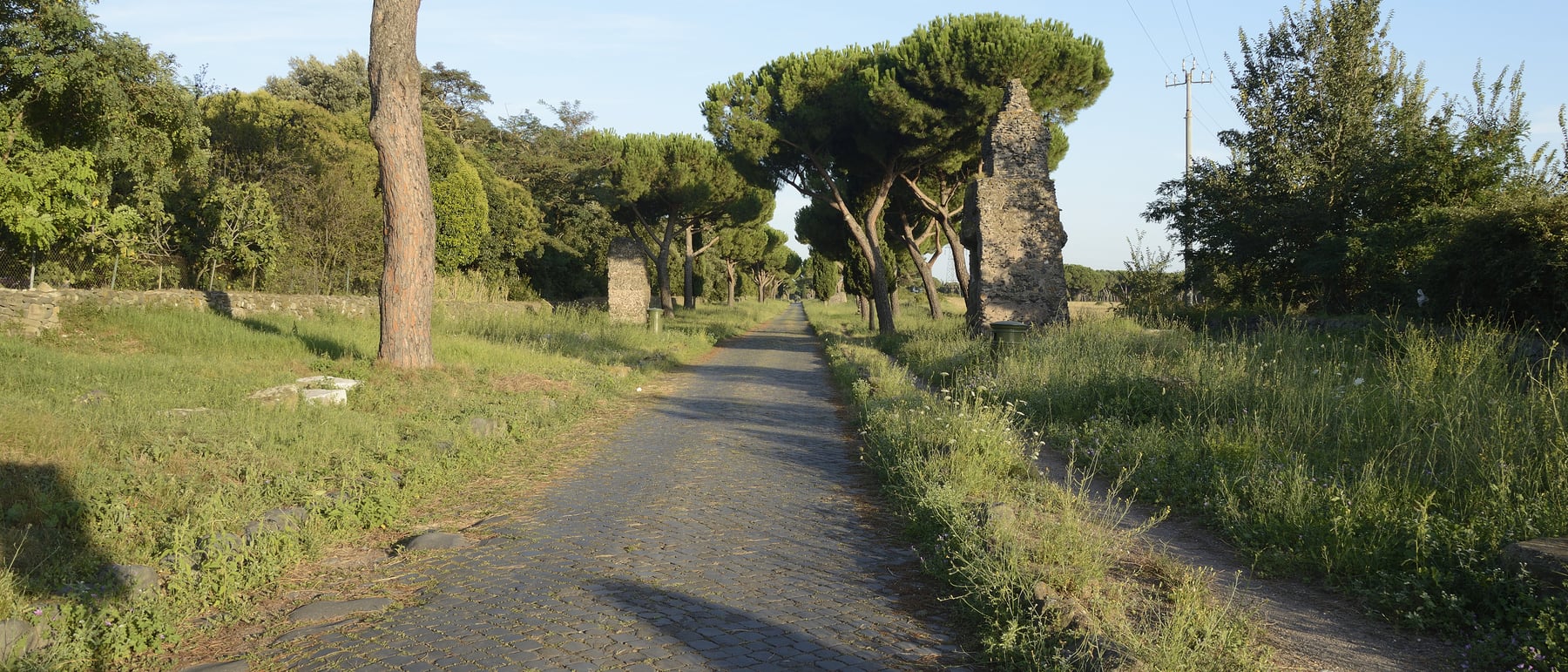
1. Infrastructure as an idea
Most entries in this canon are single buildings. This one is a system — the two engineered networks that let Rome function as a state rather than a scatter of cities. The pantheon of Roman monuments is well known, but the empire's real architecture of power was linear and horizontal: thousands of kilometres of road driven across three continents, and hundreds of aqueducts threading water into towns that had outgrown their wells. Individual monuments such as the Pont du Gard or the Aqueduct of Segovia have their own pages here; this article looks instead at the pattern they belong to.
What makes the Roman achievement architectural, and not merely logistical, is that both networks were designed — surveyed, standardised and detailed with the same rigour a temple received. The road and the aqueduct share a common toolkit: the arch, a durable pozzolanic concrete, and instruments precise enough to hold a line or a gradient over distances the eye cannot check. Understanding them together explains how a pre-industrial society moved armies, mail and clean water at a scale not matched again in Europe for well over a millennium.
2. The road as a built section
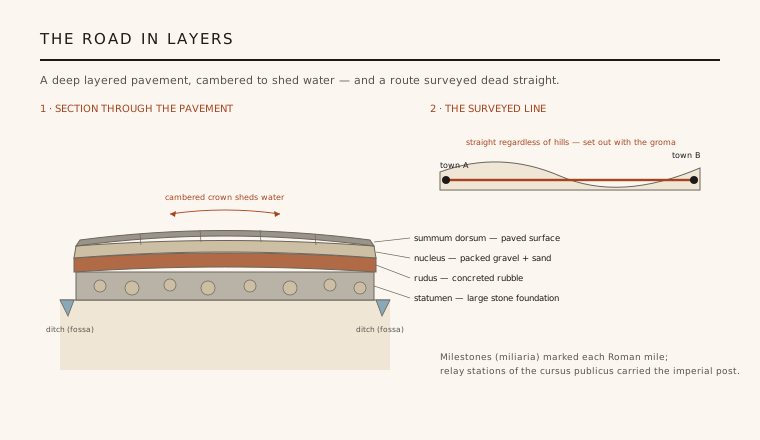
A Roman highway was not a surface but a structure in depth, closer to a wall laid on its side than to a modern tarmac ribbon. Ancient descriptions and excavated examples show a layered build: a statumen of large stones bedded in the trench as a foundation; a rudus of concreted rubble above it; a nucleus of finer packed gravel and sand; and finally the summum dorsum, the visible surface — on the great trunk roads a tightly fitted pavement of polygonal stone slabs. The whole assembly could be a metre or more thick, which is why fragments survive two thousand years later.
Two details reveal the engineering mind behind it. The surface was cambered — crowned slightly higher at the centre so rain ran off to the sides — and flanked by drainage ditches (fossae), because standing water, not traffic, is what destroys a road. Widths, kerbs and construction were broadly standardised, so a legion could rely on the same running surface whether in Gaul or Syria. Not every road was paved to this standard; many were gravel-topped. But the paved trunk routes set the template.
3. Straight lines and the aqueduct's gradient
Roman roads are famous for running straight, and the reason is instrumental. Surveyors set out alignments with the groma — a simple cross of plumb lines that let them sight true right angles and hold a bearing between fixed points, driving the route over hills rather than curving comfortably around them. Straightness was not stubbornness; it was the shortest, most legible line for an army on the march, reinforced by milestones (miliaria) counting the Roman miles and by the relay stations of the cursus publicus, the state courier and post system.
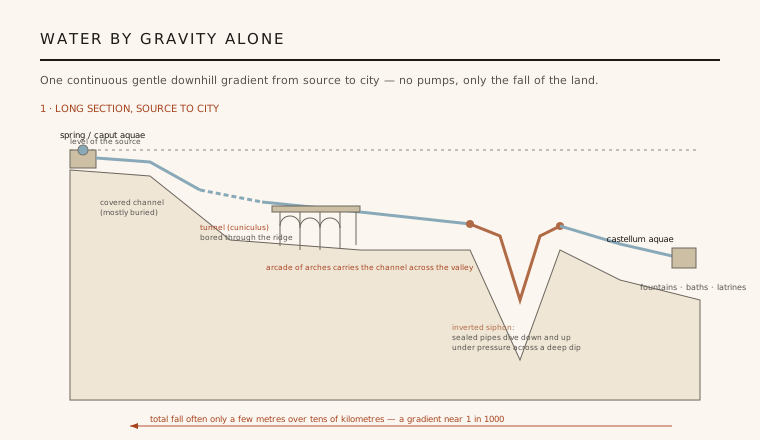
The aqueduct demanded the opposite discipline: not a straight line but a falling one, held to an almost imperceptible downhill gradient — often only a fraction of a percent — continuously over tens of kilometres so that water flowed by gravity alone, without a single pump. Surveyors used levelling instruments such as the chorobates and dioptra to maintain this fall across ravines and ridges. Most of the channel ran buried in a covered conduit (specus); the spectacular arcades appear only where a valley had to be crossed at height. The technical feat is invisible: a slope you could not see, sustained with a precision that leaves no margin for error.
4. Arches, concrete and the tools of scale
Both networks stand on the same three technologies. The arch let builders span valleys and carry loads in compression using stone and concrete, materials that are strong in exactly that way; stacked into arcades, arches raised a water channel dozens of metres into the air while leaving the valley floor open. Roman concrete — lime mortar gauged with volcanic pozzolana and packed with rubble aggregate — gave a mouldable, waterproof and astonishingly durable mass that filled road foundations, lined aqueduct channels and formed the cores of piers. Recent research on its self-healing lime clasts helps explain its endurance.
Where an arcade would have been impossibly tall, engineers used the inverted siphon: sealed pipes, often of lead or stone, that carried water down one side of a deep dip and up the other under pressure, exploiting the fact that water rises back toward its source level. Tunnels (cuniculi) cut through ridges that could not be gone around. None of this was theoretical bravado — it was a repeatable kit of parts, taught, standardised and executed by the legions themselves, which is why the same solutions recur from Britain to North Africa.
5. The skeleton of empire
Taken together, the roads and aqueducts were less a set of monuments than the infrastructure of a way of life. The roads carried the army that held the frontier, the trade that fed the cities, the post that governed at a distance — the origin of the proverb that all roads lead to Rome. The aqueducts made the dense Roman city possible at all, pouring water into public fountains, the great bath complexes and the flushed latrines that defined urban civilisation, then carrying waste away. Where the water reached, the Roman city could be built; where it did not, it could not.
This is why the network belongs in a canon of architecture. It demonstrated, at continental scale, that engineered systems could structure human life as decisively as any single building — that mobility, water and sanitation are themselves designed environments. When the western system decayed after the 4th century CE, cities shrank back toward their local water sources, a reminder of how completely urban life had come to depend on the invisible discipline of the gradient and the line.
Every modern discipline of civil and infrastructure engineering — the motorway, the water main, the idea that a city is only as large as its supply networks allow — is a direct descendant of the Roman insight that a civilization is built as much in its roads and pipes as in its palaces.
References & further reading
- 01Hodge, A. T. (2002). Roman Aqueducts and Water Supply. Duckworth, 2nd ed..
- 02Chevallier, R. (1976). Roman Roads. Batsford / University of California Press.
- 03Adam, J.-P. (1994). Roman Building: Materials and Techniques. Batsford / Routledge.
- 04Seymour, L. M., Maragh, J., Sabatini, P., Di Tommaso, M., Weaver, J. C. & Masic, A. (2023). Hot mixing: Mechanistic insights into the durability of ancient Roman concrete. Science Advances 9(1), eadd1602. https://doi.org/10.1126/sciadv.add1602
- 05Vitruvius (trans. M. H. Morgan) (1914). The Ten Books on Architecture (Books VIII & X). Harvard University Press.
Last verified 2026-07-11. Ancient and vernacular works often have no single architect or firm date; dates are given as widely accepted approximations and the builder-culture is named where no individual designer is known.