
10 · East & Southeast AsiaNo. 04 in era
Prambanan
Within sight of Buddhist Borobudur, Java's Hindu kings answered its squat mandala-mountain with the opposite gesture: a grove of tall, needle-sharp towers spiking into the sky. Prambanan is Indonesia's largest Hindu temple compound — a cosmos not climbed but multiplied, where each candi tower is its own replica of the sacred mountain.
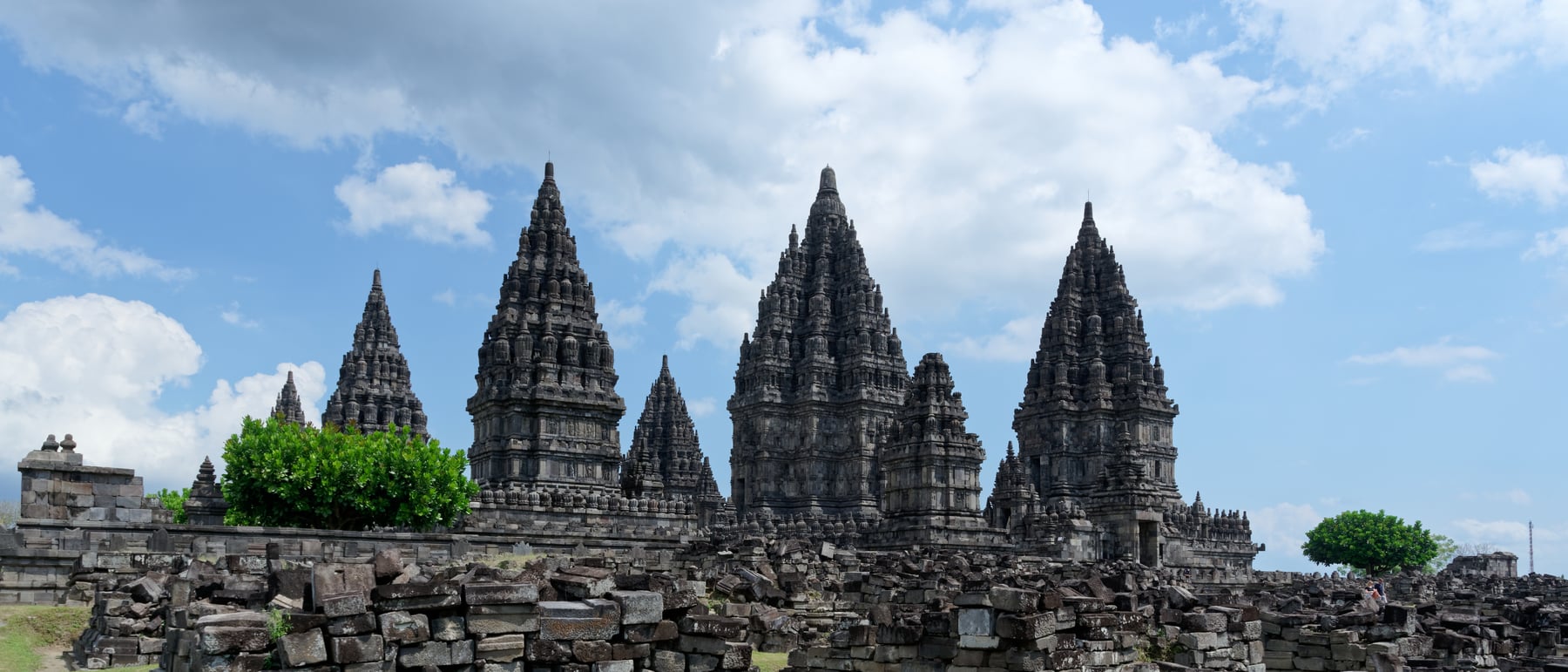
1. A Hindu answer within sight of Borobudur
Prambanan rose on the Kewu plain of Central Java around 850 CE, barely two generations after the Buddhist stupa-mountain of Borobudur was completed a few kilometres away. The two monuments frame a moment when the island's dynasties — and their royal patronage — shifted between the Buddhist Sailendras and the Hindu Sanjayas of the Mataram kingdom. Prambanan, also called Candi Rara Jonggrang, is the emphatic Hindu reply: the largest Hindu temple compound in Indonesia, begun under King Rakai Pikatan and enlarged by his successors into the early tenth century.
The contrast in form is the whole point. Borobudur is a single terraced mound you ascend, a mandala flattened into a hill. Prambanan does the reverse: it shatters the sacred mountain into a cluster of steep, pointed candi towers that leap upward. Where Borobudur is horizontal and processional, Prambanan is vertical and skyward — a forest of spires, each one an individual cosmic mountain in stone.
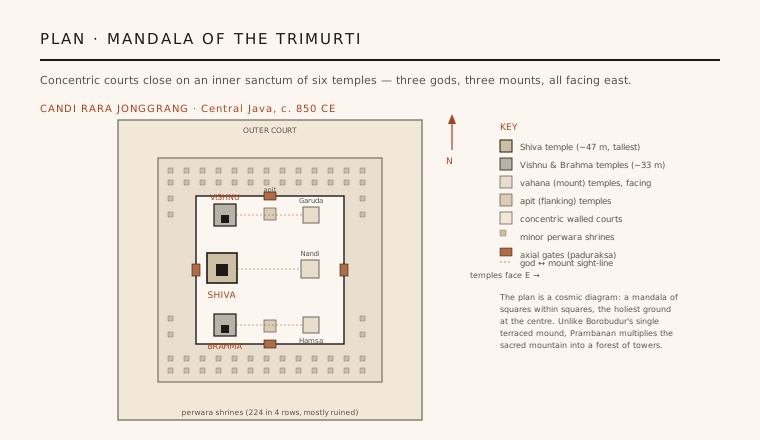
2. The plan as a mandala of concentric courts
The compound is laid out as a mandala: three square, walled courts nested one inside the next, sacredness intensifying toward the centre. The vast outer and middle courts once held rows of small perwara shrines — some 224 of them in four concentric rings — a stone congregation surrounding the holy ground. Little of that outer multitude survives intact, but the geometry of squares-within-squares still governs the whole ground.
At the heart sits the raised inner sanctum, and here the plan crystallises. Six principal temples stand in two north–south rows. On the west rise the three towers of the Trimurti — the tallest to Shiva at the centre, flanked by Vishnu to the north and Brahma to the south. Directly opposite each, across a narrow court, stands a smaller vahana temple housing the god's mount: Nandi the bull for Shiva, Garuda for Vishnu, and Hamsa the swan for Brahma. All the temples face east, god and mount locked on a single sight-line.
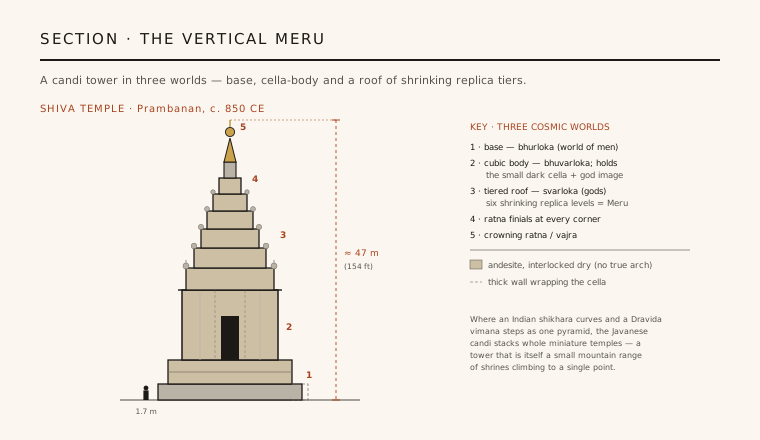
3. The candi tower: a temple built in three worlds
Each Prambanan tower is a candi — a temple built as a stack of three cosmological zones. At the foot is a stepped, moulded base (bhurloka), the world of men. Above it sits a cubic body (bhuvarloka) whose thick walls wrap a surprisingly small, dark cella holding the god's image, reached through a single door. Crowning both is a tall, tapering roof (svarloka), the world of the gods — and it is this soaring crown that gives the silhouette its needle-like drive upward.
The genius of the crown is that it is a stack of shrinking replicas. Level by level the roof repeats the body in miniature, each tier stepped in and studded at its corners with small stupa-like ratna finials, the whole ascending to a single crowning ratna or vajra. The tower is thus a vertical Meru, the cosmic mountain rebuilt as a receding series of ever-smaller shrines — a logic quite distinct from the curved Indian shikhara or the pyramidal Dravida vimana.
4. Andesite, corbels, and the absence of the arch
Prambanan is built entirely of andesite, the dark volcanic stone of Java, cut into blocks and dry-laid — set without mortar and held by their own weight, careful bedding, and interlocking joints. Like nearly all classical Indian and Southeast Asian temple building, it knows no true arch and no keystone: openings and the hollow of each cella are spanned by corbelling, courses of stone stepped inward until they meet. The tall towers are therefore essentially solid masses of masonry pierced by a small chamber, not framed voids.
Every surface is worked. The inner balustrades of the Shiva and Brahma temples carry a continuous narrative relief of the Ramayana, read as a slow processional walk around the sanctum, while the Vishnu temple bears scenes of Krishna. The carving is inseparable from the structure — the same andesite blocks that hold the building up also tell its stories.
5. Ruin, recovery, and why it matters
Prambanan's history is also a history of collapse. Abandoned within roughly a century of completion as power shifted to eastern Java, it was toppled over the centuries by earthquakes and left a field of tumbled stone; serious reconstruction began only in the twentieth century, with the Shiva temple rebuilt by 1953. Because the blocks interlock without mortar, restorers could only rebuild a temple when enough of its original stones were recovered — many minor shrines remain mounds of anonymous rubble to this day. The 2006 Yogyakarta earthquake cracked and shifted stones anew, a reminder that the compound sits on unstable, volcanic ground.
For all that, Prambanan stands as one of the great statements of the Southeast Asian temple. It fixed the Central Javanese candi form — the three-world tower crowned by a roof of replica tiers — and proved that a Hindu compound could be conceived not as one climbable mountain but as a whole ranged skyline of them. Inscribed by UNESCO as a World Heritage Site, it remains the vertical counterweight to Borobudur, and the tallest Hindu temple ever raised in the Indonesian world.
Its logic of a sacred silhouette built from repeated, self-similar units — a mountain assembled from shrinking copies of itself — anticipates the fractal, modular thinking behind much parametric and repetitive-module architecture today.
References & further reading
- 01Jordaan, R. E. (ed.) (1996). In Praise of Prambanan: Dutch Essays on the Loro Jonggrang Temple Complex. KITLV Press, Leiden.
- 02Dumarçay, J. (1986). The Temples of Java. Oxford University Press, Singapore.
- 03Miksic, J. N. & Goh, G. Y. (2017). Ancient Southeast Asia. Routledge, London (World Archaeology series).
- 04UNESCO World Heritage Centre (1991). Prambanan Temple Compounds. UNESCO World Heritage List, no. 642. https://whc.unesco.org/en/list/642
- 05Degroot, V. M. Y. (2009). Candi, Space and Landscape: A Study on the Distribution, Orientation and Spatial Organization of Central Javanese Temple Remains. Sidestone Press, Leiden.
Last verified 2026-07-06. Ancient and vernacular works often have no single architect or firm date; dates are given as widely accepted approximations and the builder-culture is named where no individual designer is known.