
17 · Art Nouveau, Arts & Crafts and the Turn of the CenturyNo. 10 in era
Postal Savings Bank
A savings bank where the fixings are the ornament: Otto Wagner clad the walls in thin marble and left the aluminium bolts that hold it on frankly on show. Inside, a hall built of glass, iron and light. This, more than any other building of its moment, is where Art Nouveau turns into the twentieth century.
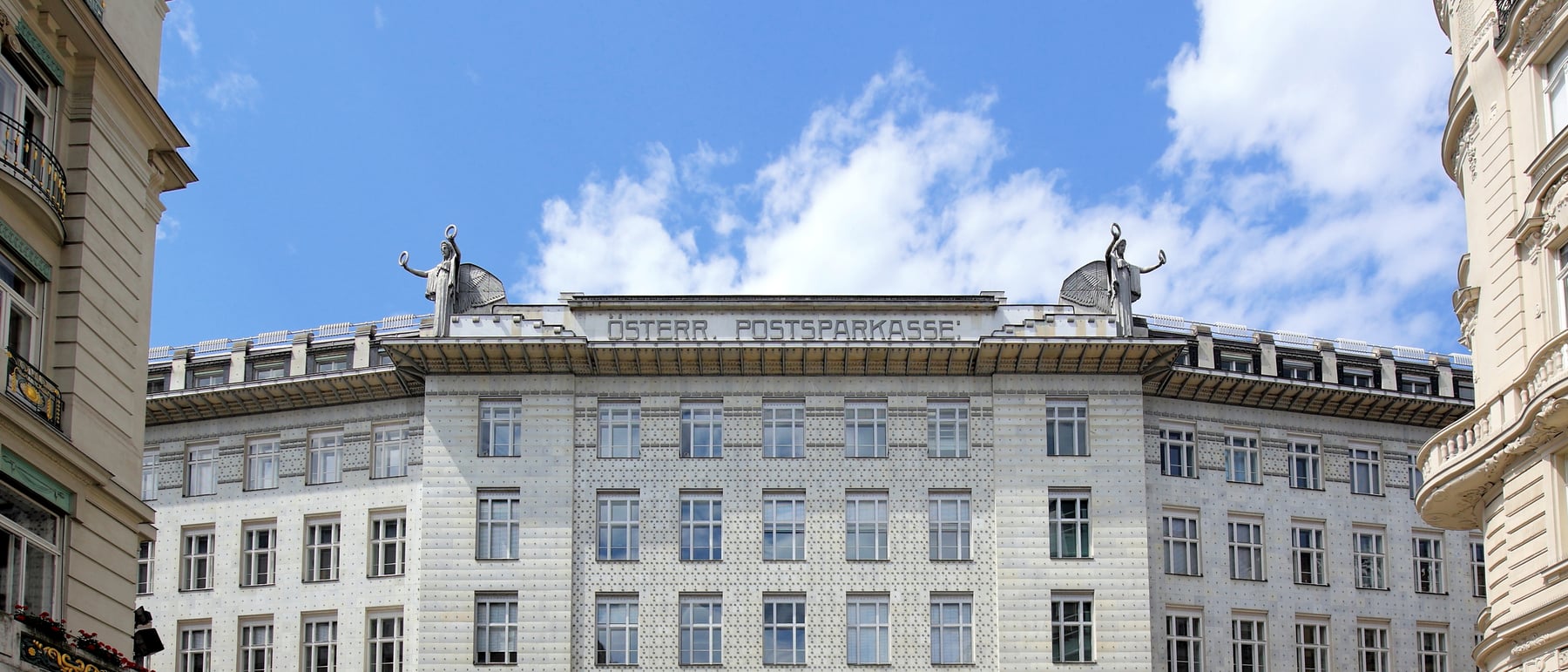
1. A manifesto with a banking licence
In 1903 the Austrian state ran a competition for a new head office for its Postal Savings Bank, on a wedge of ground facing the Ringstrasse's Stubenring. Otto Wagner — by then Vienna's most powerful architect and a professor of the Academy — won it, and built the front block in barely two years, opening the main hall in 1906; a matching rear wing followed in 1910–12. Wagner was over sixty, and he treated the commission as the built proof of a theory he had been preaching for a decade. The bank is not decorated with an idea. It is the idea.
That idea shows first in the walls. Instead of carving load-bearing stone, Wagner hung the brick carcass with thin slabs of Sterzing marble and granite, a stone skin only a couple of centimetres deep. To fix the panels he used bolts — and then, pointedly, left the bolt heads exposed across the whole facade, capped in gleaming metal so they read as a regular studded grid. The truth of the construction, that this is a veneer bolted to a wall behind, is not concealed under a cornice but published as the building's chief ornament. It is honesty made into pattern.
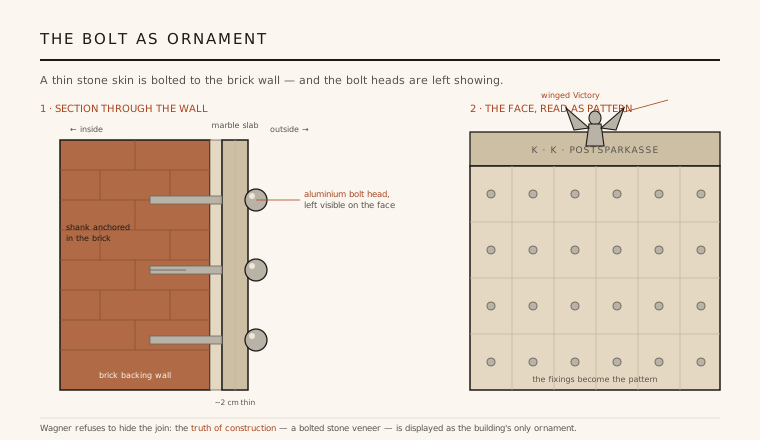
2. Aluminium: a new metal made monumental
The metal on those bolts is the building's other manifesto. Aluminium had only become industrially available in the 1880s, after the Hall–Héroult process; in 1904 it was still a novel, costly, faintly futuristic material with almost no architectural history. Wagner made it the signature of the bank. The bolt caps, the crisp cornice band, the projecting entrance canopy of aluminium ribs and glass over the door, the door furniture and countless fittings are all worked in it — the first time the metal was used monumentally and in the open on a major public building.
Aluminium also carries the sculpture. On the parapet stand two great winged Victory figures by Othmar Schimkowitz, executed in the new metal, presiding over Georg-Coch-Platz with the cornice inscription running beneath them. Where a nineteenth-century bank would have announced its solidity in bronze and carved allegory, Wagner announces the present tense — a material barely out of the laboratory, used frankly for what it is. Ornament has not been abolished so much as reassigned to the honest display of modern industry.
3. The Kassensaal: a room made of light
Behind the sober front lies the building's masterpiece, the central banking hall or Kassensaal. It is a long, top-lit room roofed by two layers of glass: an outer pitched glass roof that sheds the weather, and, hung below it, a gently curved suspended glass ceiling of small panes that scatters an even, shadowless daylight over the counters. Slender iron columns, riveted up from plate and clad in polished aluminium, march down the space; they taper, widening as they rise to splay into the vault, so that structure and ceiling become one continuous, luminous surface.
Wagner then did something almost without precedent: he made the floor of translucent glass blocks, so that the same daylight falls through it into the offices of the basement below. Heating is delivered by frankly exposed cylindrical hot-air blowers, left on show as objects rather than buried in the fabric. The result is a rational, glowing, near-ornamentless interior in which glass, iron and aluminium simply do their work — a space that looks less like 1906 than like the mid-twentieth century arriving early.
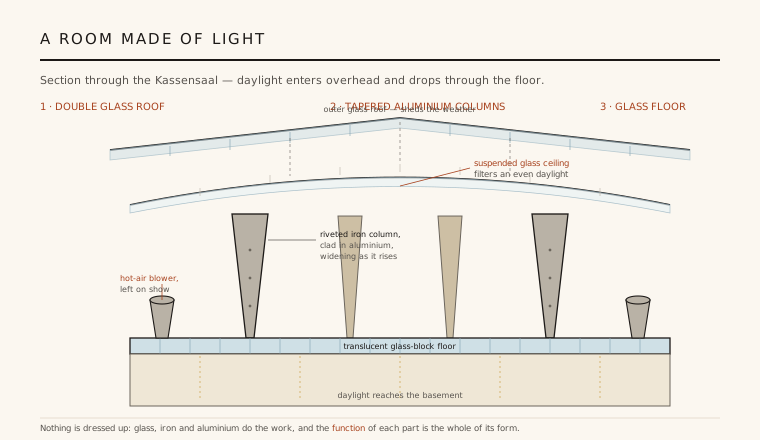
4. Artis sola domina necessitas
Every choice here is governed by a doctrine Wagner had set down in his 1896 treatise Moderne Architektur (later reissued as Die Baukunst unserer Zeit), the most influential architectural text of its German-language generation. Its argument was blunt: the historical styles were exhausted, and a new age of iron, glass and machinery demanded a new architecture answerable to modern life. Wagner's motto for the age was Artis sola domina necessitas — necessity is the sole mistress of art — and his sharpest line insisted that nothing that is impractical can ever be beautiful.
The bank obeys that creed to the letter. The bolts are shown because showing them is honest; the aluminium is used because it is the right modern material; the glass floor exists because the basement needs light; the blowers are visible because concealment would be a lie about how the room is warmed. Wagner even designed the fittings and the famous bentwood stools to the same logic. In an era besotted with the flowing ornament of Art Nouveau, this is a building arguing that function itself, cleanly expressed, is the only ornament a modern age is entitled to.
5. The hinge to modernism
What makes the Postal Savings Bank pivotal is that its author was no outsider. Wagner had joined the Vienna Secession in 1899; his pupils Joseph Maria Olbrich and Josef Hoffmann were among its founders, and his early work drips with Jugendstil line. Yet from inside that lush, ornamental milieu he produced a building that turns decisively away from it — keeping only the discipline and the craftsmanship, and discarding the flowers. It is Art Nouveau performing its own supersession.
Historians of modern architecture — from Nikolaus Pevsner to Kenneth Frampton — routinely treat the bank as a starting point, a bridge from the nineteenth century to the twentieth. Its logic of an honest structural frame, a frankly bolted cladding skin, industrial materials left legible and ornament reduced to the expression of construction runs straight ahead to Adolf Loos, to the curtain wall, and to the whole rationalist tradition that followed. More than any other building of the fin de siècle, the Postsparkasse points a clear finger at the century to come.
Every modern facade that lets its fixings show — the exposed bolts and gaskets of a stone rainscreen or a point-fixed glass wall, structure worn openly as finish — is descended from Wagner's decision to make the bolt heads of the Postsparkasse its ornament.
References & further reading
- 01Wagner, O. (trans. H. F. Mallgrave) (1988). Modern Architecture: A Guidebook for His Students to This Field of Art (Moderne Architektur, 1896). Getty Center for the History of Art and the Humanities, Santa Monica.
- 02Geretsegger, H. & Peintner, M. (1979). Otto Wagner 1841–1918: The Expanding City, the Beginning of Modern Architecture. Rizzoli / Academy Editions.
- 03Mallgrave, H. F. (1993). Otto Wagner: Reflections on the Raiment of Modernity. Getty Center Publication Programs, Issues & Debates.
- 04Schorske, C. E. (1980). Fin-de-Siècle Vienna: Politics and Culture. Alfred A. Knopf, New York (esp. ch. on Wagner and the Ringstrasse).
- 05Frampton, K. (2007). Modern Architecture: A Critical History (4th ed.). Thames & Hudson, World of Art (Wagner and the Vienna Secession).
Last verified 2026-07-08. Ancient and vernacular works often have no single architect or firm date; dates are given as widely accepted approximations and the builder-culture is named where no individual designer is known.