
26 · Vernacular, Gardens & Engineering WondersNo. 18 in era
Ponte Vecchio
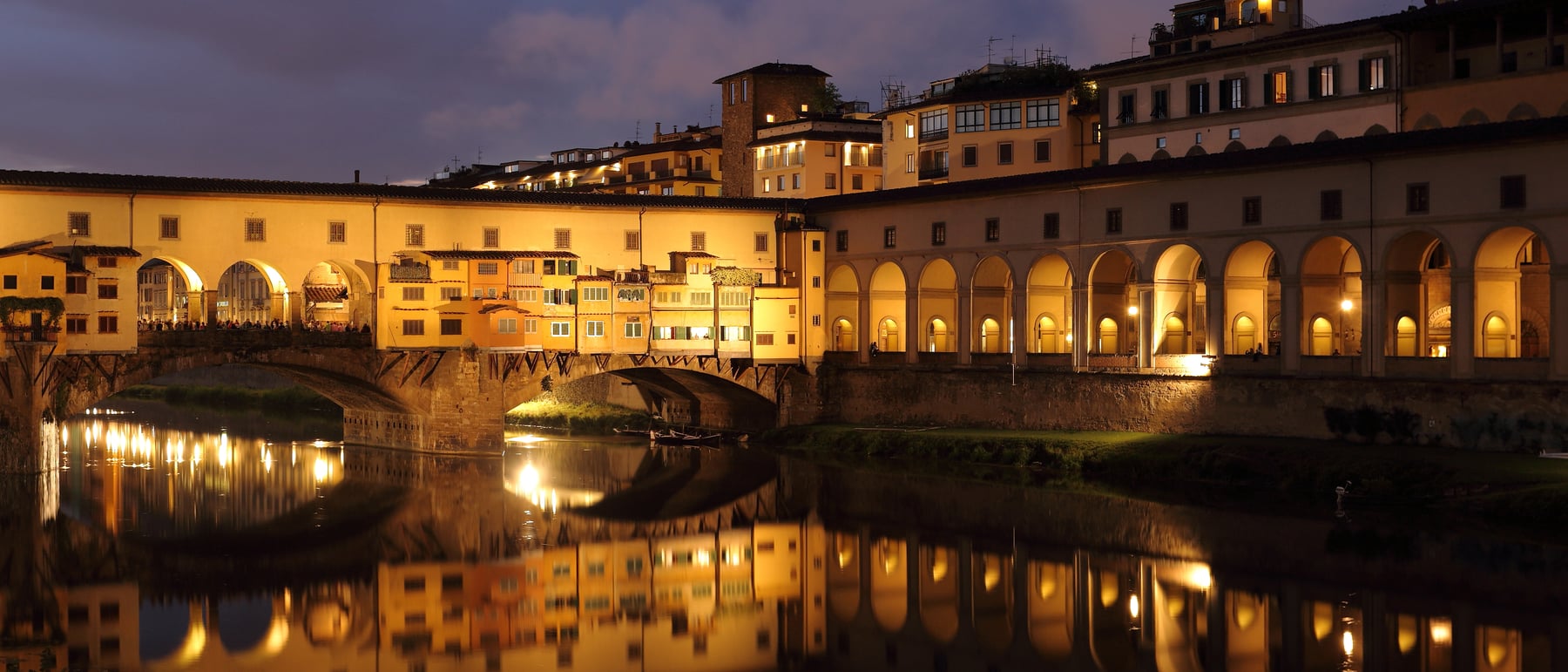
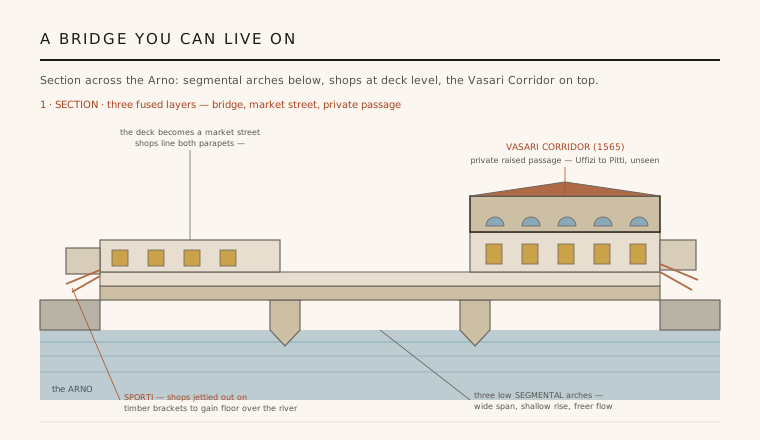
A bridge is meant to get you across a river. The Ponte Vecchio decided you should also be able to shop, work, and live on the way over. Rebuilt across the Arno in 1345, it is the most famous surviving example of a medieval inhabited bridge — a market street, a row of dwellings, and a private royal corridor all stacked onto three low stone arches.
1. A bridge that is also a street
Most bridges are pure infrastructure: a deck to carry you from one bank to the other and nothing more. The Ponte Vecchio — the "old bridge" — refuses that austerity. Across its roadway runs a continuous double row of shops, so that crossing the Arno means walking down an enclosed market street, the river invisible for much of the way. Commerce, circulation and dwelling are fused into a single structure, an idea medieval Europe applied to several bridges but which survives here more completely than almost anywhere else.
The present bridge dates to 1345, built to replace a predecessor swept away by the catastrophic flood of 1333. Vasari credits the design to the painter-architect Taddeo Gaddi; other sources name Neri di Fioravante, and the attribution remains genuinely uncertain. What is not in doubt is the ambition: this was not a repaired bridge but a rethought one, engineered to resist the river that had just destroyed its forebear while carrying an entire quarter of shops on its back.
2. The segmental arch: flatter, wider, freer
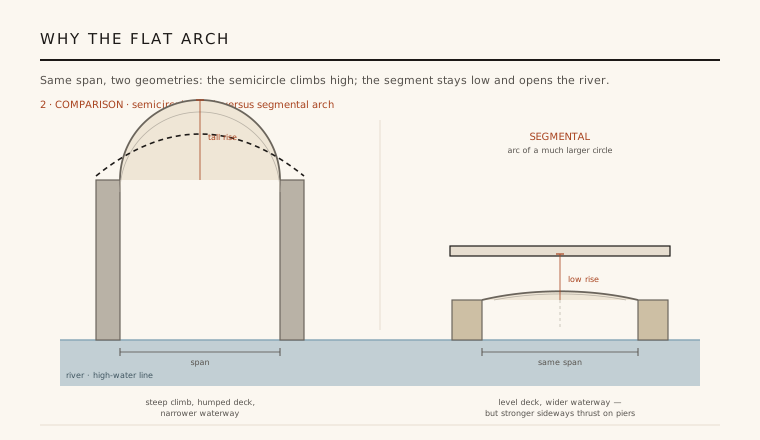
The bridge's real structural boldness lies underwater-side, in the shape of its arches. Where the standard medieval arch was semicircular — a half-circle rising as high as half its span — the Ponte Vecchio uses three segmental arches: arcs cut from a much larger circle, so they rise far less than a semicircle across the same opening. The result is a flatter, wider clear span and a near-level roadway instead of the steep hump a semicircular arch forces.
This was advanced for its date. A flatter profile means a bigger waterway beneath each arch, letting the Arno's floods pass more freely — the exact failure that had destroyed the earlier bridge. The trade-off is structural honesty: a shallow arch pushes harder sideways than a tall one, so segmental arches demand heavier piers and abutments to absorb the outward thrust. The Ponte Vecchio pays that price with two robust mid-river piers carrying pointed cutwaters that split the current.
3. Sporti: gaining floor over the water
A bridge deck is a fixed width, and the Arno crossing is narrow. To win more retail space, the builders and their successors let the shops grow outward beyond the parapet, cantilevering rooms over the river on timber brackets known as sporti. These jettied boxes hang past the structural edge of the bridge, effectively doubling the usable floor area of the shops without widening the load-bearing masonry below.
It is a piece of opportunistic medieval urbanism — the same jettying logic that pushed the upper storeys of timber town houses out over the street, here applied over open water. The irregular, improvised silhouette of overhanging shutters and props that gives the bridge its famous profile is not decoration but the visible record of centuries of tenants squeezing every possible square metre from a very constrained site.
4. From butchers to goldsmiths
The bridge's tenants have changed its character twice over. For its first two and a half centuries the shops were mostly butchers and tanners, drawn here precisely because the river below was a convenient sewer for offal and tanning waste — a rational, if noxious, use of a building that sat directly over running water. The overhanging sporti made dumping into the Arno even easier.
In 1593 Grand Duke Ferdinando I de' Medici issued a decree expelling the butchers and installing goldsmiths and jewellers in their place — partly for hygiene, partly because the smell and mess were unbecoming beneath the new princely corridor overhead. The goldsmiths never left. The Ponte Vecchio remains, nearly four and a half centuries later, a bridge of jewellers, one of the rare instances where a medieval building's original commercial programme is still legible in its shopfronts.
5. The corridor above, and the war below
In 1565 Giorgio Vasari threaded a private elevated passage across the top of the bridge for Cosimo I de' Medici: the Vasari Corridor, an enclosed walkway running roughly a kilometre from the Palazzo Vecchio through the Uffizi, over the eastern range of shops, and across the river to the Pitti Palace. It let the ruling family move through their own city unseen and unguarded — architecture as a tool of secure, invisible circulation, a third layer stacked above street and structure.
The bridge earned its final distinction in 1944. As the German army retreated from Florence it demolished every bridge over the Arno to slow the Allied advance — every bridge but this one, spared reportedly on Hitler's own order, its approaches blocked with rubble instead. So the Ponte Vecchio survives as the city's oldest crossing and a near-unique intact medieval inhabited bridge: proof that a piece of infrastructure can also be a street, a marketplace, a home and a monument all at once.
Every mixed-use scheme that stacks retail, housing and movement onto a single piece of infrastructure — from High Line-style elevated decks to inhabited-bridge competition entries — is chasing what the Ponte Vecchio has quietly done since 1345.
References & further reading
- 01Fei, S., Sica, G. & Sica, P. (1995). Firenze: Profilo di storia urbana. Alinea Editrice, Florence.
- 02Boucheron, P. & Menjot, D. (2011). La ville médiévale. in Histoire de l'Europe urbaine, vol. 2, Seuil, Paris.
- 03Heyman, J. (1995). The Stone Skeleton: Structural Engineering of Masonry Architecture. Cambridge University Press.
- 04Vasari, G. (trans. G. du C. de Vere) (1912 [1568]). Lives of the Most Excellent Painters, Sculptors and Architects. Macmillan, London (Life of Taddeo Gaddi).
- 05Paul, J. (1988). Der Ponte Vecchio in Florenz und die mittelalterliche Brückenbebauung. in Architectura: Zeitschrift für Geschichte der Baukunst 18, pp. 1–22.
Last verified 2026-07-11. Ancient and vernacular works often have no single architect or firm date; dates are given as widely accepted approximations and the builder-culture is named where no individual designer is known.