
25 · Late Modern, Postmodern & the Road to NowNo. 08 in era
Piazza d'Italia
A tiny public plaza in downtown New Orleans that became the manifesto of Postmodernism — Charles Moore ransacking the classical language for pure theatre, wrapping a fountain shaped like the map of Italy in colonnades of stainless steel, neon and spouting water.
1. A plaza built as a stage set
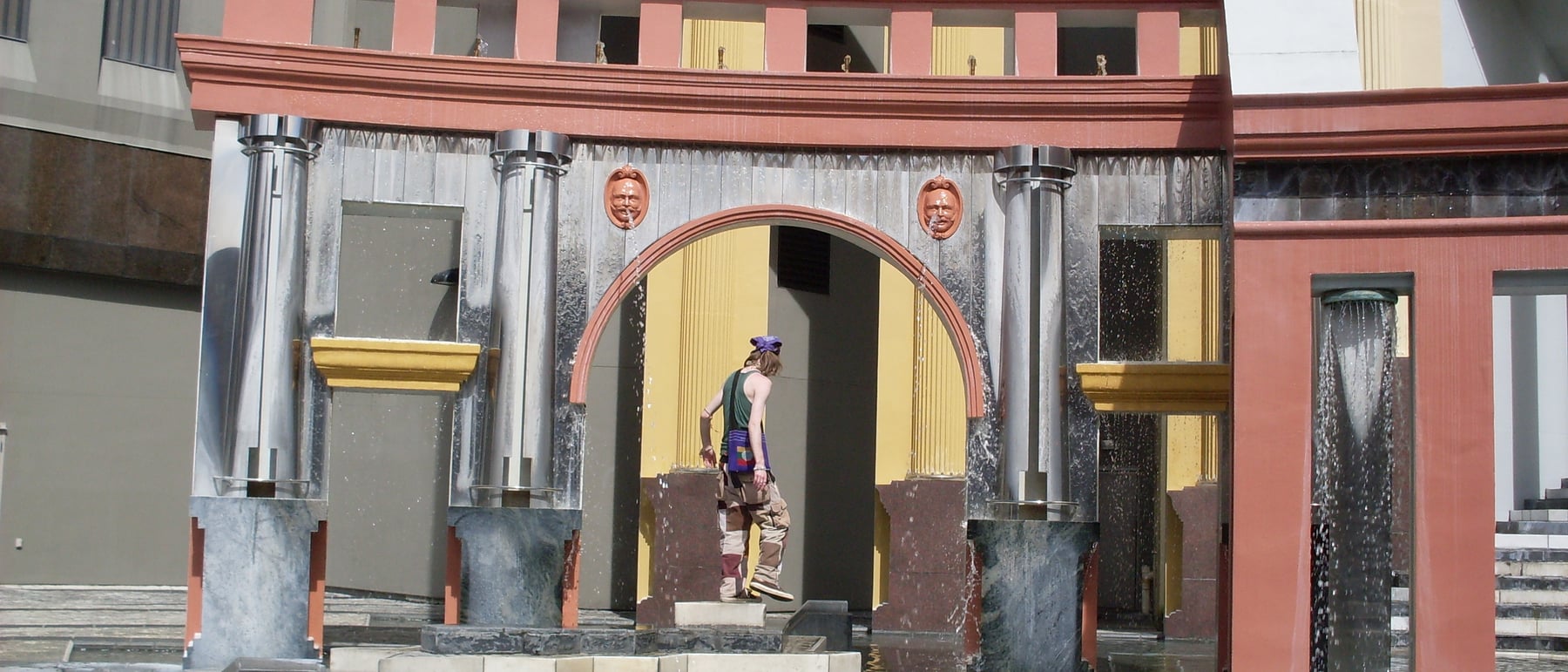
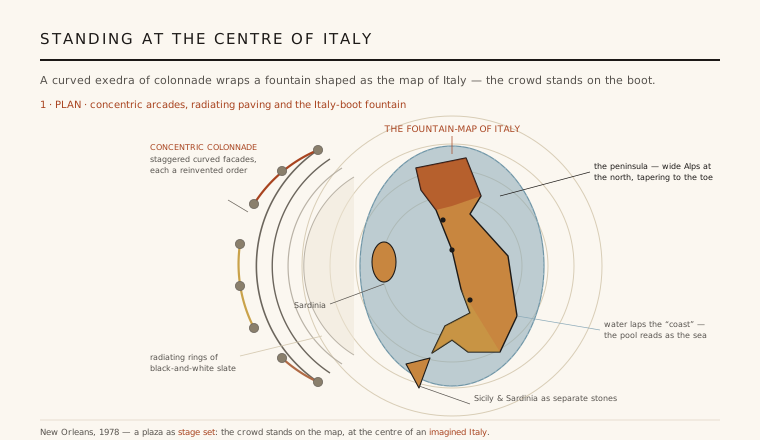
The Piazza d'Italia is small — a circular open space wedged between office blocks — and it was built for a specific civic purpose: to honour New Orleans's Italian-American community and anchor a hoped-for commercial redevelopment. Moore treated the commission not as a monument but as scenography. Curved façades of colonnade sweep around the west side of the circle in staggered, concentric arcs, an exedra that reads like a theatre backdrop with the sky for a ceiling. Rings of black-and-white slate paving radiate across the ground toward the focal point.
At the centre lies the conceit that makes the piazza unforgettable: a shallow fountain shaped as a relief map of Italy. The long boot of the peninsula tapers from the wide Alps in the north to the toe in the south, with Sicily and Sardinia set as separate stones in a pool that reads as the surrounding sea. Water laps the modelled coastline, and visitors step out onto the map itself — so the community literally stands at the centre of Italy. Architecture here is memory made walkable.
2. The orders, reinvented with a wink
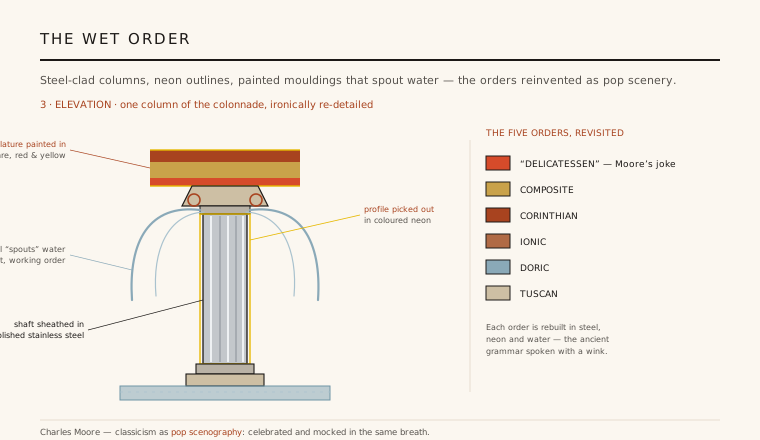
Moore built the piazza out of the five classical orders — Tuscan, Doric, Ionic, Corinthian, Composite — but reinvented every one of them as pop artefact. Columns are sheathed not in fluted stone but in polished stainless steel; entablatures and mouldings are painted in vivid ochre, red and yellow; profiles are outlined at night in coloured neon. It is classicism rendered as billboard and shopfront, the ancient grammar spoken in the accent of the American strip.
The wit turns structural. Capitals and cornices are detailed to spout water — a literal "wet" order in which the fountain's plumbing becomes ornament, so that the building performs its own decoration. Moore even proposed a joke sixth order, the "Delicatessen Order," a nod to the neighbourhood's Italian grocers. The gesture is knowing and populist at once: it celebrates the classical tradition and mocks its solemnity in the same breath, refusing the reverence that modernism and academic revivalism had both demanded.
3. A wet, painted, electric classicism
Materials carry the whole argument. By cladding columns in stainless steel and edging arches in neon, Moore severed the orders from their load-bearing, stone-carved origins and re-presented them as surface — thin, bright, theatrical skins over a light frame. The colour is deliberately garish by the standards of high modernism: this is not the white-on-white purity of the International Style but the saturated palette of signage, seaside pavilions and Hollywood sets.
Water is the second material, and it does real work. Jets arc from the capitals, sheets run down the painted mouldings, and the whole "Italy" is a working fountain fed from the pool at its coast. In fusing plumbing, paint and electric light with the columnar orders, the piazza demonstrated that ornament could be active — something that moves, glows and wets — rather than the frozen carving of the past. It is one of the purest built demonstrations that architecture might be scenography and pleasure, not only structure.
4. Postmodernism's clearest built statement
By the late 1970s a revolt against modernist austerity was gathering — Robert Venturi had called for "complexity and contradiction," and Charles Jencks was naming the new movement Postmodernism. The Piazza d'Italia arrived as its most vivid built manifesto. Where modernism prized abstraction, honesty of material and the erasure of history, Moore offered collage, irony, ornament and unashamed reference to the past. Jencks seized on the piazza as proof that a plural, communicative, symbol-rich architecture was possible.
What made the piazza radical was its embrace of pastiche as a positive value. The classical fragments are quoted, exaggerated and recombined without pretending to be authentic — a knowing quotation rather than a scholarly revival. This licensed a generation of architects to raid history freely, and the piazza remains the textbook example of Postmodernism as pop culture: architecture that trades modernist purity for memory, colour, humour and a direct address to the public.
5. Ruin, restoration and legacy
The piazza's fortunes were as theatrical as its design. The redevelopment it was meant to catalyse never materialised; the fountains were switched off, the neon failed, the steel corroded and the paint faded. Within a decade this celebrated manifesto had become a byword for Postmodernism's fragility — a stage set left to rot, sometimes called "the first Postmodern ruin." Its decline seemed to confirm sceptics who thought the style all surface and no substance.
It was rescued. A restoration completed around 2004, tied to the development of an adjacent hotel, returned the colour, water and neon, and the piazza survived Hurricane Katrina to be repaired again. Today it is read less as a failed commercial venture than as a preserved historical document — the built essay in which Charles Moore argued that architecture's job is to give people pleasure, memory and place. Few small plazas have carried so large an idea.
Every contemporary building that quotes history with a knowing grin — from the playful classicism of new civic squares to the neon-lit, Instagram-ready public rooms of today — is working the Piazza d'Italia's move: architecture as scenography, memory and pleasure rather than purity.
References & further reading
- 01Jencks, C. (1991). The Language of Post-Modern Architecture (6th ed.). Academy Editions, London / Rizzoli, New York.
- 02Johnson, E. J. (ed.) (1986). Charles Moore: Buildings and Projects 1949–1986. Rizzoli, New York.
- 03Klotz, H. (1988). The History of Postmodern Architecture. MIT Press, Cambridge MA.
- 04Keim, K. P. (1996). An Architectural Life: Memoirs and Memories of Charles W. Moore. Bulfinch Press / Little, Brown, Boston.
- 05Filler, M. (2013). Charles Moore: Play It Again, Sam (in Makers of Modern Architecture, Vol. II). New York Review Books, New York.
Last verified 2026-07-11. Ancient and vernacular works often have no single architect or firm date; dates are given as widely accepted approximations and the builder-culture is named where no individual designer is known.