
26 · Vernacular, Gardens & Engineering WondersNo. 23 in era
Palace of Westminster clock tower (Big Ben)
It is the most photographed clock in the world, and almost everything the world calls it is wrong. The tower is officially the Elizabeth Tower; the clock is simply the Great Clock; and Big Ben is properly the name of the great bell hung in the belfry above. Together — Gothic-Revival stonework, precision engineering and a resonant bronze bell — they became the single most recognised emblem of London, Britain and parliamentary democracy.
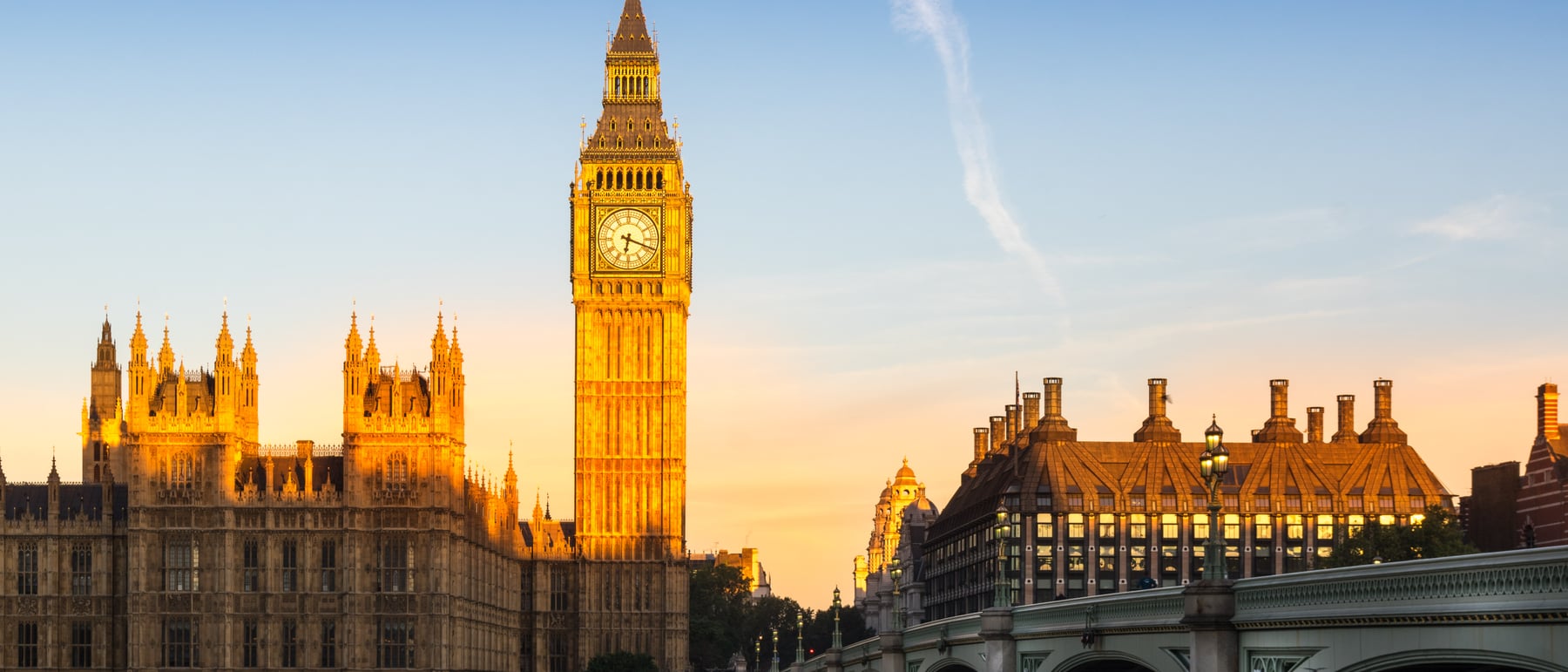
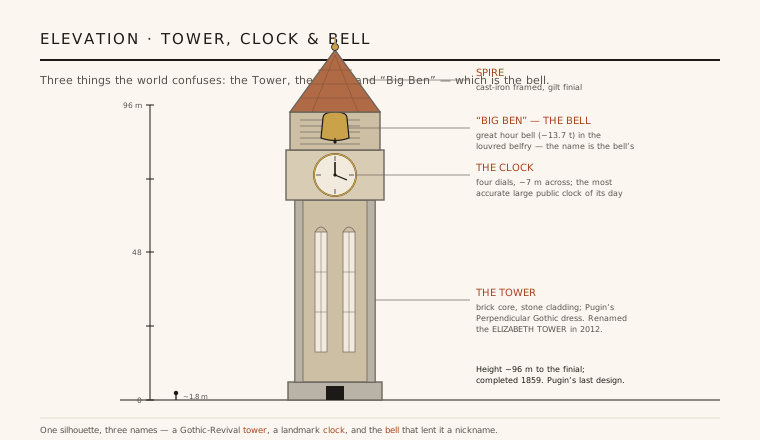
1. One silhouette, three names
Almost nothing about the popular name survives scrutiny. Big Ben is not the tower and not the clock — it is the great hour bell, a bronze casting of some 13.7 tonnes hung in the belfry near the top, most likely nicknamed after Sir Benjamin Hall, the commissioner of works when it was installed. The clock below it, with four dials each about seven metres across, is properly the Great Clock of Westminster. The tower itself carried no formal name at all until 2012, when it was renamed the Elizabeth Tower for Queen Elizabeth II's Diamond Jubilee.
The distinction matters architecturally, because the fame of the whole rests on the interlocking of three different achievements: a work of Gothic-Revival design, a feat of horological engineering, and a piece of resonant acoustics. The tower gives the clock its stage and the bell its voice; the clock gives the tower its purpose; the bell gives the ensemble a sound broadcast around the world. It is rare for one structure to be simultaneously a landmark of style, of precision and of sound — and rarer still for the confusion of its names to become part of its charm.
2. Barry's plan, Pugin's Gothic — and a last design
The tower belongs to the great rebuilding that followed the fire of 16 October 1834, which gutted the medieval Palace of Westminster. The competition to replace it demanded a Gothic or Elizabethan style, and it was won by Charles Barry, a classicist by instinct, whose strength lay in disciplined, symmetrical planning. To clothe that plan in convincing medieval detail Barry turned to A.W.N. Pugin, the fervent Gothic-Revival theorist who drew the Perpendicular tracery, panelling, pinnacles and ornament that make the palace — and the clock tower — read as authentically Gothic rather than merely castellated.
The clock tower is the most concentrated expression of that partnership, and it carries a poignant footnote: its detailing was Pugin's last design. He worked on it in 1852, in the final months before the mental collapse and death that came that September, at only forty. Pugin himself is said to have regarded the tower as his farewell to architecture. That a single tower should be at once Barry's grand civic gesture and Pugin's dying testament gives the structure an unusual weight beyond its silhouette.
3. The clock: precision engineering as public instrument
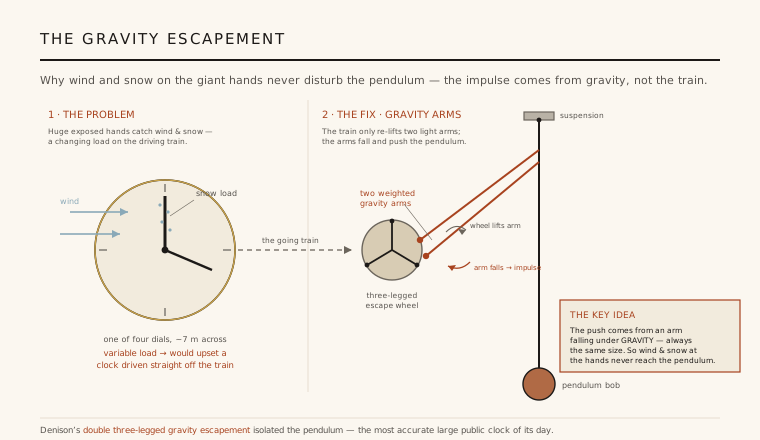
The commission set an extraordinary standard: the Astronomer Royal, George Biddell Airy, insisted the clock's first stroke of each hour be accurate to within a second, and that its rate be telegraphed twice daily to the Royal Greenwich Observatory. This was a far higher demand than any large public clock had ever met. The design fell to the lawyer and gifted amateur horologist Edmund Beckett Denison (later Lord Grimthorpe), working with the clockmaker E.J. Dent, whose firm built the movement after Dent's death.
The obstacle was the sheer size of the hands. Wind gusting against the huge exposed dials, and snow settling on the hands, vary the load fed back through the going train, and in an ordinary escapement that varying load disturbs the pendulum and ruins the timekeeping. Denison's answer was a new double three-legged gravity escapement, in which the train does nothing but re-lift two small weighted arms; the arms then fall under gravity and give the pendulum an impulse that is always the same size. Because the push comes from gravity and not from the wheels, the pendulum is isolated from whatever is happening at the hands — making it the most accurate large public clock in the world, and a design copied in tower clocks ever since.
4. The bell, the chimes, and a famous crack
The great bell had a troubled birth. A first casting of 1856 cracked during testing and was broken up and recast; the second bell, cast at the Whitechapel Bell Foundry in 1858, was hauled up into the belfry in 1859. Within months it too cracked, this time under a striking hammer that Denison had made too heavy. Rather than recast it again, the bell was turned to present a sound surface to a lighter hammer — and it has rung, cracked, ever since. That slight imperfection is now inseparable from its distinctive, faintly off-true tone.
Around the great bell hang four smaller quarter bells that sound the Westminster Chimes — the four-note phrase, drawn from a melody attributed to Handel and first used at Great St Mary's in Cambridge, that plays in rising permutations on the quarter-hours. Broadcast on radio from the 1920s onward, that sequence became one of the most widely heard pieces of music in the world. The architecture here is acoustic as much as visual: the louvred belfry is shaped to let the sound out, so that the tower's meaning travels far beyond the reach of its silhouette.
5. Why it matters: how a tower became an icon
As pure architecture, the clock tower is a confident, richly detailed exercise in the Gothic Revival — a brick-cored, stone-clad shaft of about 96 metres, rising through the clock stage to a cast-iron framed spire, its ornament handled with Pugin's unmatched fluency. But its true significance is how comprehensively it transcended its style to become a sign. Reproduced on postcards, in films, on souvenirs and in news broadcasts, the tower detached itself from Victorian Gothic and came to stand simply for London, for Britain, and for Parliament itself.
That makes it a case study in how buildings acquire meaning. The tower was designed as the ornamental clock-house of a legislature; it became a global emblem of parliamentary democracy, its image instantly legible and its chimes instantly recognisable. Few structures demonstrate so clearly that a building's cultural life can outgrow its architects' intentions — that stonework, machinery and sound, combined at the right moment and endlessly circulated, can turn a tower into an idea.
Its lesson — that a single well-composed vertical silhouette can brand an entire city — echoes in every skyline-defining tower since, from the Eiffel Tower to the Shard, structures valued as much for the image they broadcast as for the space they enclose.
References & further reading
- 01Port, M. H. (ed.) (1976). The Houses of Parliament. Yale University Press, New Haven & London.
- 02McKay, Chris (2010). Big Ben: The Great Clock and the Bells at the Palace of Westminster. Oxford University Press.
- 03Hill, Rosemary (2007). God's Architect: Pugin and the Building of Romantic Britain. Allen Lane / Penguin, London.
- 04Fowler, Peter J. (2011). The Elizabeth Tower and the Great Clock, Palace of Westminster. House of Commons Information Office factsheet, London.
- 05UK Parliament (2012). The Elizabeth Tower (formerly the Clock Tower). parliament.uk, Living Heritage / official record. https://www.parliament.uk/about/living-heritage/building/palace/big-ben/
Last verified 2026-07-11. Ancient and vernacular works often have no single architect or firm date; dates are given as widely accepted approximations and the builder-culture is named where no individual designer is known.